
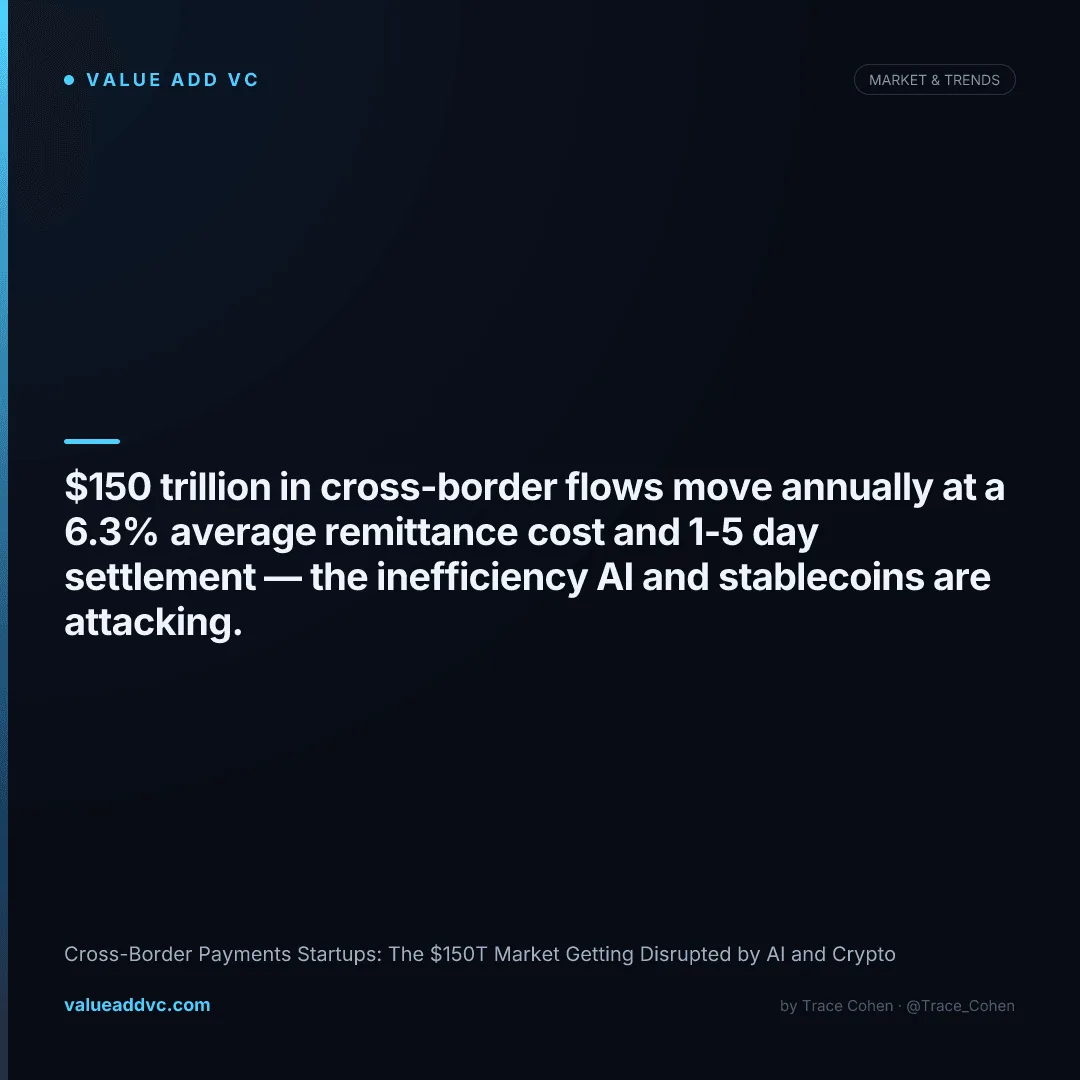
Roughly $150 trillion crosses borders every year on rails that still charge a 6.3% average remittance fee and take 1–5 days to settle — and AI plus stablecoins are now pulling that spread apart fast enough that take rates are collapsing from 6%+ toward 0.3–0.7%.
The disruption isn't one technology beating an incumbent — it's two separate attacks (cheaper rails and cheaper compliance) hitting the same fat margin at once, and the startups that win are the ones sitting on both.
Cross-border payments startups in 2026: the market and the leaders
Cross-border payment flows total roughly $150 trillion a year, split into about $40 trillion of B2B, ~$900 billion of consumer remittances, and the rest in card, e-commerce, and treasury movement. The revenue pool sits near $250 billion. The leading 2026 startups attacking it are Wise, dLocal, Airwallex, Nium, and Rapyd on the fintech side, plus stablecoin-native firms like Bridge — which Stripe acquired for ~$1.1 billion in 2024 — now operating at the infrastructure layer. The common thread: every winner has pushed marginal cost per transaction below 1%, against an industry that historically charged 3–6%.
The reason this is a venture market and not just an incumbent banking story is the spread. The cost to actually move a digital dollar across a border in 2026 is fractions of a cent. The price charged is still measured in whole percentage points. That gap — between what it costs and what it's priced at — is what $40B+ of fintech and crypto funding has been chasing for five years.
The leading cross-border payments startups compared
Each of these companies attacks a different corridor and customer. The table below compares the major players by focus, scale, and pricing as of early 2026.
| Company | Focus | Annual Volume | Blended Take Rate | Valuation |
|---|---|---|---|---|
| Wise | Consumer + SMB transfers | ~$170B | ~0.55% | ~$15B (public) |
| dLocal | Emerging-market collection | ~$25B TPV | ~1.0% | ~$3B (public) |
| Airwallex | SMB treasury + cards | ~$130B | ~0.5% | ~$6.2B |
| Nium | B2B real-time rails | ~$30B | ~0.4% | ~$1.4B |
| Rapyd | Local payments network | ~$50B | ~0.7% | ~$9B |
| Bridge (Stripe) | Stablecoin orchestration | Fast-growing | ~0.1–0.3% | ~$1.1B (acq.) |
| Conduit | Crypto B2B settlement | ~$10B run-rate | ~0.3% | ~$0.4B |
Figures are approximate, drawn from company filings, last-round disclosures, and 2025 reporting. Stablecoin-native take rates sit well below fintech rails because they skip correspondent banking entirely.
How stablecoins are disrupting cross-border payments
The single biggest shift since 2024 is that stablecoins stopped being a crypto-trading instrument and became a payments rail. Stablecoin transfer volume crossed $27 trillion in 2025 — more than Visa and Mastercard combined — and a growing share of that is genuine B2B and remittance settlement, not exchange arbitrage. A USDC transfer settles in seconds for a sub-cent network fee, against 1–5 days and a 6.3% average cost on the traditional remittance corridor.
The signal that mattered most: Stripe paid ~$1.1 billion for Bridge and another ~$1.1 billion for the wallet-infrastructure firm Privy in 2025, then began routing real merchant volume over stablecoin rails. When the most disciplined payments company in the world buys the rail instead of fighting it, the "is this real" debate is over. Visa and Mastercard have both launched stablecoin settlement pilots in response, and Circle's 2025 IPO gave the category a public-market anchor.
$27T
Stablecoin transfer volume in 2025 — above Visa + Mastercard combined
<1 sec
Settlement time vs 1–5 days for correspondent banking
~0.1%
Marginal cost on stablecoin rails vs 6.3% remittance average
How AI is reshaping cross-border payments economics
Stablecoins attack the settlement cost. AI attacks the two cost centers that actually eat a cross-border processor's margin: compliance and FX routing. Compliance — sanctions screening, AML, KYC — is the single largest operating expense for most payment companies, often 20–40% of cost base, and it's drowning in false positives. Leading processors now report machine-learning models cutting false-positive flags by 40–60%, which collapses the manual-review headcount needed to clear a payment.
AI compliance screening
40–60% fewer false-positive AML/sanctions flags, cutting manual review cost dramatically
Reinforcement-learning FX routing
Picks the cheapest liquidity path across 30+ corridors in real time, shaving basis points off every trade
Fraud and chargeback models
Real-time risk scoring lets processors price thinner without absorbing loss
Agentic treasury ops
AI agents reconcile, forecast, and auto-route corporate cash, replacing back-office FTEs
The reason this matters for valuation: a processor that spends 35% of revenue on compliance and routing, then cuts that in half with AI, doesn't just save money — it can price 100–200 basis points cheaper than a bank and still earn a better gross margin. That's how a startup undercuts an incumbent on price while being more profitable per dollar moved. It's the same dynamic reshaping how investors think about software margins on our SaaS valuations dashboard.
Where the cross-border payments market is going by 2026 and beyond
Three things are true at once. First, the B2B layer is where the durable money is — $40 trillion in flows, sticky treasury relationships, and far less fee compression than consumer remittances. Airwallex, Nium, and Conduit are building here. Second, consumer remittances are racing to zero margin; Wise's blended take rate has fallen from ~0.74% to ~0.55% over four years and stablecoins push it lower. Third, the winners are converging on a single shape: stablecoin rails underneath, AI compliance in the middle, and a software UX on top.
What founders and investors should take from this
If you're building in cross-border payments in 2026, the generic "cheaper remittances" pitch is dead — Wise already did it and the margin is gone. The opening is in three places: a specific high-friction B2B corridor (think LatAm supplier payments, where dLocal proved demand), an AI-native compliance layer that other processors license, or a stablecoin-orchestration product that abstracts the chain away from the merchant entirely. Each is a wedge, not a platform, and each can become one.
For investors, the lesson from the last cycle is that volume is not revenue and revenue is not margin. A startup moving $10B at a 0.1% take rate is a $10M revenue business — impressive volume, thin economics. Underwrite the take rate and the compliance cost structure, not the TPV headline. The companies compounding value are the ones where AI is genuinely widening the spread, not just the ones moving the most money.
The $150T cross-border market isn't being won by whoever moves money cheapest.
It's being won by whoever uses AI to widen the spread while stablecoins crush the cost of the rail underneath.
Track fintech valuations and IPO activity on the SaaS Valuations and Tech IPO dashboards at Value Add VC. Originally published in the Trace Cohen newsletter.
Latest from the Pulse
Get VC data most people never see
— free to subscribe
Trace's notes on venture, AI and startups, a few times a week. Join 5,000+ subscribers. No spam.
No spam, unsubscribe anytime. Sent via Substack · Privacy · or subscribe on Substack ↗