Update (June 2026): All three labs have shipped newer flagships since this was written — Anthropic's current top model is the latest Claude Opus 4.x, OpenAI's is the latest GPT-5.x, and Google's is the latest Gemini 3.x Pro. The specific version numbers and benchmark figures below reflect the Claude 4 / GPT-5 / Gemini 2.5 generation, but the enterprise decision framework — pick by use case, not by leaderboard — is unchanged.
The Claude 4 vs GPT-5 comparison is no longer a question of capability gaps — it's a question of which capabilities your enterprise actually needs.
As of mid-2026, all three frontier models — Anthropic's Claude 4, OpenAI's GPT-5, and Google's Gemini Pro — can write production-grade code, analyze complex documents, and handle nuanced enterprise workflows. The benchmarks have converged. The differentiation is now in context windows, pricing structures, ecosystem fit, and the specific 20% of use cases where one model still materially outperforms the others.
I've watched this market evolve across 65+ portfolio companies. The teams that pick a model and build fast outperform the ones still running procurement committees 18 months in. Here's the honest breakdown.
The Head-to-Head: Core Metrics That Matter
| Metric | Claude Sonnet 4 | GPT-5 | Gemini Pro |
|---|---|---|---|
| Context Window | 200K tokens | 128K tokens | 1M tokens ✓ |
| API Cost (input/1M) | ~$3.00 | ~$10.00 | ~$3.50 |
| API Cost (output/1M) | ~$15.00 | ~$30.00 | ~$10.50 |
| SWE-bench (coding) | ~80% ✓ | ~72% | ~68% |
| Multimodal (vision) | Strong | Best-in-class ✓ | Strong |
| Enterprise SOC2 | Yes ✓ | Yes ✓ | Yes ✓ |
| On-prem / VPC | Limited | Azure OpenAI ✓ | Google Cloud ✓ |
| Speed (TTFT) | Fast | Fast | Fastest on long context ✓ |
Sources: SWE-bench leaderboard, public API pricing pages, Anthropic/OpenAI/Google enterprise documentation. Pricing as of May 2026.
Where Each Model Actually Wins
Claude Sonnet 4 — Anthropic
- ✓ Agentic coding tasks where multi-step instruction-following matters
- ✓ Document analysis requiring structured, predictable output formats
- ✓ Safety-critical applications where hallucination rate is a compliance concern
- ✓ Teams already on Claude 3 who need a drop-in upgrade
Avoid if you need >200K context, or you're deeply on Azure/GCP infrastructure.
GPT-5 — OpenAI
- ✓ Multimodal use cases combining vision, audio, and text in a single workflow
- ✓ Microsoft 365 and Azure OpenAI integrations (Teams, Copilot, Dynamics)
- ✓ Enterprises wanting the largest plugin and tool ecosystem (ChatGPT Enterprise)
- ✓ Any team where the brand name matters for internal stakeholder buy-in
Avoid if cost-per-token at scale is a constraint — GPT-5 is roughly 3x more expensive than Claude or Gemini at list price.
Gemini Pro — Google
- ✓ Use cases requiring 200K–1M token context (codebases, legal docs, long transcripts)
- ✓ Google Workspace-native applications (Docs, Sheets, Meet, Gmail)
- ✓ Enterprises on GCP wanting tight IAM, VPC, and data residency controls
- ✓ RAG architectures where you can skip retrieval entirely with the full context
Avoid if your workflow is already built on OpenAI or Anthropic APIs — migration cost may exceed the context window benefit.
The Enterprise Decision Framework
The model choice for most enterprises should follow a simple cascade, not a benchmark beauty contest:
Do you need >200K tokens in a single call?
→ Gemini Pro. Full stop. Claude and GPT-5 cannot handle it.
Are you on Azure or already using Microsoft 365 Copilot?
→ GPT-5 via Azure OpenAI. The integration depth alone justifies it.
Is your primary use case coding, analysis, or agentic workflows?
→ Claude Sonnet 4. The instruction-following consistency is measurably better for multi-step tasks.
Is cost per token a constraint at your projected volume?
→ Eliminate GPT-5 from your shortlist unless the ecosystem value is unavoidable.
Does your security team need VPC isolation and data residency?
→ Google Cloud (Gemini) or Azure (GPT-5) both offer this. Anthropic's options are more limited here.
What the Valuation Gap Tells You About Model Strategy
OpenAI is valued at $300B. Anthropic is at $61B. Google is deploying $75B in AI capex in 2025 alone. The valuation spread says less about model quality and more about distribution moats — OpenAI has ChatGPT's brand, Google has Workspace and Cloud, Anthropic has a genuine safety reputation that resonates with regulated industries.
You can track the broader AI valuation trends on the AI Valuations dashboard — what's notable is that as frontier model capability converges, the market is increasingly valuing distribution and enterprise integration depth over raw benchmark performance. That's the right framing for your model selection too.
The labs know this. The frontier model race is no longer primarily about MMLU or HumanEval. It's about which model is embedded deepest in the workflows your enterprise already runs. That's why Microsoft invested $13B in OpenAI — not because GPT was definitively better at benchmarks, but because Azure distribution would be the moat.
The Honest Answer on Benchmarks
Enterprise buyers read benchmark results as if they predict production performance. They rarely do. SWE-bench measures how well a model fixes isolated GitHub issues. Your production workload is not an isolated GitHub issue — it's a multi-turn agentic loop running across proprietary codebases with ambiguous requirements and legacy constraints. The model that tops the leaderboard this month may not be the model that fails least in your specific environment.
The most useful signal I've seen across portfolio companies: run 50–100 real tasks from your actual workflow on all three models, measure output quality and format consistency, then extrapolate cost at projected volume. That evaluation, done in two weeks, will give you more signal than any published benchmark.
The model question is not "which is best."
It's which model fits deepest into the workflows you can't afford to rebuild.
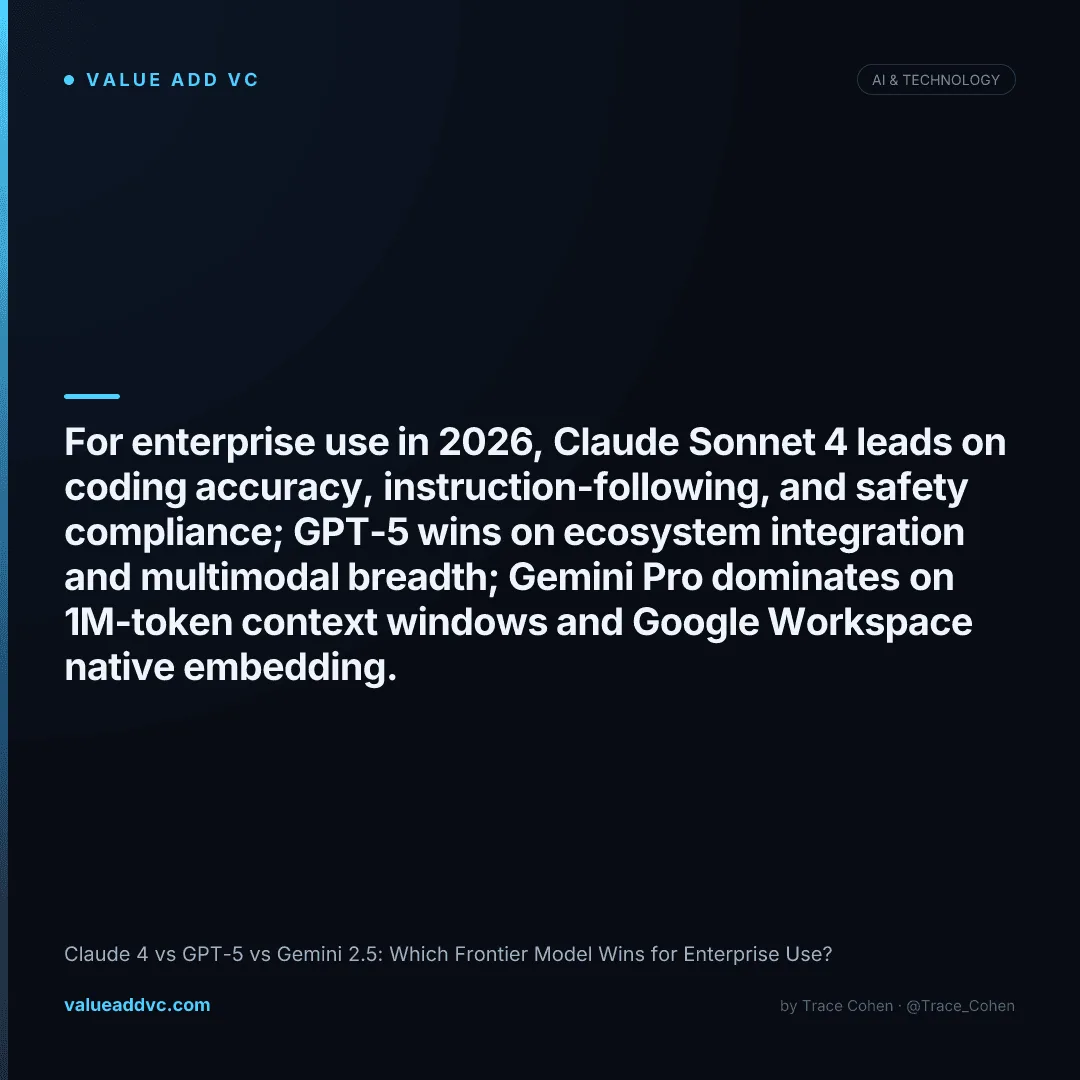
Claude 4 for coding and analysis. GPT-5 for Microsoft-native enterprises. Gemini 2.5 for long-context and Google Workspace. Everything else is benchmark theater.
Track AI company valuations and enterprise AI spending trends on the AI Valuations dashboard and Big Tech Earnings tracker at Value Add VC. Originally published in the Trace Cohen newsletter.
Get VC data most people never see — free.
Weekly benchmarks, valuations, and fund data. No spam, unsubscribe anytime.