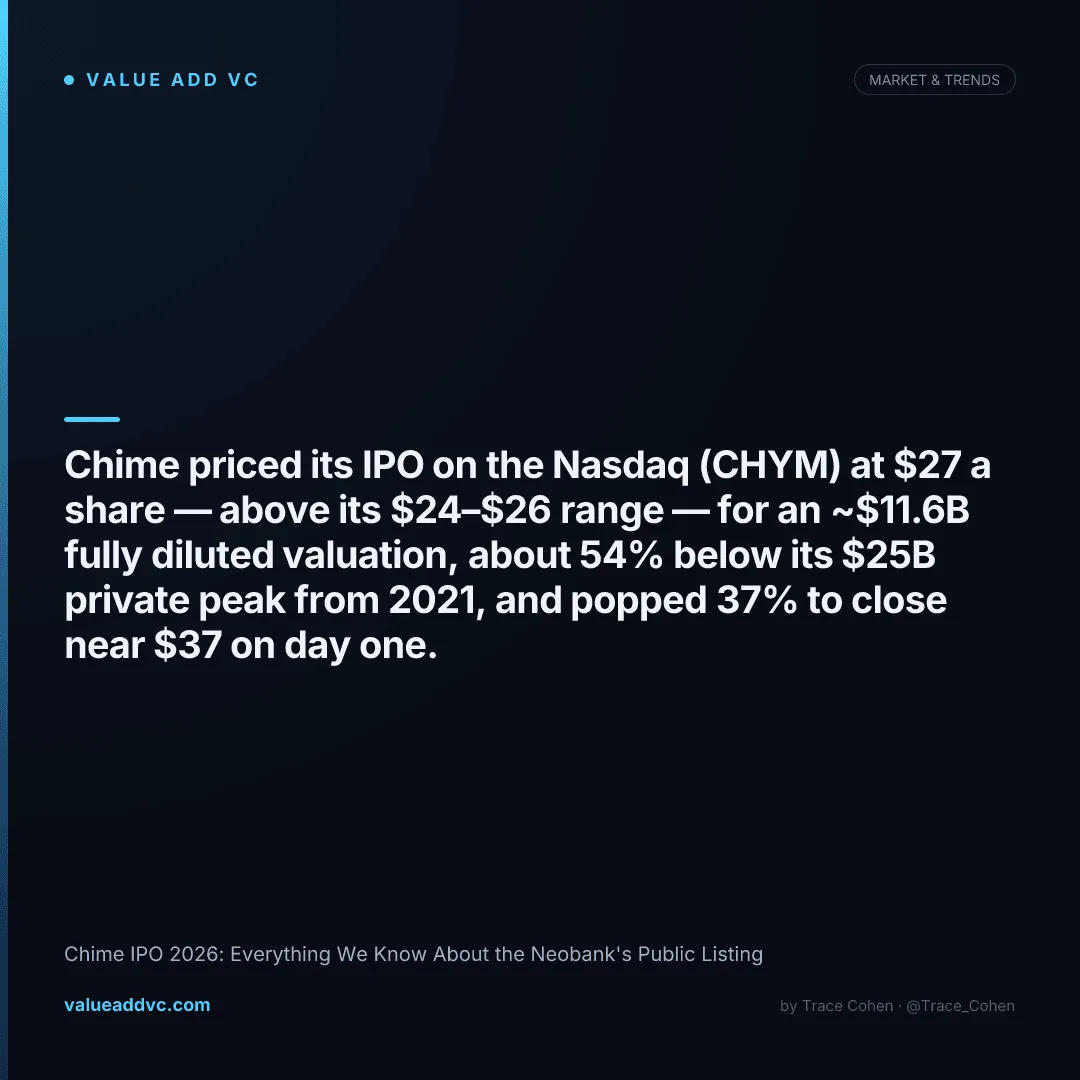
Chime went public on the Nasdaq in mid-2026 under the ticker CHYM at roughly an $11B valuation — down 56% from the $25B it was worth in 2021. That's the short answer. The longer answer is more interesting.
Chime is the biggest test of whether the public market will pay for a profitable consumer fintech in 2026. It is not a lender, not a crypto play, and not a buy-now-pay-later story. It is a debit card with a banking app attached, built for the roughly 60% of Americans who live paycheck to paycheck — and after a brutal three-year valuation reset, it finally crossed the line into the public markets.
Chime IPO 2026: the key facts
The Chime IPO priced in mid-2026 on the Nasdaq under ticker CHYM at a valuation near $11B, roughly $700M raised, on the back of about $864M in 2024 revenue and 8.6M active members. The company reached adjusted EBITDA profitability in 2024, which is what let it price above its marketed range despite carrying down more than half of its 2021 private valuation.
| Metric | Chime at IPO (2026) |
|---|---|
| Ticker / exchange | CHYM / Nasdaq |
| IPO valuation | ~$11B fully diluted |
| Last private valuation (2021) | $25B |
| 2024 revenue | ~$864M |
| Active members | ~8.6M |
| Revenue per member / year | ~$100 |
| Share of revenue from interchange | ~75% |
| Primary + secondary raised | ~$700M |
How Chime actually makes money
The single most misunderstood thing about Chime is its business model. People assume a bank makes money on deposits and loans. Chime barely does either. It earns roughly 75 cents of every revenue dollar from interchange — the ~1.5% fee Visa charges a merchant every time a Chime member swipes their card.
This works because Chime qualifies as a small bank under the Durbin Amendment exemption. Its partner banks — The Bancorp Bank and Stride Bank — each sit under the $10B asset threshold, which lets them charge merchants a far higher interchange rate (often 1.5%+) than a JPMorgan-scale issuer is allowed to. Chime keeps the bulk of that fee. Every direct-deposited paycheck that gets spent on the Chime card is the product.
Debit & credit interchange
~75% of revenue. Visa merchant fees on every swipe.
Out-of-network ATM fees
Charged when members use non-MoneyPass ATMs.
SpotMe tips & fees
Optional tips on fee-free overdraft up to $200.
Credit Builder card
Secured card that drives engagement and interchange.
The strategic risk hides in plain sight: Chime's entire margin depends on a regulatory exemption. If Congress ever lowers the Durbin threshold or rewrites interchange caps, the model compresses overnight. Public investors priced that tail risk into the multiple, which is part of why the valuation reset was so steep.
Why the Chime IPO valuation fell from $25B to ~$11B
In August 2021, at the absolute peak of the zero-rate fintech mania, Chime raised $750M at a $25B valuation led by Sequoia. That number was never about cash flow — it was about a projected path to 30M+ users and an assumed multiple that looked reasonable when capital was free. Then rates went up, fintech multiples collapsed 60–80%, and growth-at-any-cost became a liability.
By 2023, secondary marks on Chime stock implied valuations as low as $6–8B. The ~$11B IPO price is the market splitting the difference: a real haircut from 2021, but a premium to the depths of the secondary market, justified by the fact that Chime is now actually profitable on an adjusted basis. The full reset, in numbers:
| Date | Valuation | Context |
|---|---|---|
| 2019 | $1.5B | Series D, early scale |
| Sept 2020 | $14.5B | Series F, pandemic deposit surge |
| Aug 2021 | $25B | Series G, peak fintech mania |
| 2023 | ~$6–8B | Secondary market marks |
| 2025 | ~$10B | Pre-IPO crossover round |
| 2026 IPO | ~$11B | Nasdaq debut, priced above range |
Chime vs other fintech IPOs and neobanks
Chime priced into a market that has already seen how neobank and fintech stories trade publicly. The most useful comps are SoFi, which went public via SPAC in 2021, and Nubank, the Brazilian neobank that listed the same year and is now the proof point that the model can scale to profitability. Here is how they stack up.
| Company | Model | Customers | Primary revenue |
|---|---|---|---|
| Chime | Debit-first neobank | ~8.6M | Interchange (~75%) |
| SoFi | Lending + banking | ~10M+ | Net interest income |
| Nubank | Credit + banking | ~100M+ | Credit + interchange |
| Cash App (Block) | P2P + banking | ~57M | Interchange + Bitcoin |
| Dave | Cash advance neobank | ~10M+ | Fees + interchange |
| Varo | Chartered neobank | ~5M+ | Interchange + interest |
The key distinction: SoFi and Nubank both make most of their money from lending — they take credit risk and earn net interest income. Chime takes almost none. That makes Chime a cleaner, lower-risk story in a downturn, but it also caps the upside. There's a ceiling on how much interchange you can earn per member without expanding into credit, which is exactly the direction Chime has been pushing with its credit-builder and newer lending products.
What the Chime IPO signals for the 2026 fintech pipeline
Chime priced alongside Klarna as one of the two anchor fintech listings of 2026. Both matter for the same reason: they re-establish public comps for an entire category of late-stage private fintechs that have been frozen out of the IPO market since 2021. A successful Chime debut tells the boards of Stripe, Plaid, Brex, Ramp, and Revolut that the window is open — if your unit economics actually work.
That last clause is the whole story of 2026. The companies getting out are the ones that used the 2022–2025 down years to cut burn and reach profitability. The ones still waiting are the ones that can't show it yet. For LPs sitting on aging fintech positions, a Chime exit at $11B is still a real markup from the secondary lows — distributions matter more than paper marks right now, and this is one of the first meaningful liquidity events the 2020–2021 vintage has produced.
You can track the full slate of expected listings, valuations, and current filing status on our 2026 IPO pipeline and tech IPO tracker.
The Chime IPO is not a story about a $25B unicorn coming back.
It's a story about a profitable, boring, interchange-driven bank account finally being worth what the public market will actually pay — $11B — and that recalibration is the real fintech news of 2026.
Track the 2026 IPO market on the Tech IPO dashboard at Value Add VC. Originally published in the Trace Cohen newsletter.
Get VC data most people never see
— 100% free
Weekly benchmarks, valuations, and fund data. Join 5,000+ investors. No spam.