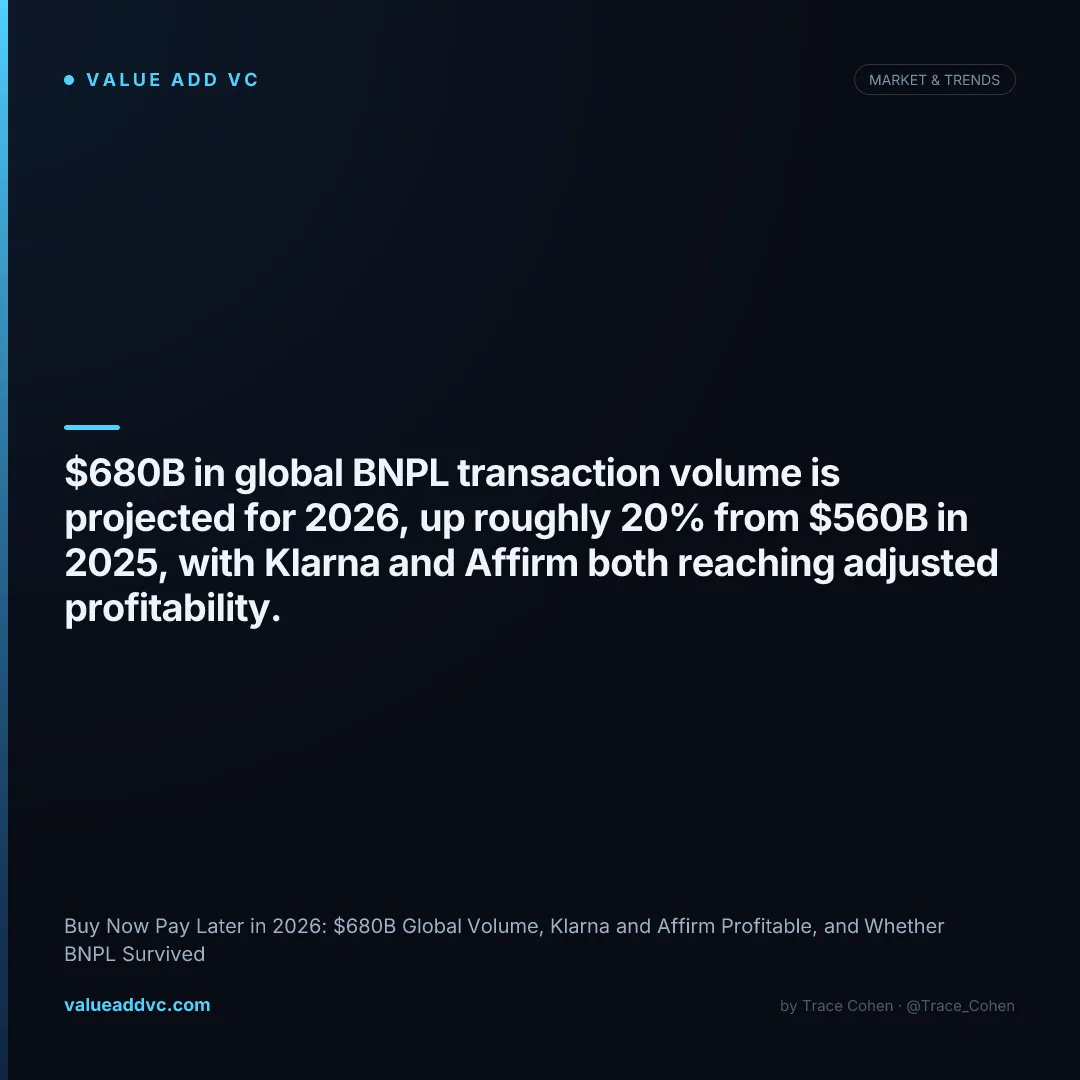
Global buy now pay later volume is tracking toward $680B in 2026, up ~20% from $560B in 2025, and both Klarna and Affirm are now profitable. That's the short answer. The longer answer is more interesting.
Three years ago the consensus take was that BNPL was a zero-interest-rate fad that would die with cheap money. It didn't. What died was the version of BNPL that gave away free credit to win share — the survivors charge merchants 2.5-6% per transaction, underwrite with AI, and run credit losses below 1% of volume. Klarna IPO'd at a $15.1B market cap in September 2025; Affirm trades near the same. The sector consolidated, repriced, and turned profitable. For the cleanest case study of the reset, see our breakdown of the Klarna IPO and the BNPL comeback math.
Buy Now Pay Later in 2026: Did BNPL Actually Survive?
Buy now pay later survived the 2022 downturn and is bigger than ever in 2026, with global volume projected at roughly $680B versus $560B in 2025 and $285B in 2021. The pivot that saved it was profitability: Klarna and Affirm both post adjusted operating income, credit losses fell to 0.4-1% of GMV, and Klarna completed a $15.1B IPO in September 2025. The free, growth-at-all-costs version of BNPL is what disappeared.
2026 global volume
~$680B
2025 global volume
~$560B
2021 global volume
~$285B
US volume (2026)
$110-120B
Annual growth
18-22%
Klarna users
100M+
Avg credit loss
0.4-1% GMV
Merchant take rate
2.5-6%
Buy Now Pay Later in 2026 by the Numbers: The Six Players That Matter
The BNPL category is far more concentrated than the "dozens of providers" narrative suggests. Six companies process the overwhelming majority of regulated volume, and the gap between the top two and everyone else widened through 2024-2026. Here is the side-by-side that actually matters for anyone evaluating the sector.
| Metric | Klarna | Affirm | Afterpay (Block) | PayPal Pay in 4 | Sezzle |
|---|---|---|---|---|---|
| Public status | NYSE: KLAR | Nasdaq: AFRM | Inside Block (XYZ) | Inside PayPal (PYPL) | Nasdaq: SEZL |
| Market cap (2026) | ~$14-16B | ~$14-16B | Segment | Segment | ~$3B |
| Annual GMV | $100B+ | $32B | $30B+ | $33B+ | ~$10B |
| Active users | 100M+ | 21M | 24M | 45M+ (Pay in 4) | ~7M |
| Merchant count | 575K+ | 330K+ | 100K+ | Universal | 48K+ |
| Take rate (rev/GMV) | ~3.0% | ~10% (incl. interest) | ~3.5% | ~2.0% | ~5.5% |
| Credit loss (% GMV) | ~0.4-0.5% | ~3.0% | ~1.0% | <0.5% | ~1.5% |
| Profitability (2025) | Adj. profitable | Adj. profitable | Profitable segment | Profitable | GAAP profitable |
| Geography lead | Europe, AU | US (Shopify, Amazon) | US, AU retail | Global checkout | US, CA |
Figures are 2026 estimates blended from company filings (Klarna F-1, Affirm 10-K, Block and PayPal 10-Ks, Sezzle 10-K), Worldpay Global Payments Report, and GlobalData BNPL tracking. Take rates and credit-loss figures are trailing-twelve-month approximations; market caps reflect mid-2026 trading ranges.
Klarna and Affirm trade at near-identical market caps but earn revenue very differently. Affirm runs longer-duration installment loans (3-36 months) and books interest income, giving it a ~10% blended take rate; Klarna sits closer to a 4-installment pay-in-4 model with merchant-fee-heavy revenue at ~3%. The economics converge at the GMV line and diverge on credit loss and capital intensity.
How BNPL Went From $285B Fad to $680B Survivor
The story of buy now pay later from 2020 to 2026 is the story of a business model getting repriced in public. Six inflection points took the category from euphoria to near-death to durable profitability.
The 2022 down round mattered more than any IPO. Marking Klarna to $6.7B forced a cost reset — AI-driven attrition cut headcount ~46% from the peak — that made profitable BNPL possible at all. The survivors are the ones that treated 2022 as a forcing function, not a temporary dip.
How BNPL Companies Make Money in 2026
The misconception that killed BNPL skeptics' thesis is that it is a consumer-lending business. It is mostly a payments business with a credit chassis bolted on. Three revenue lines, three very different margins.
Merchant fees
~70% of revenue
2.5-6% take rate paid by the retailer in exchange for higher conversion and basket size. The high-margin core.
Consumer fees + interest
~20% of revenue
Late fees, interest on longer 3-36 month plans, and FX on cross-border purchases. Most exposed to regulation.
Ads + other
~10% of revenue
Advertising networks, affiliate revenue, and bank deposit income — the fastest-growing line as BNPL apps become shopping destinations.
Why merchants pay 2.5-6% when card interchange is closer to 2%: BNPL lifts conversion 20-30% and average order value 30-50% on the checkouts where it is offered. For a retailer, a 4% fee that grows the basket by 40% is accretive. That merchant-funded model is the single reason BNPL economics work without charging most consumers interest — and the reason it looks more like a software-margin payments business than a subprime lender.
Is Buy Now Pay Later Safe in 2026? Regulation and Credit Risk
The profitability story is real. The consumer-risk story is also real, and the two are not in conflict. BNPL is a healthy business that still creates genuine harm for a slice of users. Three risks define the 2026 picture.
1. Loan stacking and phantom debt
Because most BNPL debt is not reported to the major credit bureaus, no single provider sees a user's total exposure. Industry surveys put the share of BNPL users who have missed at least one payment near 40%, and 'stacking' four or five plans across Klarna, Affirm, and Afterpay is invisible to each lender. Bureau reporting is starting to change this in 2026, but coverage is still partial.
2. The CFPB interpretive rule overhang
The CFPB's May 2024 rule classified BNPL providers as credit-card lenders, forcing disclosure parity, dispute rights, and refund processing. Industry challenges in late 2025 narrowed the scope. The 2026 open question is whether late fees — a meaningful consumer-revenue line — survive any rewrite, and whether the rule is rolled back, expanded, or held.
3. Credit normalization in a softer consumer
Losses fell to 0.4-1% of GMV thanks to AI underwriting, but that was achieved in a relatively strong labor market. A real consumer downturn would test whether the improved models hold. Affirm's longer-duration book (~3% loss rate) is more exposed than Klarna's pay-in-4 model (~0.5%), which is why duration, not brand, is the risk variable that matters most.
What BNPL's Survival Signals for Fintech in 2026
BNPL is the clearest proof that the 2021 fintech cohort can survive a full repricing cycle and come out a real business. That has direct implications for the rest of the pipeline.
- →The comp set is now public: Klarna at ~4.5x revenue and Affirm at a similar multiple give every private fintech a real public benchmark instead of 2021 vintage marks.
- →Profitability is the entry ticket: the BNPL names that listed did so on adjusted operating income, not GMV growth. The IPO window in 2026 rewards margin, not scale alone.
- →Embedded beats standalone: Afterpay inside Cash App and Pay in 4 inside PayPal show that BNPL is becoming a feature of larger wallets — a warning for any single-product fintech.
- →Big Tech retreated: Apple Pay Later's mid-2024 shutdown proved that even Apple could not casually win lending. The specialists' underwriting moat is deeper than it looked.
Track the full fintech IPO pipeline on the Tech IPO Tracker. For the broader listing wave, see our biggest IPOs of 2026 overview and the Stripe IPO rumors breakdown.
Buy now pay later did not just survive — it grew up.
A $680B, profitable, merchant-funded payments category with sub-1% losses is a fundamentally different business than the free-credit fad of 2021. BNPL won by becoming boring — and boring is exactly what makes it durable.
Explore Related Dashboards
Interactive tools with live data on this topic
Track fintech IPOs and BNPL valuations on the Tech IPO and SaaS Valuations dashboards at Value Add VC. Originally published in the Trace Cohen newsletter. See the PayPal company profile for how Pay in 4 fits into its broader business model.
Latest from the Pulse
Get VC data most people never see
— 100% free
Weekly benchmarks, valuations, and fund data. Join 5,000+ investors. No spam.