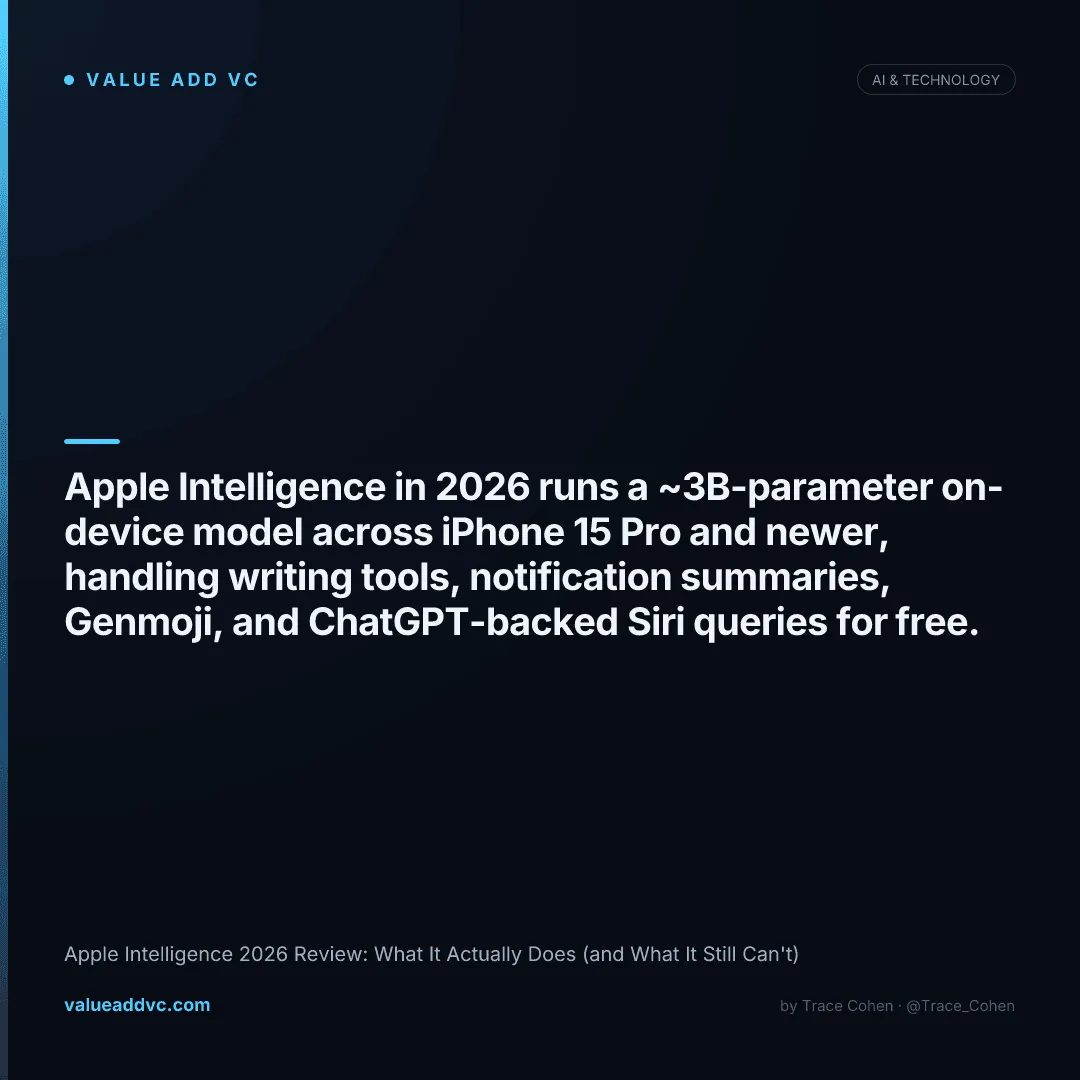
Apple Intelligence in 2026 is two products: a genuinely useful set of on-device features running free on 1.5B+ iPhones, and a contextual Siri that shipped roughly 18 months late. Those two products deserve to be judged separately.
Apple launched Apple Intelligence in October 2024 with iOS 18.1 and spent the next year-plus playing catch-up in the most public AI race in history. The company that usually ships late-but-perfect did the opposite this time: it shipped early-and-incomplete, then delayed the headline feature again and again. After 18 months of living with it across an iPhone, an iPad, and a Mac, here's where it actually stands — what works, what still doesn't, and whether the privacy-first bet is paying off.
Apple Intelligence 2026 Review: What It Actually Does
Apple Intelligence is Apple's built-in AI system, running a roughly 3-billion-parameter model on-device and a larger model in Private Cloud Compute for heavier requests. In 2026 it reliably handles writing tools, notification and email summaries, Genmoji, Image Playground, photo Clean Up, Visual Intelligence, and Siri — all free, all woven directly into iOS, iPadOS, and macOS rather than living in a separate chatbot app. For anything it can't answer, it routes the query to ChatGPT.
That architecture is the whole story. Apple split the work: small, frequent, privacy-sensitive tasks stay on the phone using the ~3B on-device model, while harder requests go to Apple-silicon servers under a Private Cloud Compute model that Apple says retains no data. Only when you explicitly approve it does anything leave the Apple stack for OpenAI. It's a different design philosophy from the cloud-first approach OpenAI and Google take — and it explains both the strengths and the ceiling.
Apple Intelligence 2026 Review: The Features That Actually Work
Let me separate the marketing from the daily reality. After 18 months, a clear tier list has emerged — some features I use constantly, some I've turned off, and one that was the entire pitch and only just arrived.
| Feature | Runs | Status in 2026 | Verdict |
|---|---|---|---|
| Writing Tools (proofread, rewrite, summarize) | On-device | Shipped Oct 2024 | Genuinely useful daily |
| Notification & email summaries | On-device | Shipped, refined 2025 | Hit or miss; better now |
| Genmoji & Image Playground | Hybrid | Shipped 2024–25 | Fun, low-stakes, works |
| Clean Up in Photos | On-device | Shipped Oct 2024 | Good, behind Google's |
| Visual Intelligence (point-and-search) | Hybrid | Expanded 2025 | Solid, improving |
| ChatGPT integration in Siri | Cloud (opt-in) | Shipped Dec 2024 | Works, but it's a handoff |
| Contextual / on-screen Siri | Hybrid | Rolling out 2026 | ~18 months late |
| Foundation Models dev framework | On-device | Opened WWDC 2025 | Promising for apps |
Feature status as of mid-2026, based on Apple's public release notes and WWDC announcements. Rollout timing varies by region and language.
The pattern is obvious: the small, bounded, on-device features are the wins. Writing Tools is the one I'd miss if it disappeared — a fast, private proofreader that lives inside every text field. The ambitious, open-ended assistant stuff is where Apple stumbled.
The 18-Month Siri Delay: What It Still Can't Do
At WWDC in June 2024, Apple demoed a Siri that could see what was on your screen, understand personal context ("when is Mom's flight landing?"), and take actions across apps. It was the most compelling part of the keynote. Apple said it would arrive "in the coming year." It didn't. The personalized Siri slipped through 2025 and only began rolling out in 2026 — roughly 18 months after the demo, an eternity in this market.
Reporting throughout 2025 pointed to a reliability problem: the system worked in demos but misfired too often in the wild, and Apple wouldn't ship a personal assistant that confidently does the wrong thing with your calendar and messages. That's a defensible call. But it cost Apple the narrative. While Siri stalled, Gemini, ChatGPT, and Claude shipped multiple model generations. Apple went from "perfectionist" to "a generation behind" in the public's mind, and the stock spent much of 2025 underperforming the rest of the Magnificent Seven on AI sentiment.
Even in 2026, the gaps are real. Siri still hands off anything genuinely hard to ChatGPT instead of reasoning itself. There's no Apple-built frontier model competing with GPT-5 or Gemini on benchmarks — Apple's on-device model is tuned for efficiency at ~3B parameters, not raw capability. And the contextual features are rolling out cautiously, region by region, rather than landing everywhere at once.
Apple Intelligence Requirements: Who Actually Gets It
Apple Intelligence has a hard hardware floor. It needs an A17 Pro chip or newer and at least 8GB of RAM, which means: iPhone 15 Pro, 15 Pro Max, the entire iPhone 16 and 17 lines, any iPad or Mac with an M1 chip or later. The standard iPhone 15, the iPhone 14, and everything older are excluded — no Apple Intelligence at all.
That matters strategically. Apple has an installed base north of 2.2B active devices and well over 1.5B active iPhones, but the AI hardware gate means only the newer slice qualifies. By 2026, with two more iPhone cycles shipped since launch, the eligible base is large — an estimated 1.5B+ devices can run Apple Intelligence — but Apple deliberately used AI as an upgrade lever. If you wanted the new Siri, you needed new hardware. Language support also expanded steadily through 2025 to cover French, German, Italian, Spanish, Portuguese, Japanese, Korean, and Chinese, after launching English-only.
Apple Intelligence vs Gemini vs ChatGPT: The Honest Comparison
The fairest way to judge Apple Intelligence is against what it's actually competing with. Apple isn't trying to win the frontier-model benchmark race — it's trying to make AI invisible and private inside the products you already own. On that axis it's doing well. On raw capability, it's behind, and pretending otherwise helps no one.
Where Apple wins
Privacy (on-device + Private Cloud Compute), zero cost, deep OS integration, and reach across 1.5B+ devices. No app to open — it's just there in every text field and photo.
Where Apple loses
Raw reasoning, conversational depth, and frontier capability. No Apple model competes with GPT-5 or Gemini; hard queries are outsourced to ChatGPT rather than answered natively.
Where it's a toss-up
Everyday assistant tasks. For setting reminders, summarizing, and quick edits, Apple Intelligence is now good enough that most users won't reach for a separate AI app.
The investor question underneath all of this is whether Apple's distribution advantage eventually beats the model labs' capability advantage. Apple doesn't need the best model — it needs a good-enough model attached to 1.5B+ phones with the deepest integration in the industry. That's the same playbook that lets distribution beat raw technology over and over, a dynamic I dug into in AI wrappers vs foundation models. You can also track how the market is pricing AI exposure across big tech on our AI Valuations dashboard.
The Verdict: Is Apple Intelligence Worth It in 2026?
If you already own a qualifying iPhone, Apple Intelligence is a free, private upgrade that quietly improves a dozen daily interactions — and you should turn it on. Writing Tools alone justifies it. The notification summaries are finally reliable, Visual Intelligence is genuinely handy, and the new contextual Siri, late as it is, is a real step forward.
But don't buy a new iPhone for Apple Intelligence. As a reason to upgrade, it's thin — the best features are the small ones, the headline feature arrived 18 months late, and for anything ambitious you're still being handed to ChatGPT. Apple's bet is that distribution and privacy win the long game even with a model that's a generation behind. After 18 months, that bet is intact but unproven. The features that work are the ones Apple kept small. The one it made big is the one that broke its perfect timing.
Apple shipped AI to a billion phones and still managed to be late. The small features are the wins; the big one is the warning.
Worth turning on. Not worth upgrading for.
Track how AI is being priced across big tech on the AI Valuations dashboard and Big Tech Earnings dashboard at Value Add VC. Originally published in the Trace Cohen newsletter. Figures are estimates based on public disclosures and are not investment advice.
Latest from the Pulse
Get VC data most people never see
— 100% free
Weekly benchmarks, valuations, and fund data. Join 5,000+ investors. No spam.