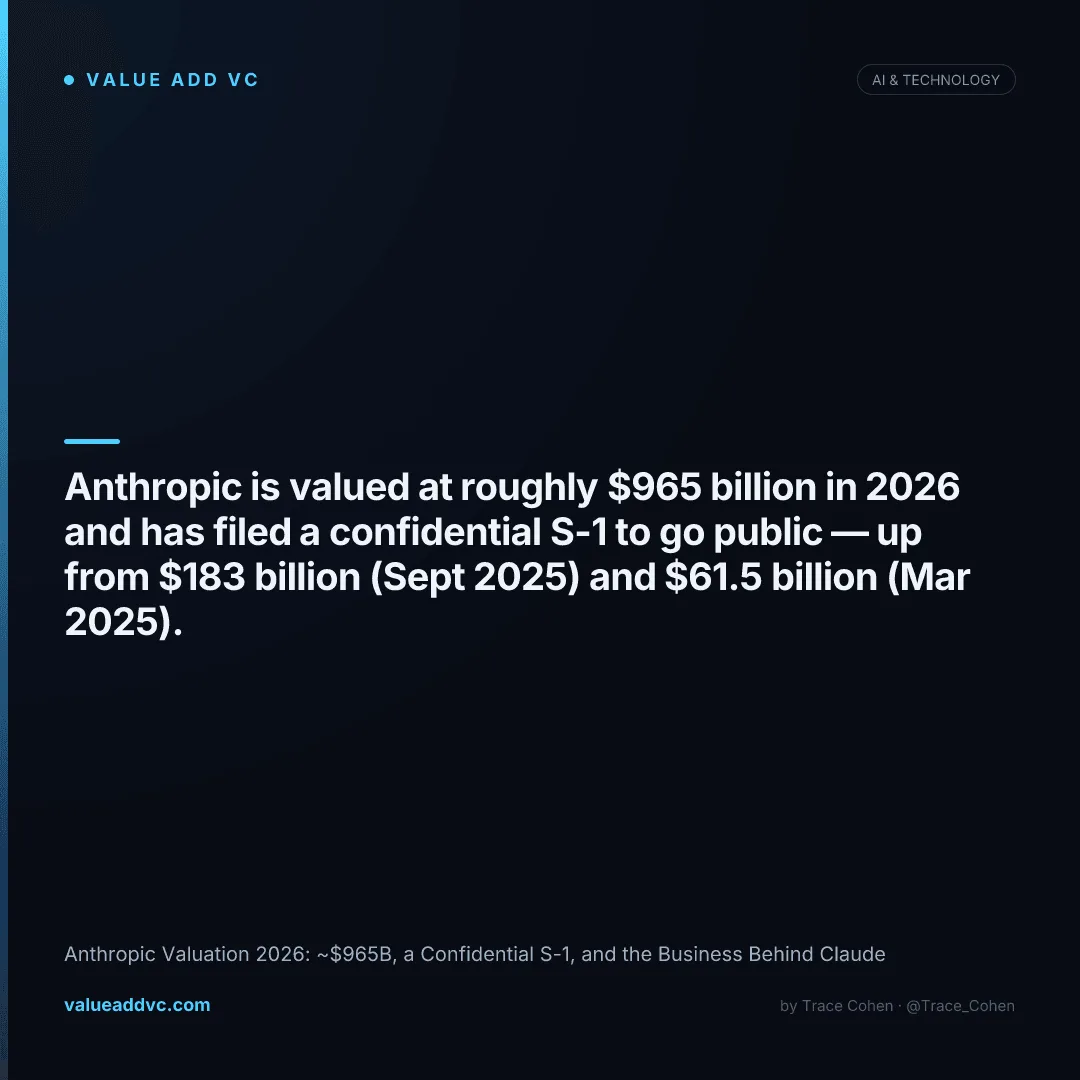
Anthropic is now valued at roughly $965 billion and has filed a confidential S-1 to go public — a vertical climb from $61.5 billion in March 2025 to $183 billion that September.
A number that triples in half a year usually means one of two things: a bubble, or a business inflecting faster than the market can reprice it. With Anthropic it's mostly the second. The company that started in 2021 as a breakaway from OpenAI — built around an AI-safety mission — has quietly turned into one of the fastest-scaling revenue engines in the history of software. The valuation is the headline. The business behind Claude is the story.
Anthropic Valuation 2026: The Latest Number
The Anthropic valuation in 2026 stands at roughly $965 billion, after the company's $183 billion September 2025 round (led by ICONIQ Capital), its $61.5 billion March 2025 round, and a stunning climb from the $4.1 billion it carried in early 2023. As of mid-2026 Anthropic has filed a confidential S-1 — so the next number that matters may be set by the public market rather than a private round.
To put ~$965 billion in context: that rivals the largest companies on the planet, achieved by a business that didn't exist five years ago and still generates a fraction of the revenue of the firms it's valued alongside. Investors aren't paying for current cash flow — they're paying for the slope of the line. You can track where Anthropic sits against other private AI leaders on the AI Valuations dashboard.
| Round / Date | Valuation (post) | Amount raised | Lead / key investor |
|---|---|---|---|
| Series A — 2021 | ~$1B | $124M | Jaan Tallinn, early backers |
| Series B — 2022 | ~$4B | $580M | FTX / Alameda (later sold) |
| Google — early 2023 | ~$4.1B | ~$300M+ | Google (cloud + equity) |
| Amazon — Sept 2023 / 2024 | N/A | Up to $8B | Amazon (strategic) |
| Series E — Mar 2025 | $61.5B | $3.5B | Lightspeed |
| Series F — Sept 2025 | $183B | ~$13B | ICONIQ Capital |
| Latest round — early 2026 | ~$965B | mega-round | Strategic + crossover |
| Confidential S-1 — June 2026 | TBD (public) | IPO filed | Racing to list |
| Total raised to date | — | ~$40B+ | Across all rounds |
Figures are 2025–2026 estimates compiled from company announcements, PitchBook, Crunchbase, and reporting by Bloomberg, The Information, and Reuters. Amazon's commitment includes cloud credits and convertible structures; exact post-money on strategic rounds is not always disclosed.
Why the Anthropic Valuation Tripled in 2025
The Anthropic valuation didn't triple on hype — it tracked revenue. The company entered 2025 at roughly a $1 billion annualized run-rate and exited the summer at an estimated $5 billion-plus, per reporting from The Information and Reuters. A 5x revenue ramp inside a single calendar year is almost unheard of at this scale, and it's the single biggest reason late-stage investors were willing to reprice the company so aggressively.
Three things drove that ramp. First, the Claude model family — particularly the Claude Opus and Sonnet tiers — became the default choice for coding workloads, where output quality translates directly into willingness to pay. Second, Claude Code turned Anthropic into a developer-tools company on top of being a model lab. Third, enterprise adoption compounded: once a company wires Claude into production, usage grows with the product, not with a fixed seat count. That usage-based dynamic is why the revenue line looks more like consumption infrastructure than traditional SaaS.
The flip side is cost. Frontier model training and inference are brutally capital-intensive, which is why Anthropic has raised over $27 billion in total and leaned on Amazon and Google not just for cash but for compute. The valuation bakes in an assumption that revenue keeps outrunning that spend — a bet that gets tested every quarter.
The Business Behind Claude: How Anthropic Makes Money
Strip away the valuation and Anthropic is, at its core, a usage-metered API business. Roughly 80% of revenue is estimated to come from the Claude API and enterprise contracts rather than consumer subscriptions — the inverse of OpenAI, whose revenue skews heavily toward ChatGPT consumer plans. Anthropic sells access to Claude billed per million tokens, layered with enterprise agreements, Claude Code for developers, and a consumer Claude.ai tier at around $20 per month for Pro.
That revenue mix matters for how you value the company. Enterprise and API revenue is generally stickier and higher-margin than consumer subscriptions once the model and infrastructure costs are covered, because switching providers means re-validating production systems. It also makes Anthropic less exposed to the churn dynamics that hit consumer AI apps. The trade-off is concentration risk: a handful of large customers and coding use cases drive an outsized share of consumption, so a single platform shift can move the numbers.
For a deeper teardown of the unit economics, see how Anthropic makes money. The short version: this is a consumption business wearing a research-lab badge.
Anthropic Valuation 2026 vs the Rest of the Frontier
Anthropic's ~$965 billion valuation now sits at the very top of the frontier-model race, neck-and-neck with OpenAI. Here is roughly how the major private (and soon-to-be-public) AI labs stack up as of 2026, by most recent priced valuation and estimated revenue run-rate.
| Company | Latest valuation | Est. revenue run-rate | Revenue skew |
|---|---|---|---|
| Anthropic | ~$965B | low-double-digit $B | Enterprise / API |
| OpenAI | ~$850B | ~$25B | Consumer-heavy |
| xAI | ~$230B | ~$1B+ | Consumer / X |
| Mistral AI | ~$14B | Sub-$1B | Enterprise / open |
| Perplexity | ~$18B | Sub-$1B | Consumer search |
| Cohere | ~$7B | Sub-$0.5B | Enterprise |
Figures are 2026 estimates blended from PitchBook, Crunchbase, and reporting by Bloomberg, The Information, and Reuters. Valuations reflect most recent priced rounds; revenue run-rates are annualized estimates and vary by source. OpenAI's structure is partly governed by Microsoft commercial terms.
Two things stand out. Anthropic and OpenAI now sit in a league of their own at the top — both valued near or above the better part of a trillion dollars, and both having filed to go public in 2026. And the gap to everyone else is enormous: the two leaders command the vast majority of frontier-lab equity value. We unpack that dynamic in the frontier AI valuation race.
What Could Break — or Re-Rate — the Valuation
A ~$965 billion valuation on a still-scaling run-rate is a bet on continued hypergrowth, and there are real ways it gets re-rated in either direction. On the upside: if Anthropic holds its lead in coding and enterprise agents and keeps compounding revenue into the public offering, the listing could clear $1 trillion and today's private mark looks cheap in hindsight.
On the downside: model commoditization is the core risk. If open-weight models close the quality gap on coding and reasoning, the pricing power that drives Anthropic's margins erodes. Compute costs, dependence on Amazon and Google for infrastructure, and the sheer capital intensity of staying at the frontier all pressure the path to profitability. And as a private company, Anthropic's eventual IPO — whenever it comes — will mark the first time public markets get to price the business directly; we cover the timeline in the Anthropic IPO outlook, and track comparable listings on the Tech IPO Tracker.
The honest read: Anthropic is one of the few companies where a triple-in-six-months valuation is backed by a triple-in-a-year revenue line. That doesn't make it cheap. It makes it one of the most consequential private companies in the world, priced accordingly.
The valuation is the headline. The Claude API business is the engine.
Anthropic went from $61.5B to $183B to ~$965B and a confidential S-1 in barely a year — because revenue is compounding faster than almost any software company in history, and roughly 80% of it comes from enterprise and API, not consumer subscriptions.
Track private AI valuations, revenue multiples, and the frontier-lab race on the AI Valuations dashboard and the Unicorns tracker at Value Add VC. Originally published in the Trace Cohen newsletter.
Get VC data most people never see
— 100% free
Weekly benchmarks, valuations, and fund data. Join 5,000+ investors. No spam.