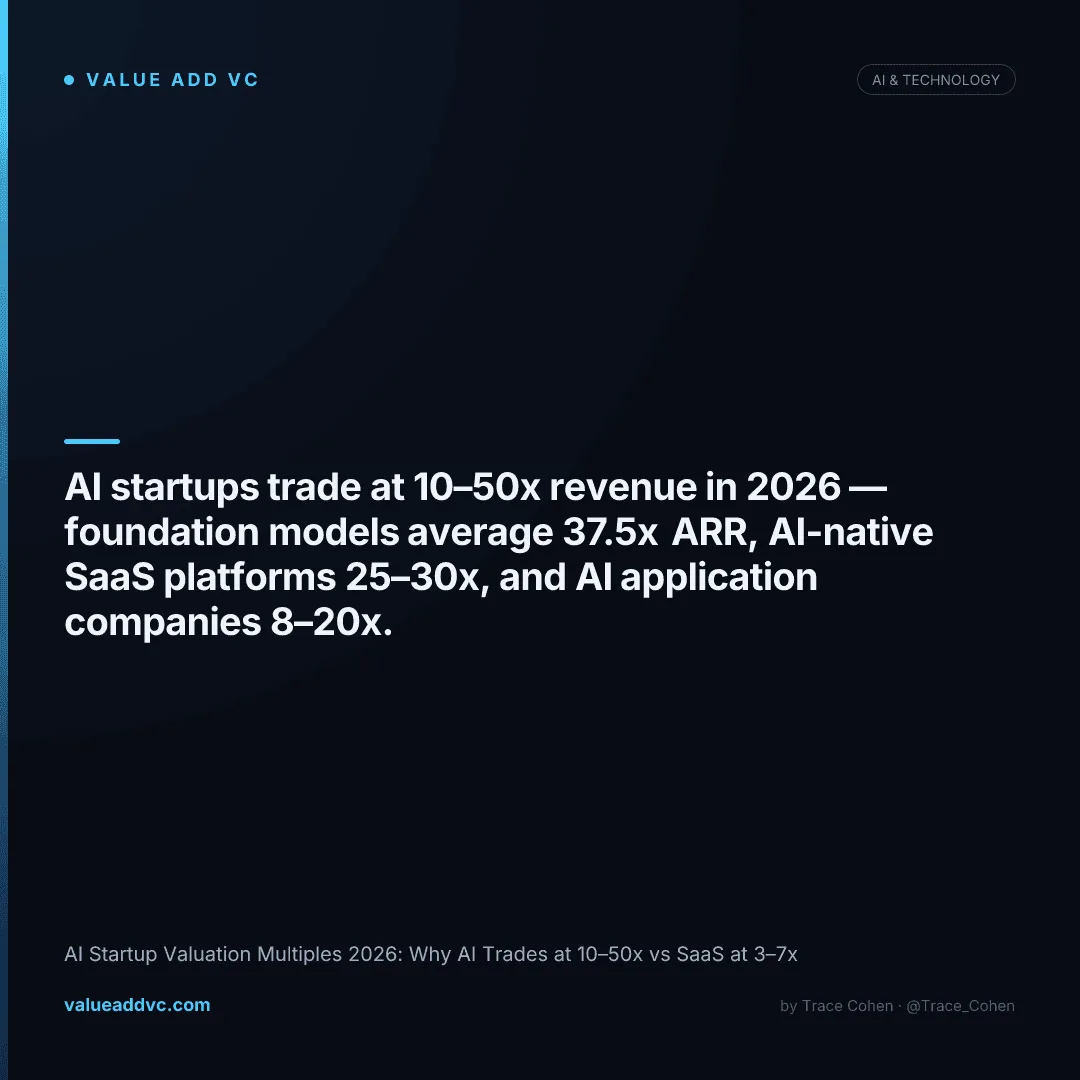
AI startups and SaaS companies are both software businesses — but they trade at completely different multiples. Foundation model companies average 37.5x revenue. The median public SaaS company is at 3.4x. That is a 10x gap that requires explanation.
The gap is not irrational — and it's not a new phenomenon. It reflects genuinely different business dynamics — different competitive structures, different growth rates, and different strategic value to hyperscalers who are willing to write checks that have nothing to do with normal VC return math. Here is the complete breakdown of AI vs SaaS valuation multiples in 2026.
The Data: AI vs SaaS Multiples in 2026
| Segment | EV/Revenue Range | Median | Examples |
|---|---|---|---|
| Foundation Model Labs | 30–120x | ~37.5x | OpenAI, Anthropic, xAI, Mistral |
| AI Infrastructure / Platforms | 15–40x | ~25x | Scale AI, Together AI, Cohere |
| AI-Native SaaS | 15–30x | ~25x | Harvey, Glean, Cursor, Perplexity |
| AI Application Companies | 8–20x | ~15x | Jasper, Writer, Copy.ai |
| High-Growth Public SaaS | 6–12x | ~8x | Snowflake, Datadog, MongoDB |
| Median Public SaaS | 2–6x | 3.4x | Salesforce, HubSpot, Zendesk |
Sources: Qubit Capital, Aventis Advisors, SEG Research, SaaS Capital Index — as of mid-2026. Private market figures are estimates based on disclosed rounds.
The Current Snapshot: OpenAI and Anthropic at Near-Trillion Valuations
The foundation model tier has reached a scale that was unimaginable two years ago. OpenAI closed a $122B funding round in March 2026 at an $852B valuation. Anthropic raised $65B in its Series H in June 2026 at $965B — overtaking OpenAI as the most highly valued private AI company. Anthropic also filed confidentially for an IPO, and public markets are already pricing AI listings on a different framework than SaaS debuts.
OpenAI
$852B$122B raised (March 2026)
Amazon, NVIDIA, SoftBank, Microsoft
Most recent round investors include a16z, D.E. Shaw, TPG
Anthropic
$965B$65B Series H (June 2026)
Altimeter, Sequoia, Dragoneer, Greenoaks
Filed confidentially for IPO. $47B revenue run rate reported.
These are not traditional VC round dynamics. Amazon has committed $8B+ to Anthropic. NVIDIA put $30B into OpenAI. These are infrastructure bets by companies for whom AI model access is existential — and their investment activity creates a valuation floor that has nothing to do with the returns math of a typical LP.
Why the AI Premium Exists: Four Structural Reasons
Winner-take-most infrastructure dynamics
Foundation model companies are not competing for a slice of a market — they are competing to own the infrastructure layer of the next decade of software. The winner here is more like Amazon Web Services than like Salesforce. AWS commands a premium multiple because it is not just a product — it is the substrate on which other products are built. The market is pricing OpenAI and Anthropic the same way.
Unprecedented revenue growth rates
OpenAI went from ~$1B to ~$11.6B ARR in approximately 18 months. Anthropic reported a $47B revenue run rate in June 2026, up from $10B annual revenue in 2025. A company growing 3–4x year-over-year at multi-billion dollar scale deserves a forward multiple that looks extreme on trailing revenue — because the trailing revenue is already stale.
Strategic capital creates a valuation floor
When Microsoft, Amazon, NVIDIA, and SoftBank are writing $8–50B checks into AI companies, they are not running a DCF model. They are buying access to technology that their own businesses depend on. This strategic capital sets a price floor that is independent of what a traditional VC would pay — and it signals to every other investor that these companies will not run out of money.
Capital intensity as a competitive moat
Training GPT-4 or Claude 4 costs hundreds of millions of dollars per run. Only a handful of organizations globally have the compute, data, and talent to build frontier models. That capital intensity is itself a moat — and investors are pricing in the difficulty of replication. The next OpenAI cannot be funded from a Series A; it requires years of infrastructure investment before the first model ships.
Where the Premium Is Compressing
The AI premium is not uniform across the stack. It is holding at the foundation model and infrastructure tier — but it is compressing rapidly at the application layer. Compare this to SaaS multiples by ARR range to see where the convergence point sits.
AI application companies — the tools built on top of GPT, Claude, and Gemini rather than competing with them — are increasingly being valued like SaaS businesses. The reason is simple: if your competitive advantage is using someone else's model via an API, your defensibility story is mostly about workflow lock-in and distribution. That is not an infrastructure premium — that is a SaaS business.
AI companies that hold the premium
- → Foundation model labs (OpenAI, Anthropic)
- → Companies with proprietary training data
- → AI infrastructure with high switching costs
- → Net Revenue Retention above 130%
- → Workflow AI with true process lock-in
AI companies that converge toward SaaS multiples
- → API wrappers with no proprietary model
- → Commodity content generation tools
- → High churn in PLG AI tools
- → Thin gross margins from compute costs
- → Feature parity with GPT/Claude native UI
How to Apply This Framework as an Investor or Founder
Avoid comping AI application companies against foundation model multiples — the comparison is misleading. Ask: what happens to this business if GPT adds this feature natively? If the answer is 'the business disappears,' you are looking at a SaaS business that will compress to SaaS multiples.
The AI label earns you a higher entry valuation, but you will be held to AI-level growth expectations. If you are growing 40% annually and call yourself AI, you will be re-rated to a SaaS multiple the moment your NRR shows churn. The premium is only durable if the growth and retention metrics support it.
The AI vs SaaS multiple gap means historical SaaS benchmarks (Rule of 40, NRR thresholds, payback periods) are not directly comparable to AI companies. A 120% NRR AI company and a 120% NRR SaaS company can trade at radically different multiples depending on their position in the stack.
If you are pricing your AI product, understand the multiple your buyers are willing to pay. Enterprise buyers at large companies have AI budgets that are separate from SaaS budgets — see the Enterprise AI Adoption dashboard for the data — and they are often being measured on AI adoption metrics, which means cost sensitivity is lower than for traditional software procurement.
The AI multiple premium is real — but it is not unconditional.
Foundation models get infrastructure multiples. Application companies get SaaS multiples. The difference is whether your moat exists without the hyperscaler's blessing.
Track AI company valuations in real time at the AI Valuations Dashboard. Analysis by Trace Cohen at Value Add VC. Contact: t@nyvp.com
Latest from the Pulse
Get VC data most people never see
— 100% free
Weekly benchmarks, valuations, and fund data. Join 5,000+ investors. No spam.