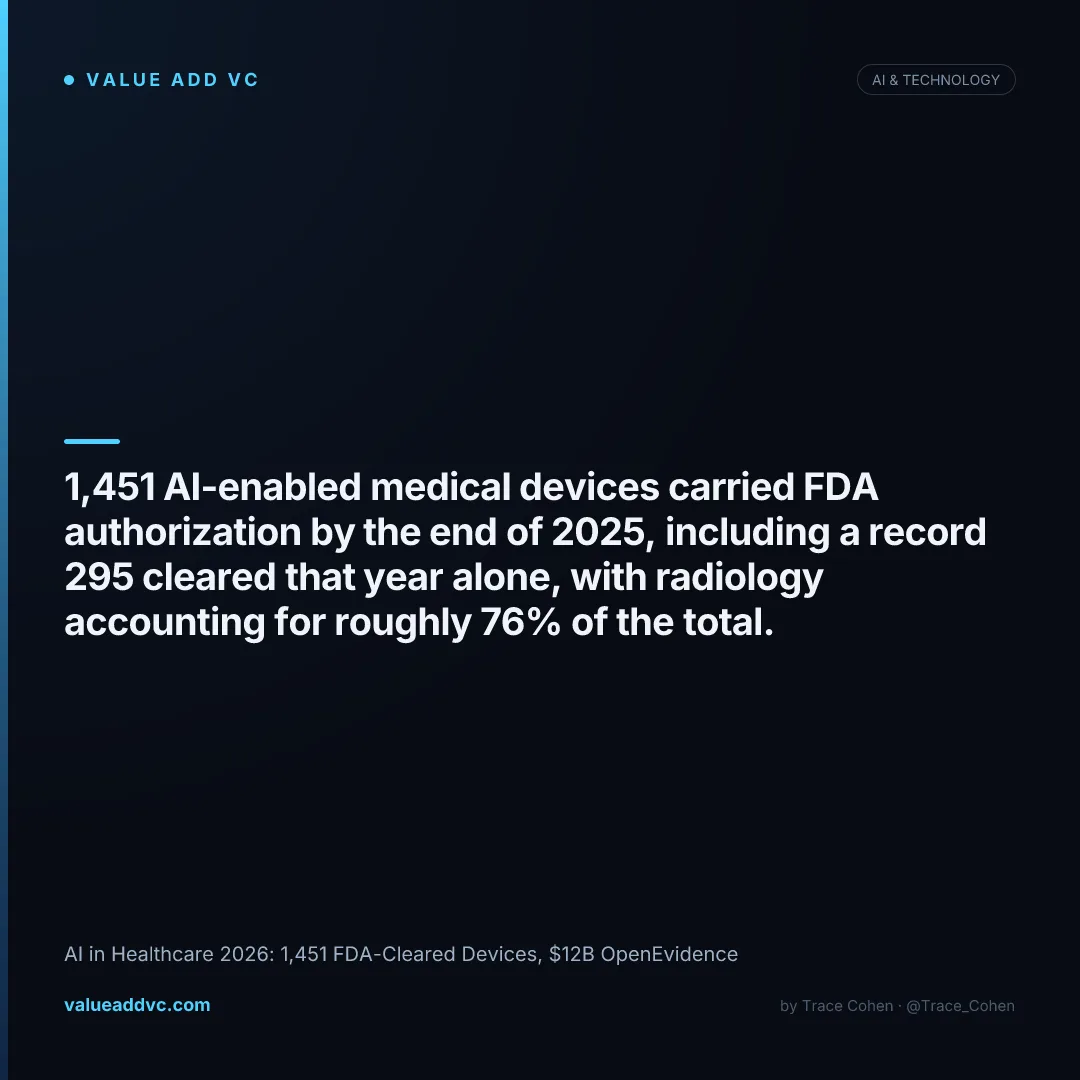
1,451 AI-enabled medical devices now carry FDA authorization, and a record 295 of them were cleared in 2025 alone.
Healthcare AI stopped being a research curiosity years ago — it's now a regulatory track record and a funding market both accelerating at the same time, with OpenEvidence and Tempus AI each clearing double-digit-billion valuations in the last six months.
AI in Healthcare 2026: What the FDA Approval Numbers Show
The FDA has authorized 1,451 AI-enabled medical devices cumulatively as of the end of 2025, up from roughly 1,156 a year earlier, with a record 295 new clearances in 2025 alone versus 253 in 2024 and 221 in 2023. Radiology imaging dominates the list, accounting for about 76% of every device cleared since the FDA began tracking the category in 1995, with cardiology a distant second at roughly 9%.
The acceleration matters because approval velocity is the leading indicator every healthcare investor should be watching. Three straight years of record clearances — 221, then 253, then 295 — means the FDA's 510(k) pathway has become a repeatable, predictable process for AI/ML software-as-a-medical-device (SaMD) rather than a one-off regulatory experiment. Compare current AI company pricing on our AI Valuations dashboard.
FDA AI Healthcare Approvals by Specialty
Radiology's 76% share isn't shrinking as the device count grows — it has held between 73% and 80% every year since 2023, meaning the specialty mix of FDA-cleared AI is remarkably stable even as absolute volume climbs. That concentration is a structural fact for anyone underwriting a healthcare AI deal: outside of imaging, the regulatory playbook is far less proven.
AI Healthcare 2026: The Top Startups by Valuation
Six companies now anchor the healthcare AI valuation table, spanning diagnostics, clinical documentation, and revenue-cycle automation. Tempus AI leads at $14.0B after acquiring imaging AI company Arterys and pathology AI company Paige, while OpenEvidence more than doubled its valuation in eight months on the back of 18 million monthly physician consultations. Newer entrants are moving even faster: an AI prescription platform tripled its valuation to $3B in just four months.
| Company | 2026 Valuation | Category | Latest Round | Lead Investor(s) |
|---|---|---|---|---|
| Tempus AI | $14.0B | Diagnostics & genomics | Public (Nasdaq: TEM) | M&A-driven (Arterys, Paige) |
| OpenEvidence | $12.0B | Clinical decision support | $250M Series D | Thrive Capital, DST |
| Commure | $7.0B | Admin & revenue-cycle AI | $70M growth round | General Catalyst |
| Abridge | $5.3B+ | Ambient clinical documentation | $316M Series E extension | a16z, Khosla Ventures |
| Hippocratic AI | $3.5B | Patient-facing AI agents | $126M Series C | Undisclosed |
| Ambience Healthcare | $1.25B | Ambient clinical documentation | $243M Series C | Oak HC/FT, a16z |
Valuations and round data from CNBC, Fierce Healthcare, Becker's Hospital Review, Modern Healthcare, and company press releases, current as of Q1-Q2 2026.
AI Healthcare Funding in 2026: Where the Money Is Going
Digital health startups raised $4B globally in Q1 2026 alone — $1B higher than the same quarter a year prior and the strongest first quarter since the pandemic peak. U.S. digital health VC totaled $5.34B across 105 deals in the quarter, capturing 76% of global capital, while global digital health venture funding reached $7.1B across 216 deals.
Within that broader digital health number, AI-specific healthcare companies raised $4.29B across just 28 disclosed equity rounds in the trailing 12 months through April 2026 — and the money is heavily concentrated. Just 12 companies captured 59% of quarterly funding, almost entirely through financing rounds of $100M or larger. Clinical documentation alone — Abridge, Ambience Healthcare, Rad AI, and Nabla combined — now commands roughly $7.7B in combined valuation on about $1.3B raised, a sign of unusually strong capital efficiency in that sub-category. Abridge's own climb past incumbents like Nuance is the clearest single case study in that sub-category. See our full ranking of the leading healthcare AI tools for pricing and compliance detail on each.
AI's share of that overall health-tech venture pool has climbed every year since 2022: 29% in 2022, 33% in 2023, 37% in 2024, and 55% in 2025. That's the fastest four-year share shift of any category we track — see how it compares to broader AI spending on our AI Spending dashboard. Not every clinical category has ridden that wave the same way: behavioral health startups saw funding contract even as capital concentrated around fewer, larger winners, a pattern that mirrors what's happening in AI-native clinical categories.
The Clinical Use Cases Actually Driving Adoption
Four clinical use cases explain almost all of the funding concentration above. Diagnostic imaging interpretation is the largest and most mature — it's the reason radiology holds 76% of FDA clearances, and it's why Tempus AI bought its way to category leadership by acquiring Arterys (imaging) and Paige (pathology) rather than building both from scratch. Ambient clinical documentation is the fastest-growing use case: Abridge, Ambience Healthcare, Rad AI, and Nabla together turned about $1.3B raised into roughly $7.7B in combined valuation by solving one narrow, painful problem — getting doctor-patient conversations out of a physician's head and into an EHR in real time.
Clinical decision support is the newest big category, and OpenEvidence is its clearest proof point. The platform is now used by 40% of U.S. physicians, ran about 18 million verified clinical consultations in December 2025 alone (up from roughly 3 million a month a year earlier), and topped $100M in annual revenue last year — the usage curve that took its valuation from $1B in February 2025 to $6B in October to $12B by January 2026. The fourth use case, administrative and revenue-cycle automation, is less visible to clinicians but arguably the largest addressable market: Commure prices the problem at roughly $1 trillion a year in administrative overhead across the U.S. healthcare system, which is why it raised $70M at a $7B valuation in May 2026 with General Catalyst, Sequoia, Morgan Stanley, and Kirkland & Ellis all participating.
What ties these four use cases together is deployment depth, not novelty. Abridge is integrated directly into Epic and counts Kaiser Permanente (24,600 physicians), Mayo Clinic (2,000+ physicians), Johns Hopkins, Duke Health, UPMC, and Yale New Haven as customers — the kind of enterprise health-system distribution that's much harder to replicate than the underlying model. See how these valuations compare across the broader market on our AI Valuations dashboard.
What Founders and Investors Should Watch in AI Healthcare
The FDA approval data and the funding data are telling the same story from two different angles: a specialty that has moved from experimental to systematized. Founders building outside radiology's 76% share should expect a longer, less-charted regulatory path, but also less competitive crowding — cardiology sits at just 9% of clearances despite comparable clinical demand, and neurology, hematology, and other specialties combined still make up only 15% of the FDA's 1,451-device list.
For investors, the capital-efficiency gap is the signal worth underwriting to. OpenEvidence turned $735M in total funding into a $12B valuation, a 16.3x multiple that's the highest among the top 10 healthcare AI companies by valuation. That kind of multiple isn't evenly distributed — it shows up where a product embeds directly into a high-frequency clinical workflow (physician consultations, ambient documentation) rather than a back-office administrative layer. With 12 companies capturing 59% of all quarterly AI healthcare funding on rounds of $100M or more, the market is already picking winners; the diligence question for 2026 is whether the next tier of $100M+ rounds goes to genuinely new use cases or simply funds more competition inside the same four categories.
Healthcare AI isn't an emerging category anymore.
1,451 FDA clearances, three straight years of record approvals, and $14B and $12B valuations at the top of the market say the regulatory and capital tracks have both matured.
The next phase isn't proving AI works in healthcare — the FDA data already shows that. It's figuring out which specialties outside radiology can replicate the same approval velocity and capital efficiency.
Track live AI company valuations on the AI Valuations Dashboard at Value Add VC. Originally published in the Trace Cohen newsletter.
Latest from the Pulse
Get VC data most people never see
— 100% free
Weekly benchmarks, valuations, and fund data. Join 5,000+ investors. No spam.