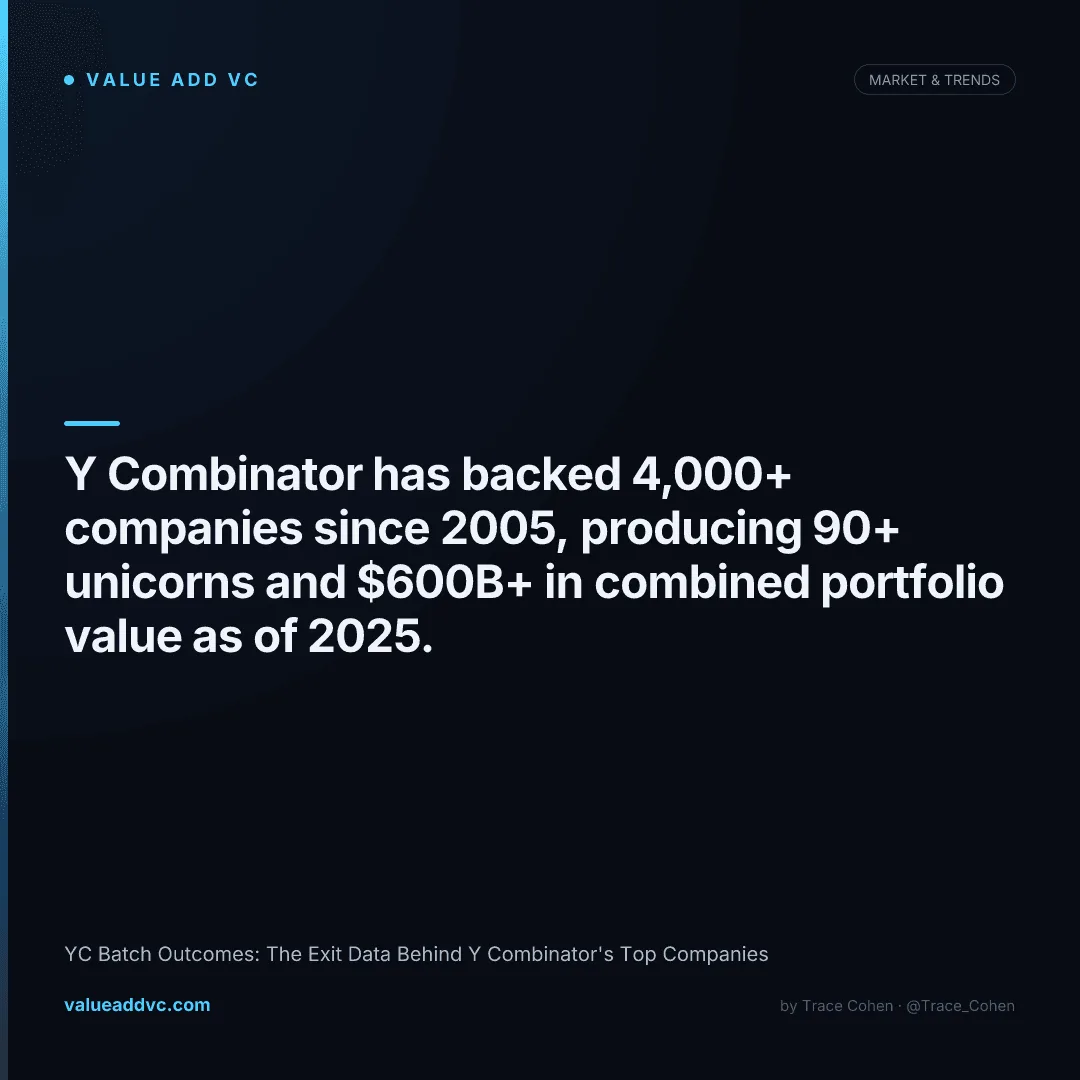
Y Combinator has funded over 4,000 companies. About 2% of them have exited for $100M or more. The top 10 companies account for an estimated 60–70% of the entire portfolio's value.
This is the power law at its most extreme — and it's exactly what anyone evaluating Y Combinator batch outcomes needs to understand before drawing conclusions about the program.
The median YC company does not become a unicorn. It does not IPO. It does not get acquired for nine figures. What it gets is a network, a credential, and a shot at Demo Day — and for roughly 40% of Demo Day graduates, that's enough to close a Series A. The rest have to fight for it on their own terms.
The Numbers That Define YC's Track Record
As of 2025, Y Combinator's portfolio statistics — across roughly 20 years of operation — look like this:
| Metric | Data Point |
|---|---|
| Companies funded (total) | 4,000+ |
| Combined portfolio valuation | $600B+ |
| Unicorns produced | 90+ |
| Exits at $100M+ | ~80–100 companies (2%) |
| Series A close rate (post-Demo Day, 12 mo) | ~40% |
| Acceptance rate per batch | ~1.5% of applicants |
| Typical batch size | 200–350 companies |
| Investment terms | $500K for 7% (standard MFN SAFE) |
| Applications per batch | 12,000–20,000 |
Sources: YC company database, Crunchbase, PitchBook, public statements from YC leadership.
The Power Law in Action: Where Y Combinator Batch Returns Come From
The top exits from YC's history are not evenly distributed across batches or sectors. They are concentrated in a handful of companies that happened to catch the right wave at the right time — with the right founder-market fit, like Coinbase's Nasdaq direct listing that valued it near $86 billion.
Marketplace · IPO (Dec 2020)
Fintech · Private (last round 2023)
Marketplace · IPO (Dec 2020)
Crypto · Direct Listing (Apr 2021)
SaaS · IPO (Mar 2018)
Marketplace · IPO (Sep 2023)
Social · IPO (Mar 2024)
Fintech · Private (last round 2022)
AI/Data · Private (49% stake, 2025)
Autonomous · Acquired by GM (2016)
Just these ten companies represent well over $300 billion in value created — from a combined YC investment that never exceeded $50M across all of them combined. That is the power law functioning at its most extreme.
Batch Trends: Which YC Vintages Are Performing Best?
Not all batches are created equal. The 2009–2014 cohorts benefited from the mobile and marketplace explosion. The 2016–2019 cohorts caught SaaS and fintech tailwinds. The 2020–2022 COVID-era batches are still maturing — and early signals suggest the AI-native companies in those batches may produce the next generation of outliers.
2007–2012 (Foundation Era)
Produced the portfolio's single largest returns: Airbnb, Stripe, Coinbase, Dropbox. Consumer internet and fintech dominated. Small batches (20–50 companies) meant YC invested more time per company.
2013–2017 (Scale Era)
DoorDash, Instacart, Scale AI, Brex emerged here. Batches grew to 100–200 companies. B2B SaaS and marketplace models dominated. Hit rate per company dropped but total value remained strong.
2018–2021 (Acceleration Era)
Batches grew to 200–350 companies. COVID W20 and S20 batches ran remotely — unusually productive. Deel, Clermont (now part of Rippling era), and several vertical SaaS companies emerged. Series A conversion remained strong.
2022–2026 (AI Era)
AI-native companies now constitute 40–60% of each batch. Exits are limited due to company age, but early valuations are tracking ahead of historical medians. The 2024–2026 batches may produce YC's next $10B+ outcomes.
Y Combinator Batch Outcomes vs. Other Accelerators
Benchmarking YC against peers is difficult because no other accelerator operates at the same scale with the same brand pull. But the data points that matter most are strikingly one-sided.
| Accelerator | Unicorns | Est. Portfolio Value | Series A Rate |
|---|---|---|---|
| Y Combinator | 90+ | $600B+ | ~40% |
| Techstars | 20+ | $50B+ est. | ~20–25% |
| 500 Global | 30+ | $30B+ est. | ~15–20% |
| a16z Speedrun | Early-stage | Not disclosed | ~60%+ |
| Antler | 10+ | Not disclosed | ~15–20% |
Note: Series A rate estimates vary by source and time window. YC data per YC; others per Crunchbase/PitchBook analysis.
What the Exit Data Actually Tells Founders
If you are a founder evaluating whether YC is worth it, the batch outcome data gives you a clear picture — and it is not what most people think.
The question is not "will I become Airbnb?" The question is: "Does the YC network, brand, and Demo Day access give me a materially better shot at raising a Series A than I would have without it?" The data says yes — by a factor of 3–4x over the baseline.
The credential compounds over time
YC alumni networks now extend across 80,000+ founders globally. The credential opens doors 5–10 years after graduation in ways that are hard to quantify but consistently reported as material.
Demo Day is a structured fundraising event
Roughly 1,000+ investors attend each Demo Day cycle. The compressed timeline creates real FOMO — and the 40% Series A close rate in 12 months is a direct result of that investor density.
The network effect benefits the whole portfolio
When Airbnb succeeds, it makes future YC companies more credible to investors. The top exits raise the value of the YC brand for every company that comes after them — this is a genuine compounding dynamic.
Batch size has tradeoffs
The jump from 50-company batches to 300+ company batches improved YC's diversity and volume but compressed the hands-on support each company gets. Founders in early batches had materially more YC partner time. Track this when evaluating what 'YC support' actually means today.
The YC brand is worth more than the $500K check.
But 98% of companies that go through YC do not exit for $100M+. The power law is real — and it is more extreme than the marketing suggests.
Track VC fund performance data and benchmark outcomes on the VC Performance Dashboard at Value Add VC. For unicorn tracking and batch-level exit data, see the Unicorn Tracker.
Latest from the Pulse
Get VC data most people never see
— free to subscribe
Trace's notes on venture, AI and startups, a few times a week. Join 5,000+ subscribers. No spam.