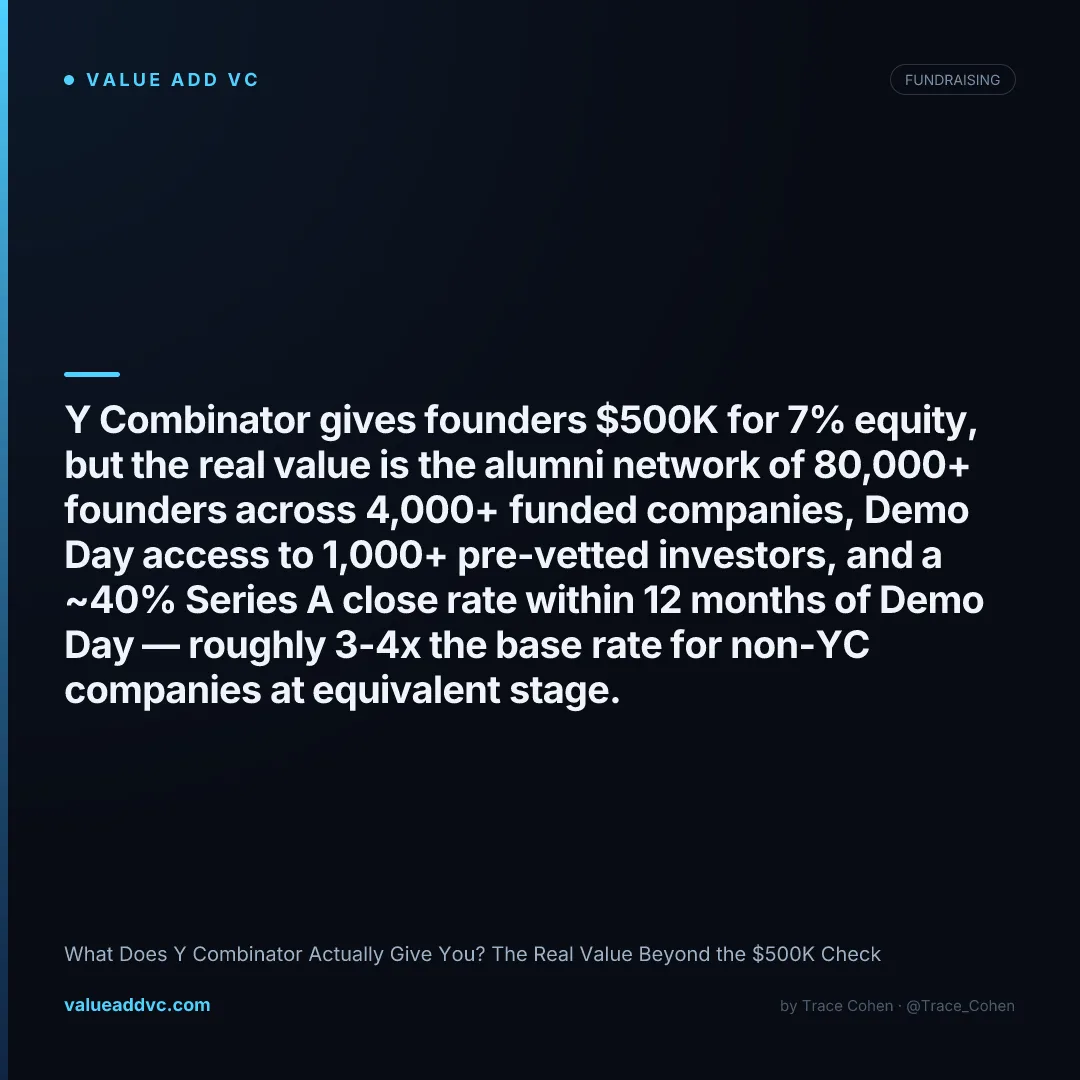
Y Combinator gives you $500K. But that's the least important thing it gives you — and every founder who gets the most from YC knows this from week one.
There are now 5,600+ YC-backed companies — including 82 unicorns — with a combined valuation north of $600B. Stripe. Airbnb. DoorDash. Coinbase. OpenAI. These are not accidents of capital allocation — they are products of a network that compounds in ways a dollar amount cannot capture.
The Actual Deal Structure
YC's current standard deal: $500K for approximately 7% equity. Structurally, this is $125K for 7% common equity plus a $375K uncapped SAFE with an MFN clause. On the $125K priced portion, that 7% implies a ~$1.8M post-money valuation for your company — before you have done much of anything.
For context: the median pre-seed check outside of YC is $150K–$500K on a SAFE at a $3–8M cap, often with no consistent follow-on network attached. YC's capital is competitive but not extraordinary on its own. What makes it worth it is what surrounds the check.
The 7% is fixed. You will not negotiate it. What you are actually buying with that 7% is the infrastructure around it — and for most founders, that is a very good deal.
As of August 2026, the deal terms and math below are unchanged from when this was first published — the $500K/7% structure has held since January 2022. What has grown is the network itself: YC has crossed 5,600+ funded companies and 82 unicorns, up from roughly 4,000 companies a year ago.
What YC Actually Gives You
What the Data Actually Shows
The clearest proof of YC's value is in the fundraising outcomes. Compare the standard startup fundraising benchmarks to what YC companies achieve post-program:
| Metric | YC Companies | Non-YC Comparable |
|---|---|---|
| Series A close rate (12 mo post-Demo Day) | ~40% | 10–15% |
| Median seed round post-Demo Day | $3–5M | $1–2M |
| Median Series A pre-money valuation | $15–25M | $8–12M |
| Companies still operating at 3+ years | ~50% | ~35% |
| Combined alumni portfolio valuation | $600B+ | n/a |
Sources: YC public data, PitchBook, Carta. Non-YC comparables are pre-seed/seed companies with $500K–$2M raised and product in market.
What YC Cannot Give You
YC cannot give you product-market fit. It cannot give you paying customers who stay. It cannot give you the ability to hire, execute, and make the 100 unglamorous decisions that separate companies that scale from companies that flame out after Demo Day.
I have watched founders use YC as a validation signal rather than an acceleration tool. They get into the batch, update their LinkedIn, and coast on the brand for six months. These are the founders who leave with a $500K check and nothing else — because they did not show up to office hours, did not post on Bookface, did not push the product forward during the program.
As of 2026, YC's acceptance rate has fallen to roughly 1% under its new four-batch model. YC filters hard. But filtering is not the same as manufacturing. The founders who get the most from YC are the ones who already have momentum going in — see what actually gets an application through that filter. YC compresses the trajectory. It does not create one.
Is 7% Worth It?
For founders who plan to raise venture capital and scale aggressively, the math is clear. If YC's network gets you a $15M pre-money Series A instead of a $10M pre-money Series A, the 7% you gave up is worth less than the valuation lift it generated on the remaining 93% of your cap table.
For founders who are capital-efficient, growing organically, and not planning to raise institutional rounds — the 7% is genuinely expensive. You are paying for a network and a brand that you may not need if you have distribution, revenue, and strong unit economics already.
The honest answer is this: apply if you are pre-product-market fit and need to compress your learning curve. Apply if you are going to raise a Series A and want 1,000 investors in a room in three months. Do not apply just for the check or the logo. Those are the founders who leave YC with 7% dilution and regret.
The founders who get the most from YC treat the $500K as the entry fee — and the network as the product they actually paid for.
Track startup fundraising benchmarks and accelerator outcomes at Value Add VC. Originally published in the Trace Cohen newsletter.
Latest from the Pulse
Get VC data most people never see
— free to subscribe
Trace's notes on venture, AI and startups, a few times a week. Join 5,000+ subscribers. No spam.