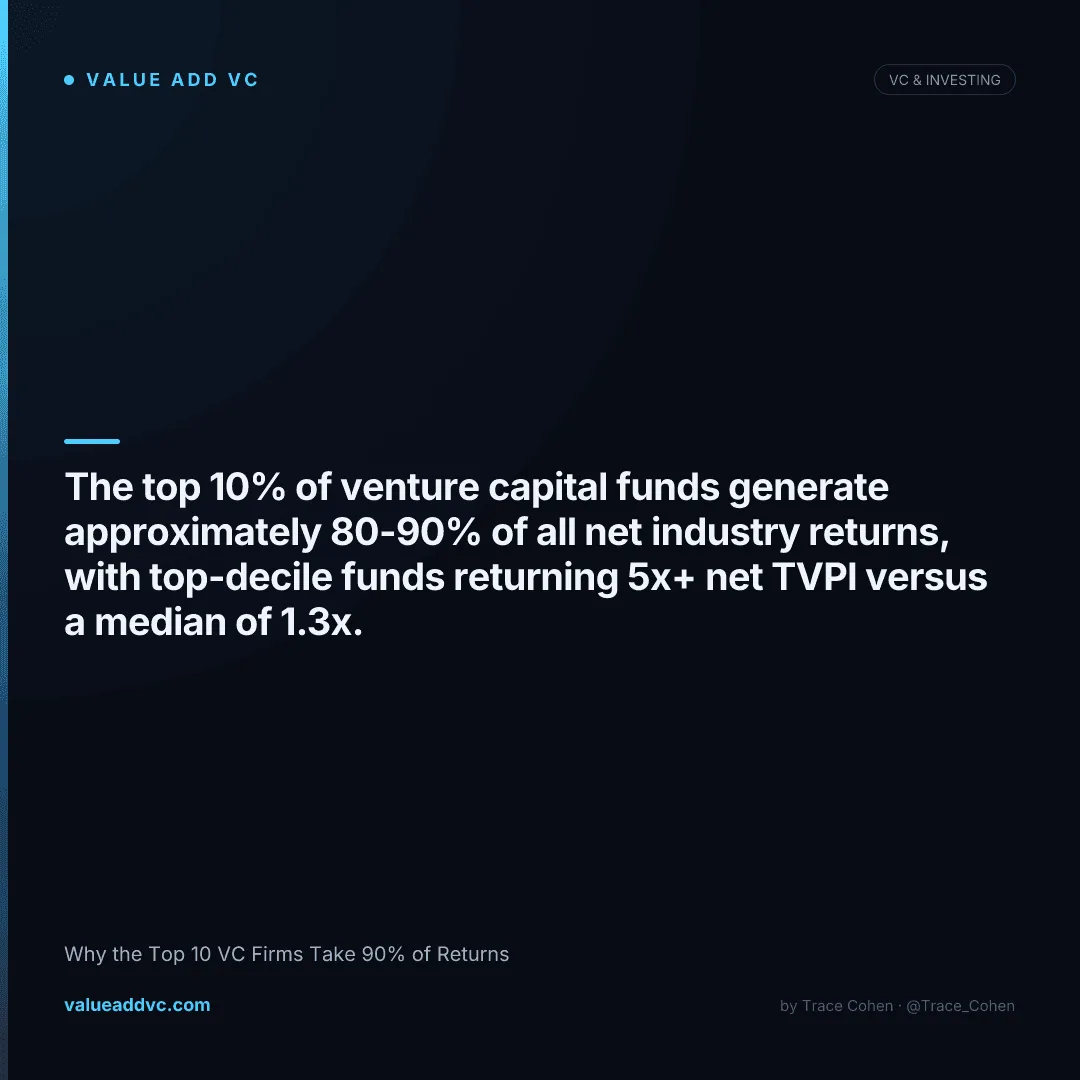
The median US venture fund returns 1.3x net of fees. That's not a typo — the average VC fund doesn't beat a Treasury bill on a risk-adjusted basis, let alone justify a 10-year lockup.
The top decile, meanwhile, returns 5x or more. That gap doesn't close over time — it compounds. Understanding why is one of the most important things anyone who allocates to or raises venture capital needs to internalize.
The Power Law Math Is More Extreme Than You Think
Cambridge Associates has tracked US venture fund performance since the 1980s. The pattern is consistent across decades and market cycles: roughly 10% of firms generate 80-90% of all net returns to LPs. The remaining 90% of funds — thousands of vehicles managing hundreds of billions in committed capital — collectively produce almost nothing after fees.
Benchmarks matter here. Top-quartile funds have historically returned 2.5-3x net TVPI. Top-decile funds hit 5x+. But the median fund at 1.3x doesn't just underperform venture benchmarks — it underperforms the S&P 500 on an IRR basis while locking up capital for a decade.
I've seen this from both sides. As a founder who raised institutional capital and as an investor who has written 65+ checks, the pattern is unmistakable: the best deals cluster around the same 10-15 firms in every market cycle. The reason isn't luck — it's structural.
Why the Gap Keeps Widening
Sequoia's 2009 fund reportedly returned over 10x net. Their 2012 fund produced over $2B in gains from Whatsapp alone. These aren't random outcomes — they reflect structural access that other firms cannot replicate. When you're Sequoia, the best founders call you before they tell anyone else they're raising. You see deals at $5M valuations that everyone else sees at $50M.
The math on entry price is catastrophic for average funds. A $10M check at a $100M valuation that returns 10x produces a $100M gain. The same $10M check at a $500M valuation — where average funds typically see the deal — produces a $20M gain at the same exit. Same company, entirely different fund economics.
Pro-rata rights accelerate the gap further. Top firms negotiate the right to maintain ownership in follow-on rounds. They can write a $5M check at seed, then a $25M check at Series B, then $50M at Series D. Emerging managers who lack pro-rata or reserve capital watch their ownership dilute to irrelevance by the time the company goes public.
Five Advantages That Self-Perpetuate
- •Brand as a deal filter: Top-tier brand attracts the founders who are most likely to build category-defining companies. Andreessen Horowitz, Benchmark, and Sequoia don't just see more deals — they see the right deals before anyone else knows they exist.
- •Portfolio network density: A fund with 200 portfolio companies generates warm intro volume that no outsider can replicate. Founders refer other founders. CEOs share hiring pipelines. The network becomes a competitive advantage that compounds with every new investment.
- •Proprietary benchmarking data: Firms with 20+ years of portfolio data can benchmark a company's metrics against hundreds of comparable companies at the same stage. This makes diligence faster, conviction higher, and decision-making sharper — a structural edge in competitive processes.
- •Institutional LP access: The largest university endowments, sovereign wealth funds, and pension funds only allocate to the top 10-15 VC firms. This isn't elitism — it's fiduciary responsibility. Access to this LP base allows top firms to raise $3-6B funds, giving them the reserve capital to maintain ownership that matters.
- •Follow-on firepower: A $4B fund can write a $150M check at Series C without blinking. That ability to be the largest check in every follow-on round keeps ownership intact and signals confidence to the market — which attracts co-investors and accelerates the company's fundraising timeline.
What This Means for Everyone Else
This isn't a counsel of despair for emerging managers — it's a strategic clarification. If you can't compete on brand, compete on access through a different vector: a niche sector where you have proprietary sourcing, a geographic market the incumbents ignore, or a founder-facing credential (operating experience, deep technical expertise) that resonates in a specific community.
Micro-funds under $50M can actually outperform on a TVPI basis precisely because they aren't competing for the same deals as Sequoia. A $25M fund can build a concentrated portfolio of 15-20 seed bets in, say, climate infrastructure or defense tech — sectors where brand matters less than sector expertise and operator credibility.
For LPs, the implication is uncomfortable but clear. Diversifying across 30 average VC funds doesn't reduce risk — it locks in median returns at illiquidity costs. The rational strategy is extreme selectivity: allocate to the top 10-15 firms and build a small satellite portfolio in 2-3 differentiated emerging managers with genuine sourcing edges, not pedigree plays.
If you're allocating to venture as an LP, the math is unambiguous: 90% of your return comes from getting into the 10 best firms — not from diversifying across 50 average ones.
Track VC fund performance data at Value Add VC. Originally published in the Trace Cohen newsletter.
Latest from the Pulse
Get VC data most people never see
— 100% free
Weekly benchmarks, valuations, and fund data. Join 5,000+ investors. No spam.