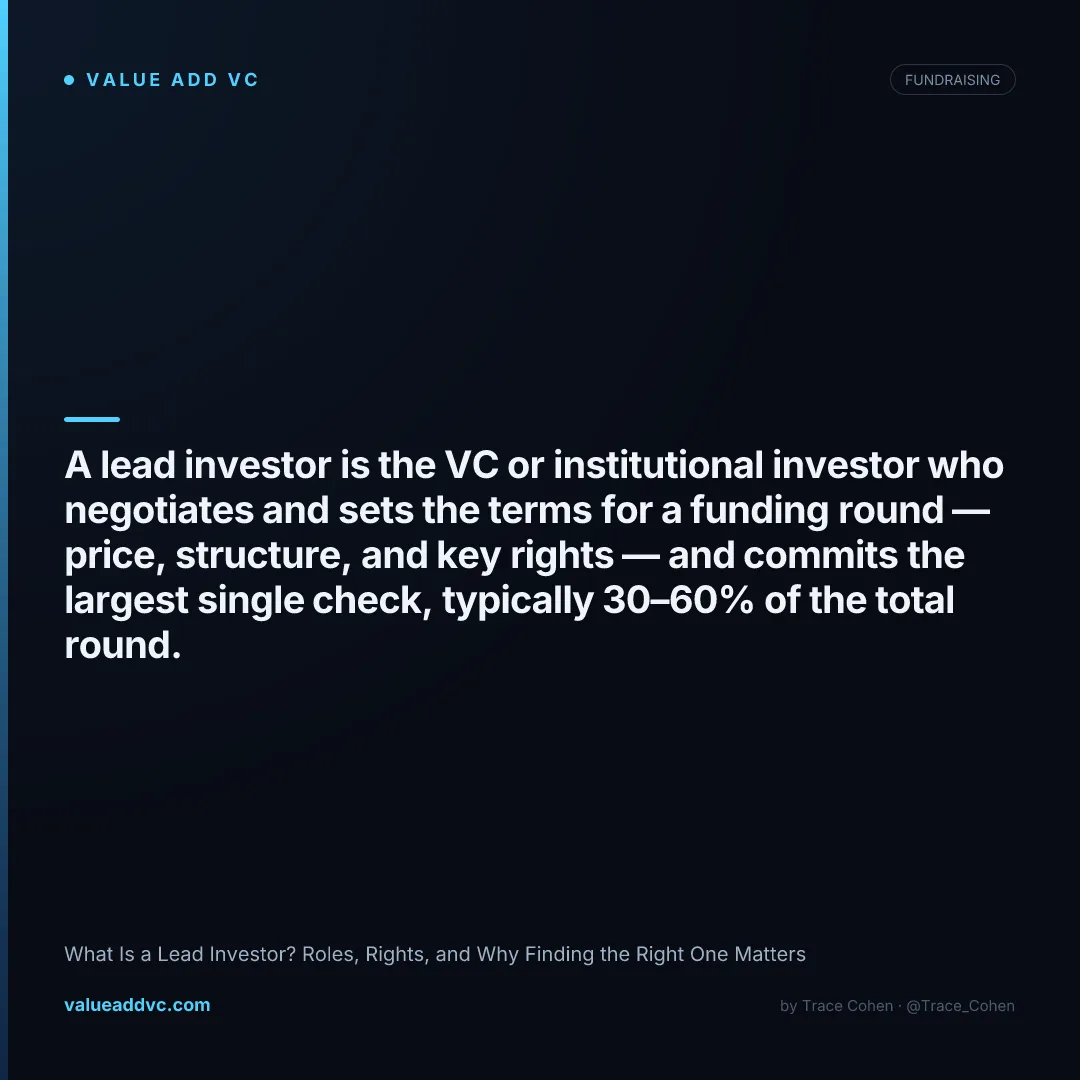
A lead investor is not just the biggest check in the round. They are the person who makes the round happen at all.
When VCs say a round is "led by" Sequoia or a16z, what they mean is that firm negotiated the valuation, wrote the term sheet, did the primary due diligence, and committed capital before anyone else. Every other investor in that round looked at the lead's conviction and decided whether to follow. If you want to understand what goes into that term sheet and how to negotiate it effectively, read our full breakdown.
This is why "what is a lead investor" is the wrong question for most founders. The right question is: what do I have to give them to get them — and is it worth it?
What a Lead Investor Actually Does
Lead investors take on work that follow-on investors explicitly don't. That labor is why they get better economics.
Sets the price
Valuation is negotiated between founder and lead. Follow-ons take it or leave it.
Writes the term sheet
Board composition, liquidation preferences, pro-rata, information rights — the lead drafts all of it.
Conducts primary diligence
Reference calls, legal review, financial model scrutiny. Typically 50–100 hours per deal.
Takes a board seat or observer rights
Series A+ leads almost always take a board seat. Seed leads often take observer rights.
Signs off on the closing documents
The lead's counsel drives the SPA, IRA, and shareholders agreement. Everyone else co-signs.
Manages the investor relationship long-term
Board attendance, strategic intros, follow-on capital decisions — all flow through the lead.
What Rights Does a Lead Investor Get?
Lead investors negotiate for rights that protect their position and give them structural advantages follow-on investors don't get. Most of these are encoded in the Investors' Rights Agreement (IRA) signed at closing.
The right to invest in future rounds at the same terms to maintain ownership percentage. At Series A, leads typically get full pro-rata. At seed, meaningful pro-rata (>$500K check) is increasingly common.
Series A leads almost always take a board seat. This gives them voting rights on major decisions: selling the company, issuing new equity, executive hiring and firing.
Audited annual financials, monthly management accounts (often), and quarterly investor updates. Standard for any investor over $500K at seed, near-universal at Series A+.
Anti-dilution protection, right of first refusal on secondary sales, and approval rights over certain material transactions. Reserved for investors above a threshold (typically 1% ownership or $1M invested).
Broad-based weighted average anti-dilution is standard. Full ratchet (much more punishing for founders) is rare but exists in downside negotiations. See our anti-dilution guide for the mechanics.
Lead Investor Economics by Stage
The economics of what a lead investor expects — check size, ownership target, valuation — change dramatically by stage. Here's what the 2025 data shows.
| Stage | Typical Lead Check | Target Ownership | Board Seat? |
|---|---|---|---|
| Pre-Seed | $200K–$750K | 5–8% | Rarely (observer) |
| Seed | $1M–$2.5M | 8–15% | Sometimes (observer or full) |
| Series A | $7–12M | 15–25% | Almost always |
| Series B | $15–30M | 12–20% | Always |
Source: Carta 2025 State of Private Markets; PitchBook Q4 2025 venture data.
Why the Lead Investor Matters More Than the Round Size
Founders close $5M rounds with a bad lead and struggle for two years because the board dynamics were wrong. Other founders close $1M seeds with a legendary lead who unlocks their Series A on signal alone.
The lead investor signal is underrated in three specific ways:
Future fundraising
Every Series A investor will ask who led your seed and what they think. A seed lead from Benchmark or First Round opens rooms that an SPV syndicate doesn't. The brand of your first institutional backer compounds.
Board dynamics
Board composition is determined at the lead stage. A bad board member — one who micromanages, leaks information, or blocks decisions — is nearly impossible to remove. Choose the person, not just the capital.
Follow-on signaling
When your Series A comes around, your seed lead either participates (bullish signal) or passes (red flag). Sophisticated Series A investors watch this. A lead who doesn't follow on forces you to explain why.
How to Find and Convert a Lead Investor
The mechanics of finding a lead investor are well-known but poorly executed. Here's what actually moves the needle.
Run a tight 8–12 week process. Leads feel urgency when they sense competitive pressure. A process that drags over six months signals weak demand. Start conversations, build momentum, and create a closing window.
Get warm intros through portfolio founders. Cold email-to-term-sheet rates are below 1% at top-tier funds. The fastest path is a founder they've already backed saying "this team is the real deal." Build those relationships before you're fundraising.
Target 30–50 VC conversations in parallel. You need enough surface area to find the one or two who will lean in. Most VCs will pass — that's not a signal about your company, that's the math of VC portfolio construction.
Understand what makes a lead say yes. Leads need to believe: (1) this is a large enough market to return the fund, (2) this team can capture it faster than anyone else, and (3) now is the right time. Miss any of the three and they'll pass regardless of traction.
Use angels and angels to create pull. Having two or three credible angels committed to a seed round — even at $100K each — creates pressure for an institutional lead to move. "We have $700K soft-circled" changes conversations more than a perfect pitch deck.
Track the funds actively deploying into your stage and sector using the VC Funds Dashboard — knowing who has dry powder and recently led rounds in your space significantly improves targeting.
Lead Investor vs. Follow-On Investor: The Practical Difference
Lead Investor
- ✓ Negotiates valuation and term sheet
- ✓ Commits before others confirm
- ✓ Conducts deep primary diligence
- ✓ Takes board seat or formal observer rights
- ✓ Gets pro-rata and major investor rights
- ✓ Drives legal documentation process
Follow-On Investor
- → Accepts the lead's terms
- → Commits after lead is confirmed
- → Does lighter reference and diligence
- → No board seat (usually)
- → Limited or no pro-rata rights
- → Signs the same documents as the lead
Finding a lead investor is not about pitching hundreds of VCs.
It's about finding two or three who have the conviction to move first — and giving them a reason to before anyone else does.
Track active VC funds and recent rounds on the VC Funds Dashboard at Value Add VC. Originally published in the Trace Cohen newsletter.
Latest from the Pulse
Get VC data most people never see
— free to subscribe
Trace's notes on venture, AI and startups, a few times a week. Join 5,000+ subscribers. No spam.