A bridge round is one of the most misunderstood financing events in startup life. It is not a failure. It is not a rescue. It is a timing instrument — and how you use it determines everything.
About 35–40% of venture-backed startups raise at least one bridge round between their seed and Series A, per Carta data. The median bridge is $750K, closes in 4–6 weeks, and is led entirely by existing investors. Understanding what a bridge round is — and what it signals — is foundational knowledge for any founder approaching the end of a runway cycle.
Bridge Round Definition
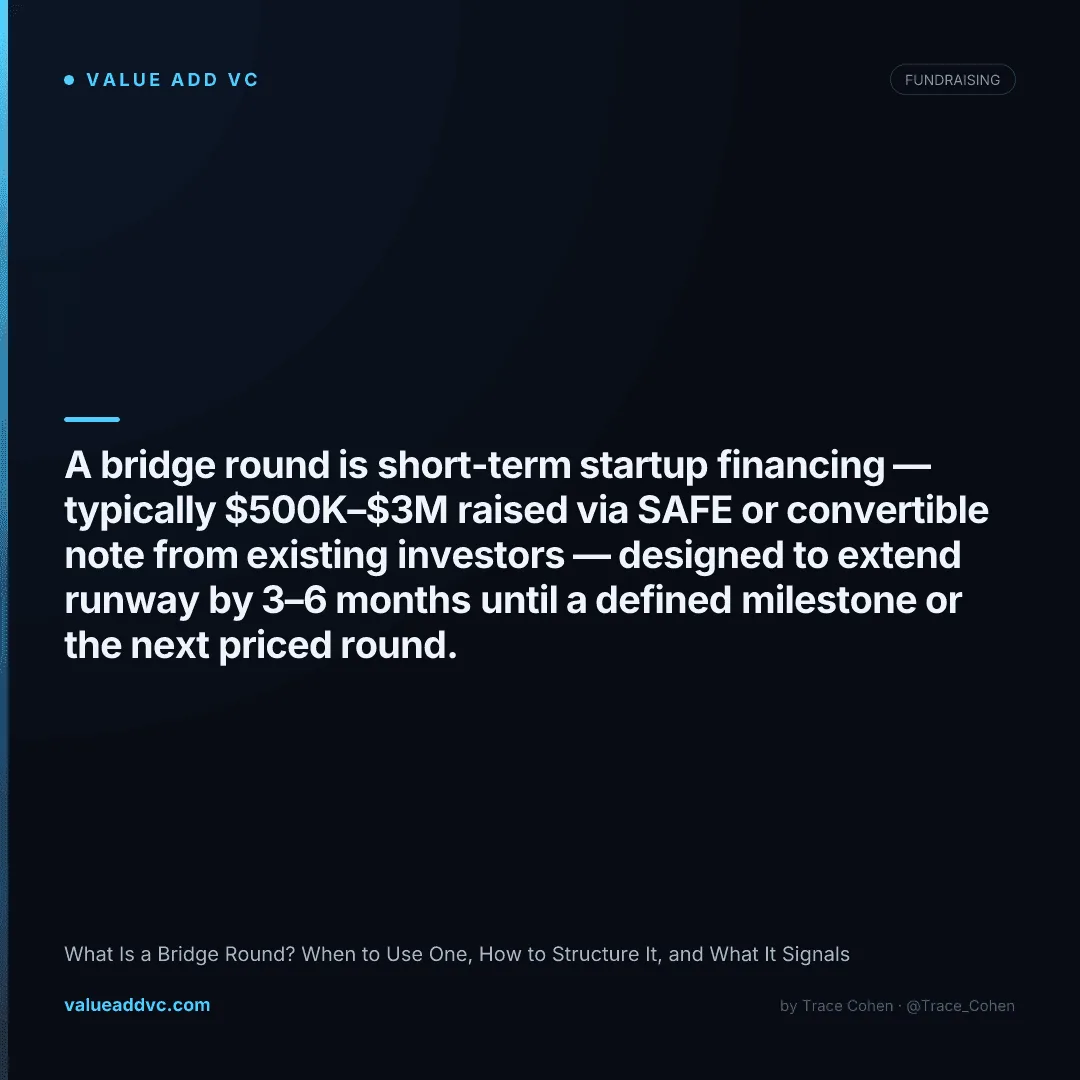
A bridge round is short-term financing raised between two larger priced rounds, designed to extend a startup's runway by 3–6 months to a specific milestone. The word "bridge" is literal: it bridges the company from where it is today to where it needs to be to raise the next institutional round at better terms.
Typical size
$500K–$3M
Median is ~$750K per Carta 2024
Instrument
SAFE or convertible note
Rarely a priced round for pure bridges
Timeline
3–6 months
Runway extension target
When a Bridge Round Makes Sense
The right time to raise a bridge is narrow. Too early and you dilute unnecessarily; too late and you negotiate from desperation. The ideal window is when you have 2–4 months of runway, a specific identifiable milestone within reach, and existing investors who believe in the path forward.
You need one more data point before a Series A
Example: 3 months to hit $1M ARR from $700K. Bridge buys that time without a premature priced round.
The fundraising market is temporarily closed
Q4 2022 and Q1 2023 saw many bridges as institutional capital froze. Timing risk is real.
A key enterprise pilot is closing in 60 days
A signed enterprise contract can add $2–5M to your Series A valuation. The bridge math works.
You missed your growth targets and need more time
More runway does not fix a broken growth rate. Series A investors will see through this.
Churn is high and you need time to fix retention
Retention problems are structural. Bridging to a retention fix that may not come is high-risk.
How Bridge Rounds Are Structured
The vast majority of bridge rounds use one of two instruments. The choice depends on your jurisdiction, existing cap table complexity, and investor preference.
SAFE (Simple Agreement for Future Equity)
- • No maturity date — converts at the next priced round
- • Valuation cap set at or near last post-money
- • MFN clause common for first-money-in bridges
- • No interest accrual
- • Most founder-friendly for short bridges
Convertible Note
- • Has maturity date (typically 12–24 months)
- • Carries interest rate (6–8% annually)
- • Converts at a discount to the next priced round (15–20%)
- • May have a valuation cap in addition to discount
- • Preferred by investors wanting legal protection
Key Terms to Negotiate
| Term | Typical Range | Founder Concern |
|---|---|---|
| Valuation cap | Last round post-money or 10–20% above | Cap too low = excessive dilution at Series A |
| Discount | 15–20% off next priced round | Stacks with cap — avoid both when possible |
| Interest rate | 6–8% annually (notes only) | Accrues — matters if round takes 18+ months |
| MFN clause | Standard on pre-money SAFEs | Gives early investors same terms as later ones |
| Maturity date | 12–18 months (notes) | Short maturities create repayment pressure |
What a Bridge Round Signals to Investors
Every Series A investor who looks at your cap table will see your bridge. The SAFE or convertible note is right there. What matters is the narrative you build around it — because the instrument alone does not tell the story.
The best bridge framing I see from founders: "We raised a $1.2M bridge from our full existing syndicate to reach $1M ARR before our Series A. We hit that milestone in month four." That framing signals discipline, investor confidence, and milestone orientation.
The worst framing: "We needed a little more time." That tells an incoming investor nothing about what you were trying to achieve or whether you achieved it.
Signals Strength
- ✓ All existing investors participated pro-rata
- ✓ Bridge tied to a specific, measurable milestone
- ✓ Milestone was actually hit on the bridge runway
- ✓ Terms at or above last round's valuation cap
- ✓ Amount is proportionate to the runway gap (not a lifeline)
Signals Weakness
- ✕ One or more existing investors passed on the bridge
- ✕ Bridge is at a lower cap than the last round (down-bridge)
- ✕ No defined milestone — just "extending runway"
- ✕ Multiple bridges in a row with no priced round
- ✕ Bridge includes outside investors at a discount to current investors
Bridge Round vs Extension Round: What's the Difference?
These terms are often used interchangeably, but technically they are different instruments. An extension round adds capital into an existing priced round at the same share class and price — it is literally the same round with more participants or more capital from existing investors. A bridge is a new instrument (SAFE or note) that converts into the next round.
From a signaling standpoint, an extension is cleaner — it implies you had demand to fill and structured it neatly. A bridge implies you needed interim capital. Neither is inherently negative, but know which one you are doing before you start term negotiations.
The Bridge Round Process: Step by Step
Identify the milestone
Be specific. '$1M ARR,' 'signed enterprise contract with Fortune 500,' or 'FDA clearance filed' are real milestones. 'More traction' is not a milestone.
Calculate the capital needed
Take your monthly burn, multiply by the runway you need (3–6 months), add a 20% buffer. That is your bridge target. Don't raise more than you need — excess bridge capital is pure dilution.
Go to existing investors first
Lead with your largest, most supportive investors. Their participation gives you social proof with anyone new. If your lead investor passes, that is a serious signal you need to address before going broader.
Agree on terms
SAFE with a cap at last post-money is the path of least resistance. If investors push for notes, negotiate the maturity date (18+ months minimum) and cap structure carefully.
Close quickly
Bridge rounds should close in 2–4 weeks. If you are still negotiating at week six, something is wrong with either the terms or the investor conviction.
Execute on the milestone
This is the only part that actually matters. Raising the bridge is the easy part. Hitting the milestone is why the bridge existed.
Bridge Round Math: What Does Dilution Actually Look Like?
Founders underestimate bridge dilution because the instrument converts later. But the dilution is real — it just shows up at Series A closing. Here is how it stacks:
Example: $1M Bridge at $8M Cap, Converting into a $10M Pre-Money Series A
Track your full cap table and dilution stack at the SPV and fund data dashboard or model your round on the benchmarking tool.
A bridge round is not a rescue. It is a precision instrument.
Used with a specific milestone, full investor conviction, and clean terms, it is a disciplined capital decision. Used to delay a hard conversation about product-market fit, it is expensive runway that leads to the same outcome — just later and with less leverage.
Track venture funding rounds and emerging manager activity at Value Add VC. Model your fundraise structure and cap table dynamics with the benchmarking dashboard. Originally published in the Trace Cohen newsletter.
Latest from the Pulse
Get VC data most people never see
— free to subscribe
Trace's notes on venture, AI and startups, a few times a week. Join 5,000+ subscribers. No spam.