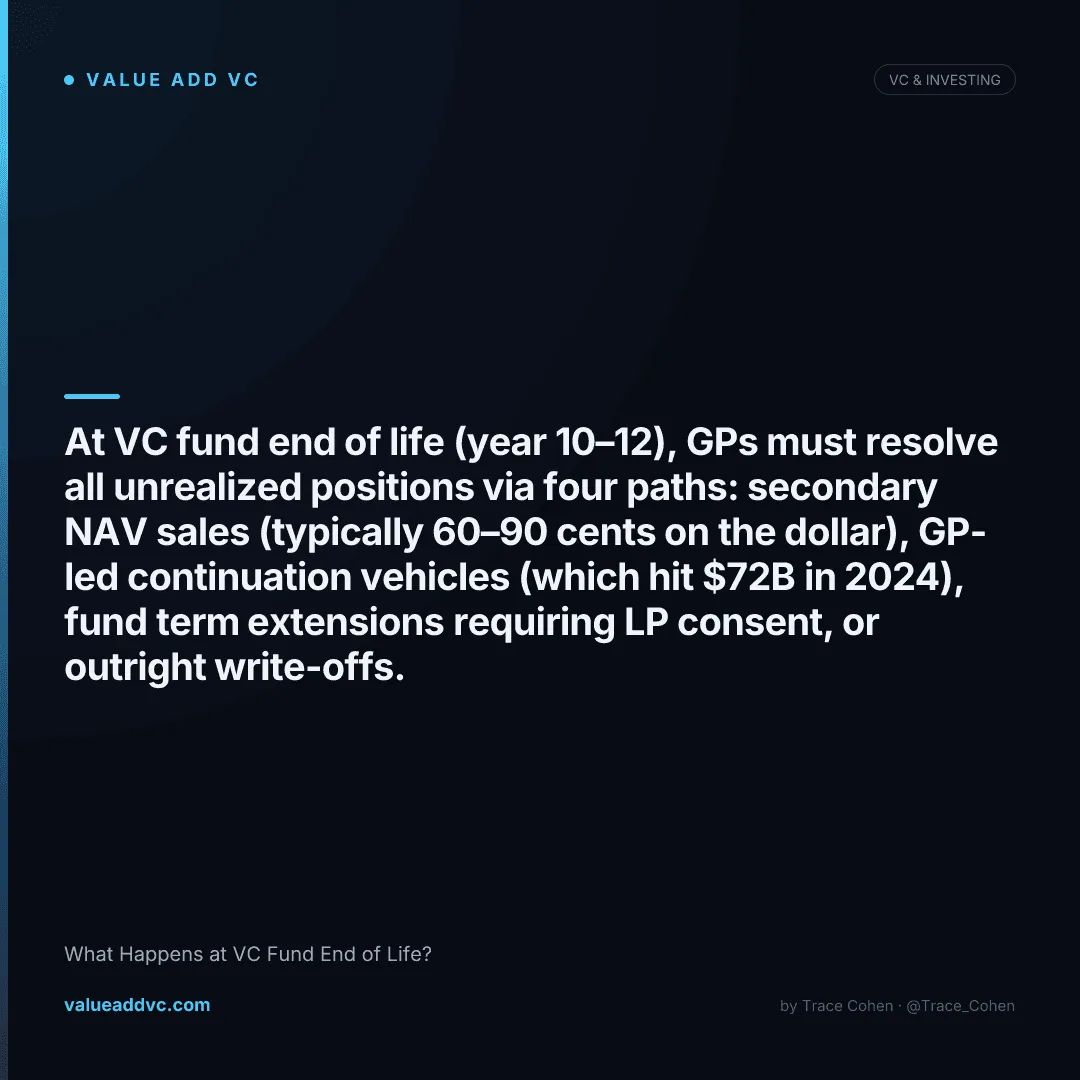
A standard VC fund has a 10-year life with up to two 1-year extensions. When that clock expires, every unrealized position must be resolved — and the process looks nothing like the tidy waterfall charts in the LPA.
Most LPs never think about fund end of life until they get the call from their GP. By then, options are limited. Understanding what happens — and when — gives both GPs and LPs the leverage to make better decisions before it becomes a forced liquidation.
The Standard VC Fund Lifecycle
Most fund LPAs follow a predictable structure, even if the underlying portfolio rarely does:
Investment Period
Deploying capital across new investments; follow-on reserves held back
Late Deployment + Portfolio Support
Final new investments; pro-rata reserves deployed in top performers
Active Portfolio Management
Supporting companies toward exit; marking positions; beginning distributions from early exits
Wind-Down Mode
Maximizing exit timing; preparing tail-end positions for secondary sale or continuation
Fund End of Life
Resolving all remaining positions; final distributions; carried interest calculations
The Distribution Waterfall Explained
When distributions flow — whether from an IPO, acquisition, or secondary sale — they move through a contractual priority stack before the GP sees a dollar of carry. Most US VC funds use a whole-fund waterfall (rather than deal-by-deal), which means the GP waits until LPs are fully made whole before taking carry.
Return of Capital
All contributed capital returned to LPs before any carry is calculated. This includes management fees in some fund structures.
Preferred Return (Hurdle)
LPs receive a cumulative 8% annual return on invested capital before carry kicks in. Not all funds include this — seed funds often skip it.
GP Catch-Up
Once the hurdle is met, the GP catches up until they hold 20% of total profits. This tier disappears quickly in practice on strong-performing funds.
Carried Interest
All remaining profits split 80/20. Some top-tier funds negotiate 25–30% carry for top-performing vintages.
Four Paths for Unrealized Positions at VC Fund End of Life
When a fund hits its term limit, every company still on the cap table needs a resolution. GPs typically use a combination of these four mechanisms:
1. Secondary NAV Sale
Selling LP interests or direct positions to secondary buyers. Typical pricing: 60–90 cents on the dollar for quality assets, 10–40 cents for tail-end positions. The $120B+ secondary market (2024 data, PitchBook) has made this the default resolution for most unrealized assets.
2. GP-Led Continuation Vehicle
The GP creates a new vehicle to hold 1–3 highest-quality remaining assets. Existing LPs elect to roll in or cash out at a third-party NAV. Global CV volume hit $72B in 2024 (Jefferies data). Pricing at 90–100 cents on NAV signals strong asset quality.
3. Fund Term Extension
GPs request LP consent to extend the fund 1–2 years beyond the standard term. Most LPAs permit this with majority LP approval. Extensions delay the DPI clock and frustrate LPs who needed liquidity — which is why CVs have largely replaced simple extensions for quality assets.
4. Write-Off
Companies with no viable exit path — the 25–40% of VC portfolios that become zombies — are written down to $0 or sold for nominal consideration (1–5 cents on dollar). This is the tax-efficient outcome for LPs (capital loss) but a silent loss for founders who stayed at stagnant companies.
What GPs Get Wrong at Fund End of Life
Having sat on both sides of this conversation — as a founder, as an LP, and as a fund manager — the mistakes I see most often are timing and transparency failures:
- →Waiting until year 11 to address tail-end positions, when secondary buyers know you're forced and discount accordingly
- →Continuing to collect management fees on a near-zero-NAV fund while LPs wait for resolution (creates serious LP relationship damage)
- →Underestimating zombie company count — most GPs are still carrying 3–5 companies they privately know will never exit
- →Choosing extensions instead of CVs because they're cheaper administratively, despite LPs uniformly preferring the CV structure
- →Failing to model clawback risk: if early distributions exceeded the final carry entitlement, GPs must return the difference — a cash flow shock most first-time managers aren't prepared for
Track current fund performance metrics and DPI trends across vintage years on the VC Performance Dashboard and Fund Benchmarking tool at Value Add VC.
What LPs Should Do in Years 8–10
As an LP in a fund approaching end of life, you have more leverage than most people realize — but only before the GP starts the wind-down process. By year 10, your options narrow fast.
Actions to Take Now
- ✓ Request full position-by-position NAV breakdown
- ✓ Ask GP directly about CV plans for top 2–3 assets
- ✓ Check secondary market pricing for your fund interest
- ✓ Review LPA for clawback provisions before final distributions
Red Flags to Watch For
- ✕ GP still marking zombie companies at original cost
- ✕ Management fees continuing on a fund with <5% RVPI
- ✕ No communication about tail-end resolution plan
- ✕ Extension requests without a defined exit timeline
The real measure of a VC fund isn't TVPI at year five.
It's DPI at year twelve — how much cash actually came back to LPs after every zombie was written off and every tail-end asset was resolved.
Compare VC and PE fund performance metrics on the VC/PE Performance Dashboard at Value Add VC. Originally published in the Trace Cohen newsletter.
Latest from the Pulse
Get VC data most people never see
— free to subscribe
Trace's notes on venture, AI and startups, a few times a week. Join 5,000+ subscribers. No spam.