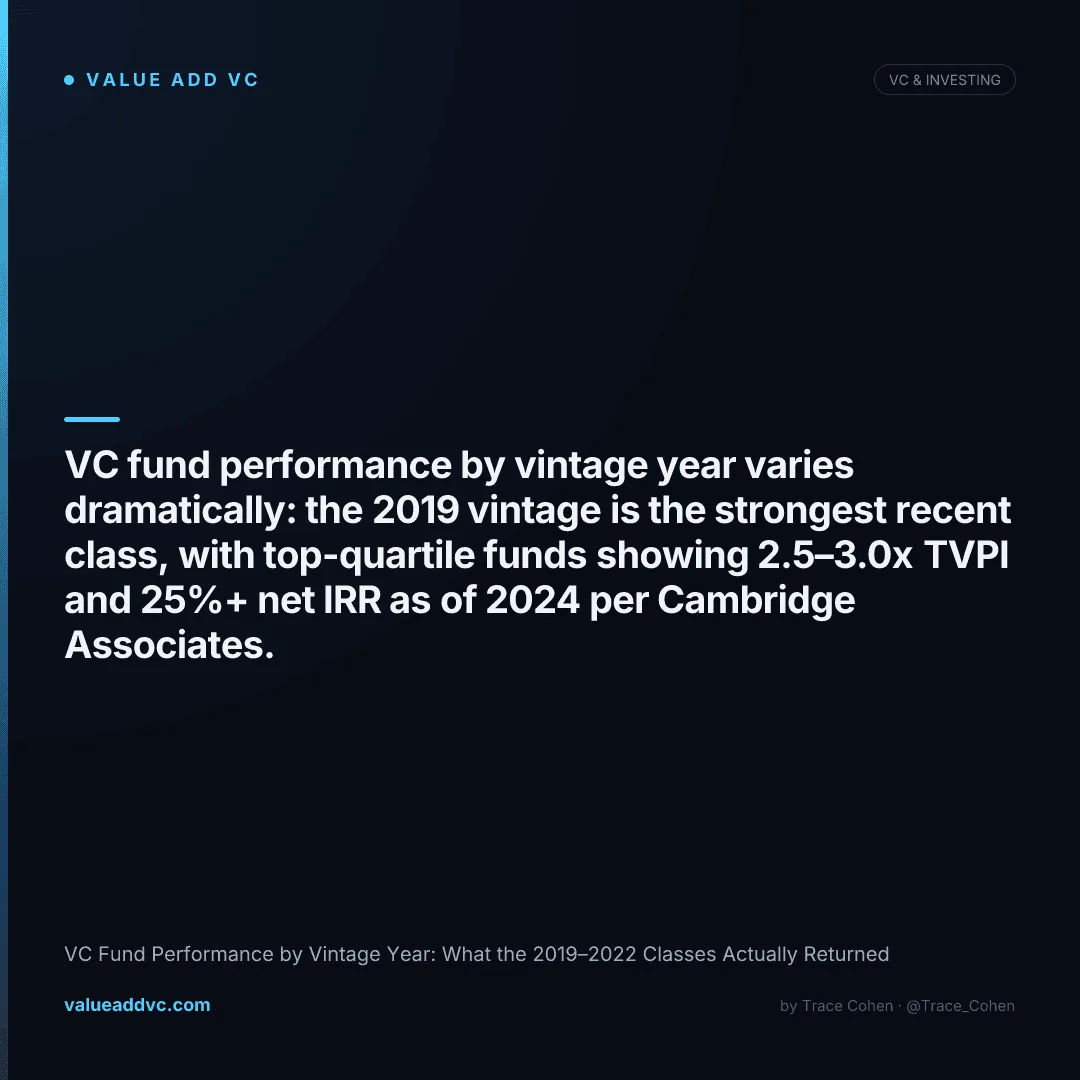
The 2021 vintage is a disaster. The 2019 vintage is a standout. The difference has almost nothing to do with manager skill — and almost everything to do with what you paid.
Vintage year is the most underappreciated variable in venture capital. LPs obsess over manager brand, thesis, and team. But if you invested at 20x ARR multiples in 2021, you were playing a fundamentally different — and much harder — game than someone who deployed at 7x ARR multiples in 2019. The 2021 class has to produce exits 3x larger just to match 2019 returns at the same underlying business performance.
I've sat across from LPs who can't figure out why their "best" manager's 2021 fund is underperforming their "mediocre" manager's 2019 fund. The answer is almost always vintage. Here's the data. (For a primer on interpreting these numbers, see how to read a VC fund performance report.)
VC Fund Performance by Vintage Year: The Benchmarks
The table below summarizes Cambridge Associates and Preqin benchmark data on venture capital returns by vintage year. Note that earlier vintages are more mature and show higher DPI; recent vintages are still early in their J-curve.
| Vintage Year | Median TVPI | Top-Quartile TVPI | Median DPI | Net IRR (median) |
|---|---|---|---|---|
| 2015 Mature | 2.4x | 4.1x | 1.8x | 21% |
| 2016 Mature | 2.1x | 3.5x | 1.4x | 18% |
| 2017 Late stage | 1.9x | 3.2x | 0.9x | 16% |
| 2018 Mid stage | 1.7x | 2.8x | 0.6x | 14% |
| 2019 Mid stage | 1.5x | 2.7x | 0.4x | 12% |
| 2020 Early stage | 1.3x | 2.1x | 0.2x | 9% |
| 2021 Early / impaired | 0.95x | 1.4x | 0.05x | –4% |
| 2022 Very early | 1.0x | 1.5x | 0.03x | 2% |
Source: Cambridge Associates, Preqin, and public LP disclosures as of Q4 2024. Numbers are approximations — actual fund-level performance varies widely within each vintage.
As of H1 2025 benchmark updates, the broad picture holds: top-quartile 2019 vintage funds are tracking roughly 2.9x TVPI with 25%+ net IRR, the 2021 vintage median sits around 1.1x TVPI with top-quartile near 1.6x, and the 2022 vintage remains too early to call (top-quartile around 1.3x, IRR not yet meaningful). The 2018 vintage — slightly more mature — shows top-quartile TVPI of roughly 3.1x and 27%+ net IRR, per Cambridge Associates, Preqin, and Carta benchmarks.
The Four Benchmarks Behind the Table: IRR, TVPI, DPI, and RVPI
Before reading any vintage table, it helps to be precise about what each metric measures — and where each breaks down. Every serious LP reads these four together.
| Metric | What It Measures | Top Quartile Target | Median |
|---|---|---|---|
| Net IRR | Time-weighted return net of fees & carry | 25%+ by year 10 | 12–15% |
| TVPI | Total value (realized + unrealized) / paid-in | 3.0x+ | 1.5–1.8x |
| DPI | Actual cash returned to LPs / paid-in | 2.0x+ by year 10–12 | 0.8–1.2x |
| RVPI | Remaining portfolio value / paid-in | Declining as DPI rises | Varies widely |
Source: Cambridge Associates, Carta State of Private Markets 2024, Preqin benchmarks
These full-maturity targets explain why the vintage table above looks "low" for recent classes: a 2019 fund at 2.7x top-quartile TVPI in year five is on pace for the 3.0x+ full-life standard, while a 2021 fund at 1.4x is not. IRR is also the easiest of the three to game — dividend recaps and early secondary sales boost it disproportionately — which is why LPs always pair it with TVPI and, ultimately, DPI. Our 2026 update on median and top-quartile fund performance walks through how those targets have moved since this table was built.
Why the 2019 Vintage Is the Standout Class
The 2019 vintage had the fortune of deploying at rational multiples — SaaS was trading at 8–12x ARR in private markets — and then watching those same companies get marked up 2–3x in the 2020–2021 bull run, often within 12–18 months of initial investment. A $15M post-money Seed that became a $50M Series A became a $200M Series B by 2021. That's not genius. That's multiple expansion.
But the paper gains were real enough: top-quartile 2019 vintage funds are now tracking 2.5–2.7x TVPI as of late 2024, per Cambridge Associates. And critically, the underlying companies in those portfolios built real products and real revenue before the market turned — so many are still standing and on a path to eventual exit, even if timelines stretched.
The DPI story is a caveat: even strong 2019 vintage funds are only showing 0.3–0.5x DPI. The IPO window closed in 2022 and hasn't reopened at the volume needed to generate real distributions. The TVPI is real but the cash isn't yet. This is exactly why DPI is the metric LPs care about most.
The 2021 Vintage Problem: Buying the Top
2021 was the most capital-deployed year in VC history. Global venture investment hit $621B according to Crunchbase. Seed round pre-money valuations averaged $14–16M. Series A medians crossed $50M post-money. SaaS multiples in private markets hit 25–40x ARR on high-growth companies.
Avg. Seed Pre-Money (2021)
$14–16M
vs. $7–9M in 2019
Avg. Series A Post-Money (2021)
$50M+
vs. $25–35M in 2019
Peak SaaS Multiple (private, 2021)
25–40x ARR
vs. 8–12x in 2019
Global VC Deployed (2021)
$621B
2x the 2019 total
By 2023, those marks had been cut 40–70%. A company that raised at a $150M Series A in 2021 was raising a flat or down round at $100–120M in 2023 — if it could raise at all. The median 2021 vintage fund sits at approximately 0.9–1.0x TVPI as of late 2024. That means LPs are, at best, slightly above breakeven on paper — with no DPI and a 10-year lockup still in play. The structural forces behind this are explored in depth in the real reason venture returns are compressing.
The 2020 and 2022 Vintages: Two Different Stories
2020 Vintage: The Lucky Timing Class
Funds that deployed in early 2020 — often at discounted prices due to COVID uncertainty — then watched valuations explode in late 2020 and 2021. Some 2020 vintage funds caught both the dip and the rip.
But funds that deployed in Q3–Q4 2020 increasingly paid 2021-style prices. The vintage is bifurcated: the top half looks like 2019, the bottom half looks like 2021.
2022 Vintage: Contrarian Opportunity?
The 2022 vintage deployed into the correction. SaaS multiples had already compressed from 25x to 6–8x ARR. Seed pre-money valuations fell back to $8–10M. For disciplined managers, 2022 may prove to be the best buying opportunity since 2015–2016.
It's too early to tell — the 2022 vintage is still in early J-curve. But the entry price math is favorable if the AI wave produces exits in the next 3–5 years.
What LPs Should Use This Data For
Vintage-year benchmarking is the most defensible way to evaluate whether your fund manager actually outperformed — or just benefited from market timing. A 2019 vintage fund at 2.0x TVPI is underperforming; a 2021 vintage fund at the same 2.0x TVPI is a massive outperformer relative to its peers.
The tools that matter here are Cambridge Associates (the institutional gold standard, covering 1,800+ VC and PE funds), Preqin (best for cross-asset-class and vintage cohort analysis), Burgiss/MSCI (strongest on public market equivalent calculations), Carta's State of Private Markets (the best freely available data for seed-stage and emerging managers), and public LP disclosure databases like those from CalPERS, Washington State, and the University of Texas Investment Management Company. These sources publish fund-level data that lets you construct peer cohorts. For a full guide to sourcing this data, see where to find VC fund performance data.
The most sophisticated LPs benchmark in three layers. First, same-vintage, same-stage quartile comparison. Second, Public Market Equivalent (PME) analysis — comparing the fund's actual capital calls and distributions against what those cash flows would have returned in the S&P 500 or Russell 2000. Only the top quartile of VC funds consistently posts a PME above 1.2x, per Cambridge Associates; the median fund has historically trailed public markets net of fees. Third, GP-specific attribution: was the return one outlier position, or a repeatable portfolio construction thesis?
You can explore aggregated VC performance benchmarks on the VC Performance dashboard and compare across fund types on the VC vs. PE Performance tracker at Value Add VC.
The uncomfortable truth about VC fund performance:
The best funds in a bad vintage still lose to mediocre funds in a great vintage. Entry price is not everything — but it's close.
Before attributing a fund's underperformance to bad picks or weak operators, run the vintage-year comp. If the entire 2021 class is sitting at 0.9–1.0x TVPI, a fund at 1.3x might be the best in class — even if it still looks bad on an absolute basis.
Explore VC fund benchmarks and vintage-year performance data on the VC Performance Dashboard at Value Add VC. Originally published in the Trace Cohen newsletter.
Latest from the Pulse
Get VC data most people never see
— 100% free
Weekly benchmarks, valuations, and fund data. Join 5,000+ investors. No spam.