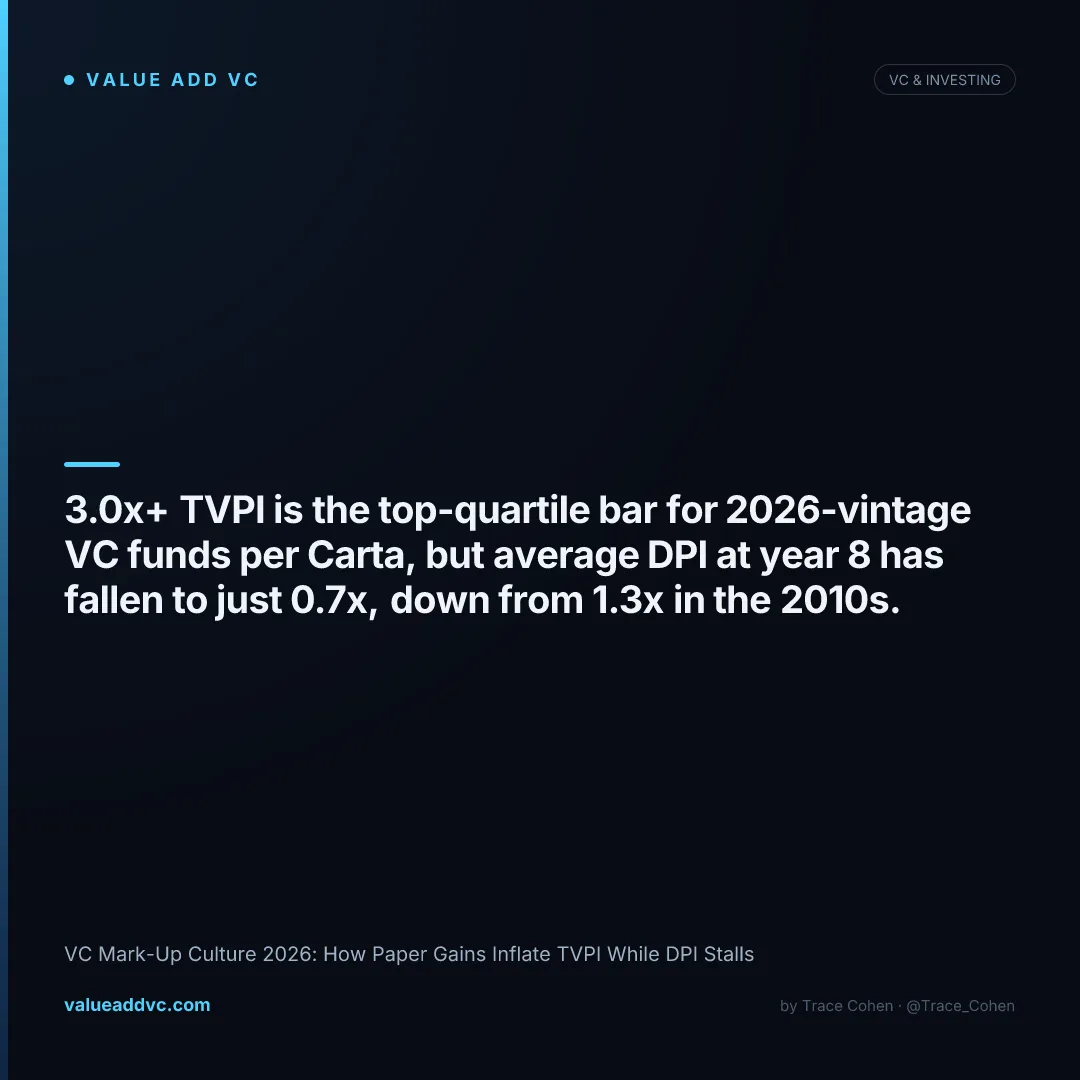
Average VC fund DPI at year 8 has fallen to 0.7x in 2026, down from 1.3x for 2010s-era funds — even though median TVPI climbed to 1.1x in Q1 2026. That's the short answer. The longer answer is that venture capital has built an entire reporting culture around a number that doesn't require anyone to actually get paid.
Every quarter, LPs open their capital account statements and see a TVPI number that's gone up. Almost none of that increase is cash. It's a mark-up — a paper adjustment to the carrying value of a portfolio company, usually triggered by someone else's new funding round, not by a sale. In 2026, the gap between what funds report as "value" and what they actually pay out has become the single biggest credibility problem in venture reporting, and LPs have started pricing it in.
Figures are 2026 estimates blended from Carta VC Fund Performance (Q1 2026), PitchBook-NVCA Venture Monitor, and ILPA. TVPI and DPI are median figures across tracked institutional VC funds.
What Is VC Mark-Up Valuation and Why Do Paper Gains Distort Performance?
VC mark-up valuation is the practice of raising a portfolio company's carrying value on a fund's books whenever that company closes a new round at a higher price, even though the fund holding the earlier position hasn't sold a share or received a dollar. That paper gain flows straight into TVPI, the metric most GPs lead with, while DPI — the cash LPs have actually received — stays flat until an IPO, acquisition, or secondary sale actually happens.
This isn't fraud or even unusual — it's standard fair-value accounting under ILPA and AICPA guidance, which instructs GPs to mark positions to the price of the most recent priced round. The distortion isn't in the accounting rule itself. It's in how mark-ups get communicated: a fund reporting 2.5x TVPI in a quarterly letter reads, to most LPs, as "we're up 2.5x," when the accurate read is closer to "on paper, assuming every unrealized position eventually sells at its last mark, we'd be up 2.5x."
The TVPI-DPI Gap: How Wide the Mark-Up Culture Has Made It
The numbers make the gap concrete. Carta's Q1 2026 VC Fund Performance report shows median net TVPI climbing for nearly every vintage tracked from 2017 through 2024, with the 2021 and 2022 vintages both reaching roughly 1.02x. That sounds like recovery. But average DPI at year 8 has dropped to about 0.7x in 2026, down from roughly 1.3x for funds of the same age raised in the 2010s — meaning a fund the same age today returns, on average, roughly half the cash a comparable 2010s fund did.
The 2019 and 2020 vintages are the starkest examples: median DPI for both is still barely above zero, and per PitchBook-NVCA data, less than half of all funds in those vintages have returned any capital to LPs at all. Only the 2017 and 2018 cohorts — old enough to have caught the 2020-2021 exit window — show meaningful DPI. Everything raised since is mostly TVPI, mostly marks, mostly unrealized.
Some of this is cyclical rather than a mark-up problem specifically: 2021-vintage funds have taken 30-50% markdowns from peak valuations as the 2022 correction worked through portfolios, with bottom-quartile 2021 funds sitting at just 0.6x TVPI. But the direction of travel — marks moving up again in 2026 even as realized cash stays flat — is exactly the dynamic that makes LPs distrust headline TVPI numbers on their own.
VC Fund Performance by Vintage Year: TVPI vs. DPI, 2017-2024
| Vintage Year | Median Net TVPI | Median Net DPI | % of Funds Returning Any Capital | Status in 2026 |
|---|---|---|---|---|
| 2017 | 1.9x | 1.1x | >75% | Mature, cash-generative |
| 2018 | 1.7x | 0.9x | >65% | Mature, cash-generative |
| 2019 | 1.4x | ~0.1x | <50% | TVPI-heavy, DPI-light |
| 2020 | 1.3x | ~0.1x | <50% | TVPI-heavy, DPI-light |
| 2021 | 1.02x | ~0.05x | <35% | Post-correction, largely unrealized |
| 2022 | 1.02x | ~0.05x | <30% | Too young, mostly marks |
| 2023 | ~1.0x | ~0x | <15% | All paper, no distributions |
| 2024 | ~1.0x | ~0x | <10% | All paper, no distributions |
Figures are 2026 estimates blended from Carta VC Fund Performance (Q1 2026), PitchBook-NVCA Venture Monitor, and Ben Lakoff's fund-performance tracking. Later vintages' DPI figures are directional estimates given limited realized-exit data at this stage of fund life.
Why AI Valuations Are Making the Mark-Up Culture Worse in 2026
The mark-up problem is compounding because the rounds generating those marks have gotten larger and more concentrated. The average AI startup funding round hit $51 million in 2026 versus $4.7 million for non-AI deals — a 10.9x gap, up from 8.4x in 2024 — and OpenAI and Anthropic alone captured 43% of all global startup capital in the first half of 2026. Q1 2026 alone saw $300 billion in total startup funding, with 65% of it concentrated in just four deals.
That concentration means a small number of mega-rounds are now responsible for marking up a disproportionate share of the entire venture industry's TVPI. If a fund holds even a small stake in one of those four deals, its reported TVPI can jump sharply in a single quarter — without a single dollar of DPI changing. LPs underwriting new fund commitments are increasingly asking GPs to show what share of portfolio value sits in positions priced above 50x revenue, because those are the marks most likely to reverse rather than convert to cash. Our VC fund performance benchmarking tool tracks TVPI and DPI by vintage separately for exactly this reason.
How LPs Are Responding to the VC Mark-Up and Paper-Gains Problem
The clearest sign the market has caught on: DPI has overtaken IRR as the metric LPs say drives their re-up decisions, with 74% of institutional LPs now ranking realized distributions as their primary evaluation criterion, according to ILPA's 2024 survey. That's a reversal from the 2015-2021 era, when a strong markup-driven IRR alone was often enough to get an LP to commit to a GP's next fund sight unseen.
In practice, that means LPs are now asking GPs three questions before every re-up: what percentage of TVPI is actually DPI, how many portfolio positions are marked at their last round price versus a public comparable or independent valuation, and what's the realistic distribution timeline for the fund's top five marked-up positions. Funds raised between 2015 and 2018 that still haven't returned LPs' initial capital are facing the hardest version of these questions right now.
None of this means TVPI is useless — it's still the earliest read on whether a fund's underlying picks are working. But 2026 is the year the industry stopped treating TVPI and DPI as interchangeable, and started treating the gap between them as the actual story. Our VC and PE performance comparison data breaks out both metrics separately for exactly this reason — because reporting only one of them is how the mark-up culture got this far in the first place.
How VC Mark-Ups Affect GP Fees, Carry, and Fundraising Timing
Mark-ups aren't just a reporting quirk — they have real economic consequences for GPs, which is part of why the culture persists. Many fund documents calculate management fees off net asset value (NAV) rather than committed capital once the investment period ends, meaning a mark-up that lifts a fund's NAV can directly increase the fees a GP collects, even though no cash has actually come into the fund. Carry, by contrast, is almost always calculated on realized proceeds — but a fund showing a strong TVPI is also a fund that can point to "unrealized carry" when marketing its next vehicle to prospective LPs, which is exactly why GPs have limited incentive to mark positions down aggressively even when comparable public multiples have compressed.
Timing compounds this. A GP raising Fund III in 2026 wants Fund II's TVPI to look as strong as possible in the data room, and the fastest way to do that — short of an actual exit — is to lean on the most recent priced round for every position that has one. That's not manipulation under the accounting rules; it's the accounting rules working exactly as designed. But it does mean LPs evaluating a new fund should ask when the GP's existing portfolio was last marked, and against what — a Series C six months ago is a much stronger data point than a mark carried over from 2022.
Red Flags: How to Spot an Inflated TVPI Before You Re-Up
For LPs sizing up whether a fund's VC mark-up valuations reflect real progress or just paper gains, a handful of questions do most of the work. First, ask what percentage of TVPI is DPI — funds above roughly 30-40% at year 6-8 are converting marks into cash at a reasonable clip; funds near 0-10% are almost entirely unrealized. Second, ask how concentrated the marks are: a fund where two positions account for most of its TVPI above 1.0x is one bad down-round away from a materially different number. Third, ask how recently each major position was marked and at what basis — a mark from a round closed in the last two quarters is far more defensible than one carried forward from 2021 or 2022.
Fourth, compare the fund's DPI at a given fund age against the vintage-year benchmarks in the table above — a 2020-vintage fund with DPI meaningfully below the ~0.1x median for that cohort is lagging its peers, not just the market broadly. And fifth, watch for funds that stop reporting DPI prominently once TVPI becomes the more flattering number to lead with in quarterly letters; a shift in which metric gets top billing in a GP's own reporting is itself a signal worth asking about directly.
Bottom line: Median VC TVPI climbed to 1.1x in Q1 2026, but average DPI at year 8 has fallen to 0.7x, down from 1.3x in the 2010s — proof that today's reported gains are overwhelmingly paper, not cash. With 74% of institutional LPs now weighting distributions over IRR, GPs who can't show real DPI alongside their TVPI are going to have a harder time raising their next fund, no matter how good the marks look on a quarterly letter.
Latest from the Pulse
Get VC data most people never see
— free to subscribe
Trace's notes on venture, AI and startups, a few times a week. Join 5,000+ subscribers. No spam.