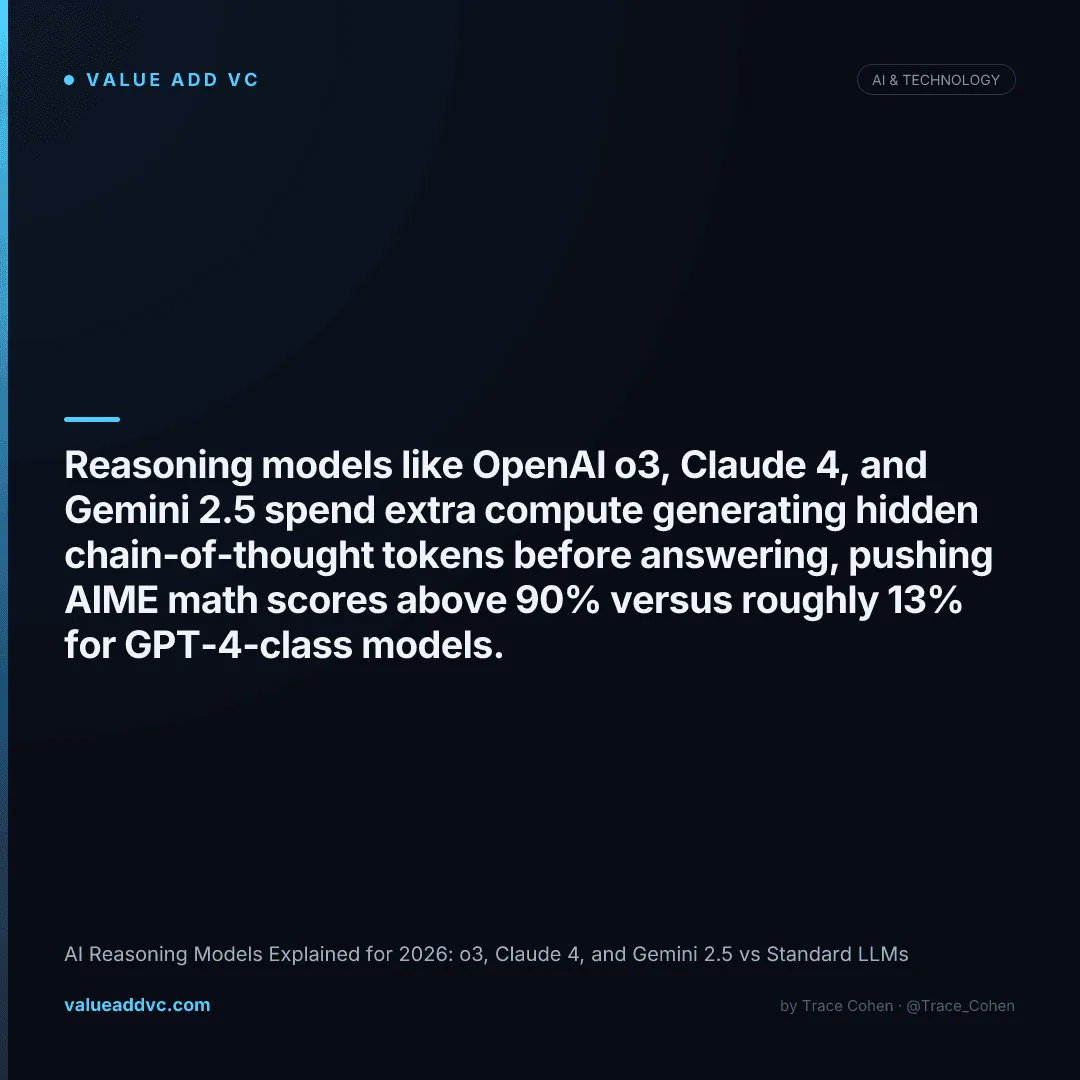
Reasoning models hit ~96% on AIME competition math in 2026 where GPT-4-class models managed ~13% — by spending thousands of hidden chain-of-thought tokens before they answer. That's the short answer. The longer answer is more interesting.
In two years the frontier shifted from "make the model bigger" to "let the model think longer." The o-series from OpenAI started it, Claude added an explicit thinking budget, Gemini shipped Deep Think, and DeepSeek R1 made the whole approach open-source and cheap. The result is a genuinely new class of model that's better at hard problems, slower, and several times more expensive per query. Knowing which one to reach for — and when not to — is now a real cost-and-quality decision, not a branding one.
AI Reasoning Models Explained: What Changed in 2026
A reasoning model is a large language model trained with reinforcement learning to produce a long internal chain of thought before its final answer. Instead of replying in one pass, it spends extra "test-time compute" — typically 1,000 to 10,000+ hidden tokens — working a problem step by step, checking itself, and backtracking. That single change lifted competition-math accuracy from roughly 13% to over 90% and turned multi-step coding from a coin flip into a reliable workflow.
The mental model that matters: standard LLMs are System 1 — fast, pattern-matched, intuitive. Reasoning models bolt on System 2 — slow, deliberate, self-correcting. GPT-4o answers a hard AIME problem the way a smart person blurts out a guess. o3 answers it the way that person would if you handed them scratch paper and 40 seconds. The scratch paper is the breakthrough, and it's entirely invisible to the end user — you see the answer, not the 8,000 tokens of reasoning that produced it.
How AI Reasoning Models Differ From Standard LLMs
The difference isn't the architecture — most reasoning models are the same transformer base as their non-reasoning siblings. The difference is training and inference. They're post-trained with reinforcement learning that rewards correct final answers regardless of how long the chain of thought runs, then at inference they're allowed to spend that chain freely. Three practical consequences fall out of this, and every one of them shows up on your bill.
First, latency. A GPT-4o reply lands in ~2 seconds; an o3 answer to a hard problem can take 30–60 seconds because it's generating thousands of tokens you never see. Second, cost. You pay for those hidden reasoning tokens as output tokens — a hard query can burn 10,000+ of them, so the same question costs 3–6x more than on a standard model. Third, controllability. Newer reasoning models expose a "thinking budget" or effort setting (low/medium/high), letting you trade accuracy for speed and dollars per call. That dial is the single most important thing to tune in production.
One subtlety worth flagging: more thinking is not monotonically better. On easy questions, forcing a reasoning model to deliberate can make it overthink and get worse answers than a cheap model would — while charging you 6x for the privilege. The skill in 2026 is routing: send the 80% of queries that are simple to a fast model, and reserve reasoning models for the 20% that are genuinely hard. You can see how investors are pricing the labs behind these models on the AI Valuations dashboard.
AI Reasoning Models Compared: Benchmarks, Cost, and Context
Here's where the leading reasoning models stand in mid-2026. AIME 2024 measures competition math, SWE-bench Verified measures real-world coding, and the price is per million output tokens — the number that actually drives your cost because reasoning tokens are output tokens.
| Model | AIME 2024 | SWE-bench Verified | Context | Output $/1M |
|---|---|---|---|---|
| OpenAI o3 | ~96% | ~69% | 200K | ~$8 |
| OpenAI o4-mini | ~93% | ~68% | 200K | ~$4.40 |
| Claude 4 Opus (extended thinking) | ~90% | ~79% | 200K | $75 |
| Gemini 2.5 Pro (Deep Think) | ~92% | ~64% | 1M | $10–15 |
| xAI Grok 3 (Think) | ~93% | ~55% | 1M | $15 |
| DeepSeek R1 (open weights, MIT) | ~80% | ~49% | 128K | $2.19 |
| GPT-4o (non-reasoning baseline) | ~13% | ~33% | 128K | $10 |
Figures are mid-2026 estimates blended from OpenAI, Anthropic, Google DeepMind, and xAI model cards, the DeepSeek R1 technical report, and the SWE-bench Verified and AIME 2024 public leaderboards. Benchmark scores reflect each model's high-compute setting and move with version updates; prices are list per-million output-token rates and exclude batch discounts.
Read the bottom row first. GPT-4o — a genuinely strong model — scores ~13% on AIME and ~33% on SWE-bench. Every reasoning model above it roughly doubles or triples those numbers. That's not a marketing gap; it's the difference between a model that can't reliably solve a hard problem and one that can. The trade is right there in the last column: Claude 4 Opus is the best agentic coder on the list and also the most expensive, at roughly 34x DeepSeek R1's output price.
Why Reasoning Models Cost More: The Token Economics
The sticker price per token is only half the story. The other half is how many tokens a reasoning model burns to answer a single question — because every hidden reasoning token is billed as an output token. The same model can cost 50x more on a hard query than an easy one. Here's what a single call actually costs at a representative $10/1M output rate:
| Query type | Output tokens | Cost / call | Latency |
|---|---|---|---|
| Standard LLM answer (no reasoning) | ~500 | ~$0.005 | ~2s |
| Reasoning model, easy question | ~2,000 | ~$0.02 | ~8s |
| Reasoning model, hard math | ~8,800 | ~$0.088 | ~40s |
| Reasoning model, agentic coding task | ~27,000 | ~$0.27 | ~3 min |
| 10K hard queries/day at scale | ~88M | ~$880/day | batched |
| Same 10K queries on DeepSeek R1 | ~88M | ~$193/day | batched |
Illustrative math at a $10/1M output rate (DeepSeek R1 row at $2.19/1M); token counts are typical observed ranges, not guarantees, and exclude input/prompt tokens. Real costs vary with the model's thinking budget, prompt size, and provider batch discounts.
The jump from $0.005 to $0.27 — a 54x swing — is the entire economic argument for routing. If you send every query to o3 on high effort, you'll pay reasoning prices for the 80% of traffic that a $0.15/1M model would have handled fine. The teams getting this right in 2026 run a cheap classifier or a small model first, then escalate only the genuinely hard requests. That's also why open-weight R1 matters: at $193/day versus $880/day for the same workload, the value model isn't a compromise, it's a 4.5x cost cut.
When to Use a Reasoning Model in 2026 (and When Not To)
The decision is almost never "which model is smartest." It's "is this query hard enough to justify 6x the cost and 20x the latency?" Most aren't. Here's the split I'd use:
Use a reasoning model
- ✓ Multi-step math, proofs, or quantitative analysis
- ✓ Agentic coding and multi-file refactors
- ✓ Complex planning with constraints and dependencies
- ✓ Scientific/technical reasoning (GPQA-style)
- ✓ Anywhere a wrong answer is expensive to ship
Skip it — use a fast model
- ✓ Chat, summarization, and rewriting
- ✓ Classification, extraction, and tagging
- ✓ Simple Q&A and lookups
- ✓ Anything latency-sensitive or user-facing real-time
- ✓ High-volume tasks where pennies per call compound
If you're building a product, the architecture that wins is a router, not a single model. Default to a fast, cheap model; detect hard queries (by length, by a cheap classifier, or by a confidence check); and escalate only those to a reasoning model with the thinking budget tuned to the problem. That pattern routinely cuts inference bills 60–80% versus "everything goes to o3" while keeping the hard-query accuracy that made reasoning models worth adopting in the first place.
So Where Does the Reasoning Model Era Go From Here?
The lines are blurring. GPT-5 folded reasoning into a single model that decides for itself how long to think, and Claude and Gemini both ship a unified model with a thinking dial rather than a separate "reasoning" SKU. Within a year, "reasoning model" may stop being a product category and become a setting — an effort parameter on every frontier model. The o3-vs-GPT-4o distinction that defined 2025 is collapsing into one model that reasons when it needs to and answers instantly when it doesn't. That trajectory is already visible in how the newest generation of models now benchmark against each other.
What won't change is the economics. Thinking costs tokens, tokens cost money, and someone has to decide when the extra compute is worth it. Whether that decision is made by your router or by the model's own effort dial, the underlying trade — accuracy versus dollars versus latency — is permanent. The labs racing to win this are also the ones absorbing the most capital; you can track how the market is valuing them on the AI Valuations and Unicorns dashboards.
Reasoning models didn't make AI smarter. They made it willing to think before it speaks — and willing to charge you for it.
The winning move in 2026 isn't picking the best model. It's routing the right query to the right one.
Track AI model economics, lab valuations, and the companies building them on the AI Valuations and Big Tech Earnings dashboards at Value Add VC. Originally published in the Trace Cohen newsletter.
Latest from the Pulse
Get VC data most people never see
— 100% free
Weekly benchmarks, valuations, and fund data. Join 5,000+ investors. No spam.