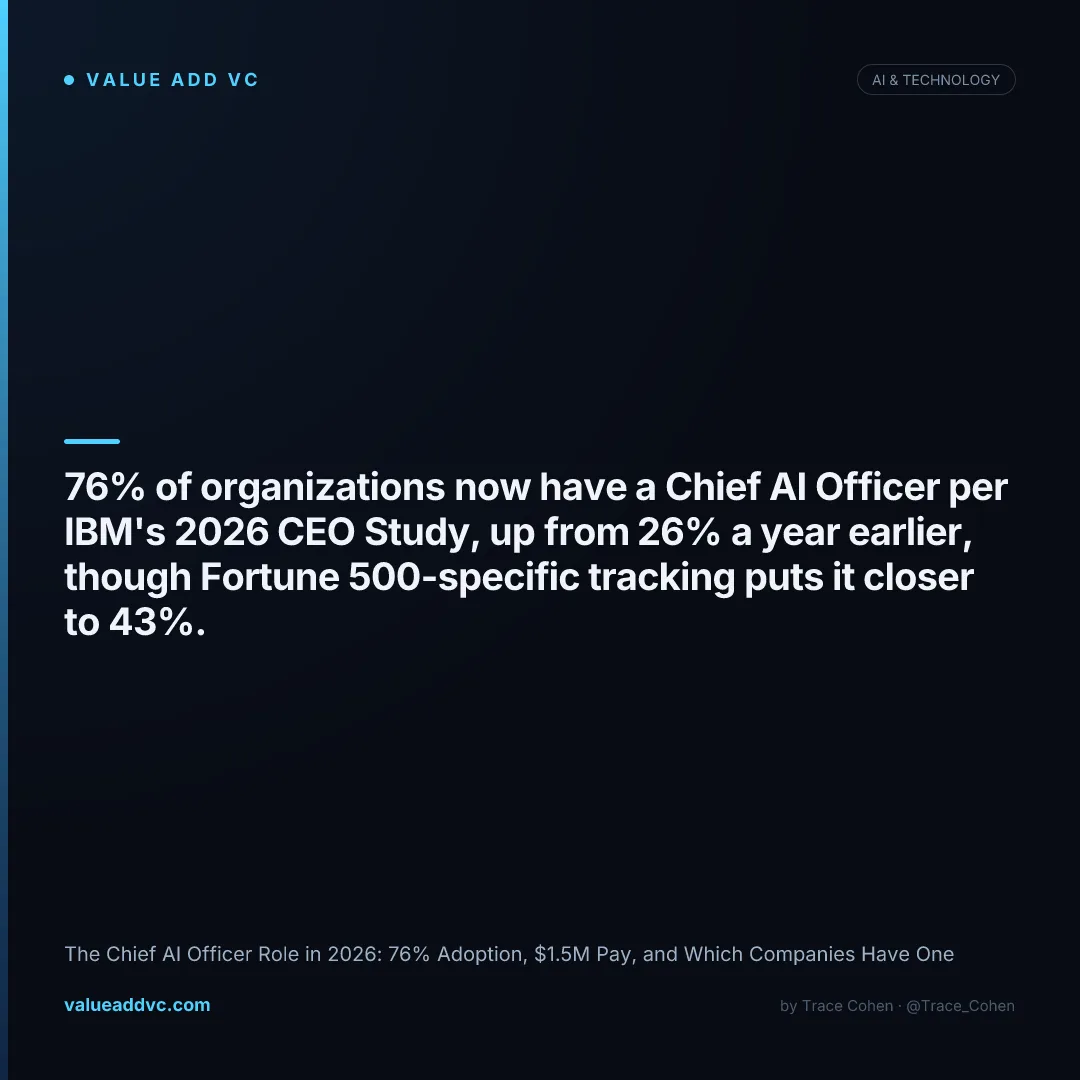
76% of organizations now have a Chief AI Officer, according to IBM's 2026 CEO Study — nearly tripling from 26% a year earlier. That's the short answer. The longer answer is that the title means three completely different jobs depending on who's hiring.
Same title, wildly different job. Here's what the data actually shows about who's hiring this role, what it pays, and whether it survives past this cycle.
What Is the Chief AI Officer Role and Why Are Companies Filling It Now?
The Chief AI Officer role is a C-suite position responsible for enterprise-wide AI strategy, governance, and deployment, and it exists because AI adoption crossed a threshold in 2025–2026 where no single existing executive — CTO, CIO, or CDO — had a clean mandate to own it. IBM's 2026 CEO Study found 76% of organizations now have a CAIO, up from 26% in 2025, based on a survey of 2,000 senior leaders across 33 countries and 21 industries conducted with Oxford Economics.
The gap between that 76% figure and other trackers matters. LinkedIn's Fortune 500-specific data — a narrower, harder-to-fake dataset built off actual title changes — puts Fortune 500 CAIO adoption at roughly 43% today, up from 19% a year ago. A separate industry projection pegs US companies overall (not just Fortune 500) at closer to 35% by year-end 2026. The honest read: adoption is real and accelerating fast, but the IBM self-reported number is almost certainly inflated by companies counting a VP or director-level AI lead as a "Chief AI Officer" in the survey.
Chief AI Officer Salary in 2026: What CAIOs Actually Earn
Base salary for a Chief AI Officer ranges from $280,000 to $650,000 in 2026, per Kore1's CAIO salary guide, with the spread driven almost entirely by company stage rather than industry. Growth-stage startups pay $250K–$400K base, mid-market companies pay $300K–$500K, and large enterprises pay $400K to $1M-plus. Layer on equity, signing bonuses, and performance pay, and total compensation at Fortune 500 tech companies and frontier AI labs reaches $1.5 million to $3 million — comparable to a divisional CTO or CFO seat, not an entry-level VP role.
Aggregator sites disagree sharply on the average, which is itself a data point: Glassdoor reports $353,220 average, Comparably reports $259,523, and ZipRecruiter reports just $151,203 — a three-to-one spread that reflects how inconsistently the "Chief AI Officer" title is applied across company sizes and how new the role's comp benchmarking still is. Anyone negotiating a CAIO offer in 2026 should treat any single average number with real skepticism and instead anchor to the company-stage bands above.
Which Companies Have a Chief AI Officer?
A wave of named Fortune 500 appointments landed in late 2025 and early 2026. Cigna Group named a CAIO in November 2025 with a governance-first mandate reporting directly to the CEO. Target Corporation followed in January 2026 with a product mandate — owning the AI features roadmap across its app, supply chain, and personalization stack. UnitedHealth Group, American Express, and Lowe's all filled the role within a roughly 60-day window in early 2026. At Accenture, Lan Guan leads AI-driven transformation, overseeing a $3 billion internal AI investment hub called the Center for Advanced AI.
| Sector | Fortune 500 CAIO Adoption | Typical CAIO Mandate |
|---|---|---|
| Financial services | ~62% | Risk, compliance, fraud detection, model governance |
| Healthcare | ~51% | Clinical AI governance, data privacy, regulatory approval |
| Retail | ~47% | Personalization, supply chain, product AI features |
| Fortune 500 overall | ~43% | Blend of governance and product ownership |
| US companies overall (est.) | ~35% | Varies widely by company stage |
| Large enterprises (global) | ~26% | Governance-first, up from 11% two years ago |
| FTSE 100 | ~48% | AI or equivalent digital-transformation lead |
Figures are 2026 estimates blended from IBM's 2026 CEO Study (with Oxford Economics), LinkedIn Fortune 500 hiring data, and Rework/Digital Chiefs sector adoption reporting. Sector adoption figures are directional, based on named-appointment tracking rather than a full census.
Is the Chief AI Officer Role a Real Job or Just a Title?
The hiring data on this is genuinely mixed, and that is arguably the most underreported part of the story. Indeed logged a 478% year-over-year jump in chief AI job postings in 2024 — the peak of the hype cycle. But in 2025, chief-level AI postings actually declined, even as general senior AI-leadership postings grew 265% year-over-year, their biggest jump since 2020. Read together, that looks like companies moving away from one centralized "Chief AI Officer" and toward distributed AI leads embedded inside engineering, product, risk, and each business unit — the same pattern that played out with Chief Digital Officer roles a decade ago, most of which eventually got absorbed back into the CTO or CMO function.
For founders and operators, the practical takeaway is not "hire a CAIO because it's trending." It's that someone at the company needs explicit ownership of AI tooling decisions, data governance, and vendor selection before those decisions get made by default across five different teams — whether that person carries a Chief AI Officer title or not is secondary. We track this same build-versus-buy dynamic on the AI Valuations dashboard, where the companies commanding the highest multiples are the ones with a single, coherent AI strategy rather than fragmented experiments.
Governance CAIO vs. Product CAIO: The Two Jobs Hiding Under One Title
The single biggest source of confusion in Chief AI Officer hiring right now is that the title covers two nearly opposite jobs. A governance CAIO — the Cigna model — spends most of the week on model risk, data privacy compliance, bias auditing, and regulatory reporting, and typically reports to the CEO, General Counsel, or a board risk committee. A product CAIO — the Target model — owns a P&L-adjacent roadmap, sits closer to engineering and product leadership, and gets measured on feature velocity and revenue lift from AI-powered personalization or automation, not compliance metrics.
Regulated industries skew heavily governance-first: financial services and healthcare, the two highest-adoption Fortune 500 sectors at roughly 62% and 51%, both cite regulatory exposure (SEC, HIPAA, state AI disclosure laws) as the primary driver for creating the role at all, according to Rework's 2026 CAIO adoption analysis — a dynamic that mirrors the surge of FDA clearances for AI-enabled medical devices driving healthcare's own governance buildout. Retail and consumer tech skew product-first, since the AI use cases there — recommendation engines, dynamic pricing, chat-based customer service — map directly to revenue rather than risk mitigation. Getting this distinction wrong in a job description is the single most common reason CAIO searches drag on for 6+ months, per multiple 2026 executive search reports: candidates from a compliance background rarely have the product instincts a retail board expects, and vice versa.
Reporting lines track the same split. Governance CAIOs report directly to the CEO or a board committee in roughly two-thirds of documented 2025–2026 appointments, while product CAIOs are more evenly split between reporting to the CEO, the CTO, or a Chief Product Officer — a structural signal worth asking about explicitly before accepting an offer, since it determines how much real authority the seat actually carries.
When Should a Startup Actually Hire a Chief AI Officer?
Most seed and Series A startups don't need a standalone CAIO — the founder or a technical co-founder should own AI strategy directly at that stage, and a $280K-plus base salary is better spent on two senior engineers. The threshold where a dedicated CAIO starts making sense is closer to Series C and beyond, or wherever a company has more than 50 people touching AI tooling decisions independently and no single person accountable for data governance, model risk, or vendor spend. Below that, the role is usually a bolt-on VP of AI or Head of AI title, not a full C-suite seat — a distinction worth getting right before a board pushes a company to make an expensive hire it doesn't need yet.
It's a hiring decision that mirrors what we cover on the Hiring Trends dashboard — the roles growing fastest in tech right now aren't always the ones companies actually need first, and the CAIO title in 2026 sits squarely in that category for anyone earlier than Series C.
76% self-reported adoption globally, ~43% among Fortune 500, $280K–$650K base pay, and a 2025 posting slowdown even as senior AI-leadership hiring accelerated 265%.
The Chief AI Officer title is real, but it's consolidating faster than it's spreading.
Companies aren't abandoning dedicated AI leadership — they're distributing it. The standalone C-suite CAIO title looks likely to follow the Chief Digital Officer path: a useful bridge role during a technology transition that eventually folds back into the CTO or CIO function once AI stops being a special initiative and just becomes how the company operates.
Track how AI adoption is showing up in company valuations on the AI Valuations dashboard and Hiring Trends tool at Value Add VC. Originally published in the Trace Cohen newsletter.
Latest from the Pulse
Get VC data most people never see
— free to subscribe
Trace's notes on venture, AI and startups, a few times a week. Join 5,000+ subscribers. No spam.