Back to Blog
BLOGApril 2026ยท10 min read

Tech IPO Market: What Founders Need to Know

The IPO window, what it takes to go public, and why most VC-backed companies never will.

TC
Trace Cohen
3x founder, 65+ investments, building Value Add VC

The State of the IPO Market: 2024-2026

The tech IPO market has been one of the most closely watched indicators of venture capital health over the past three years. After the IPO window effectively slammed shut in mid-2022, the industry spent 2023 and most of 2024 in a holding pattern. A handful of high-profile IPOs in late 2024 and throughout 2025 tested the waters and signaled that public markets were once again willing to absorb new technology offerings, but the recovery has been selective rather than broad-based.

In 2025, approximately 45 venture-backed technology companies went public, a significant increase from 2023 and 2024 but still well below the 100+ tech IPOs of 2021. The total capital raised in tech IPOs exceeded $35 billion, with AI companies accounting for a disproportionate share. Early 2026 has continued this trend, with several notable offerings already completed and a robust pipeline of companies that have filed or are expected to file. Track all of these in real time on our IPO Dashboard.

The key dynamic to understand is that the IPO market is no longer welcoming to any company with a certain revenue threshold. Public market investors have recalibrated their expectations dramatically since 2021. They want profitability or a clear, near-term path to it. They want predictable revenue growth. They want strong unit economics. They want management teams that can operate in the public market spotlight. Companies that meet these criteria are finding receptive markets and attractive pricing. Companies that do not are still stuck in the private market purgatory that has defined the past few years.

What It Takes to IPO in 2026

The bar for going public has risen substantially. If you are a founder even remotely considering an IPO as a potential exit path, understanding the current requirements will help you plan backward from that milestone. Here is what public market investors and underwriters are looking for in 2026.

The IPO Readiness Checklist

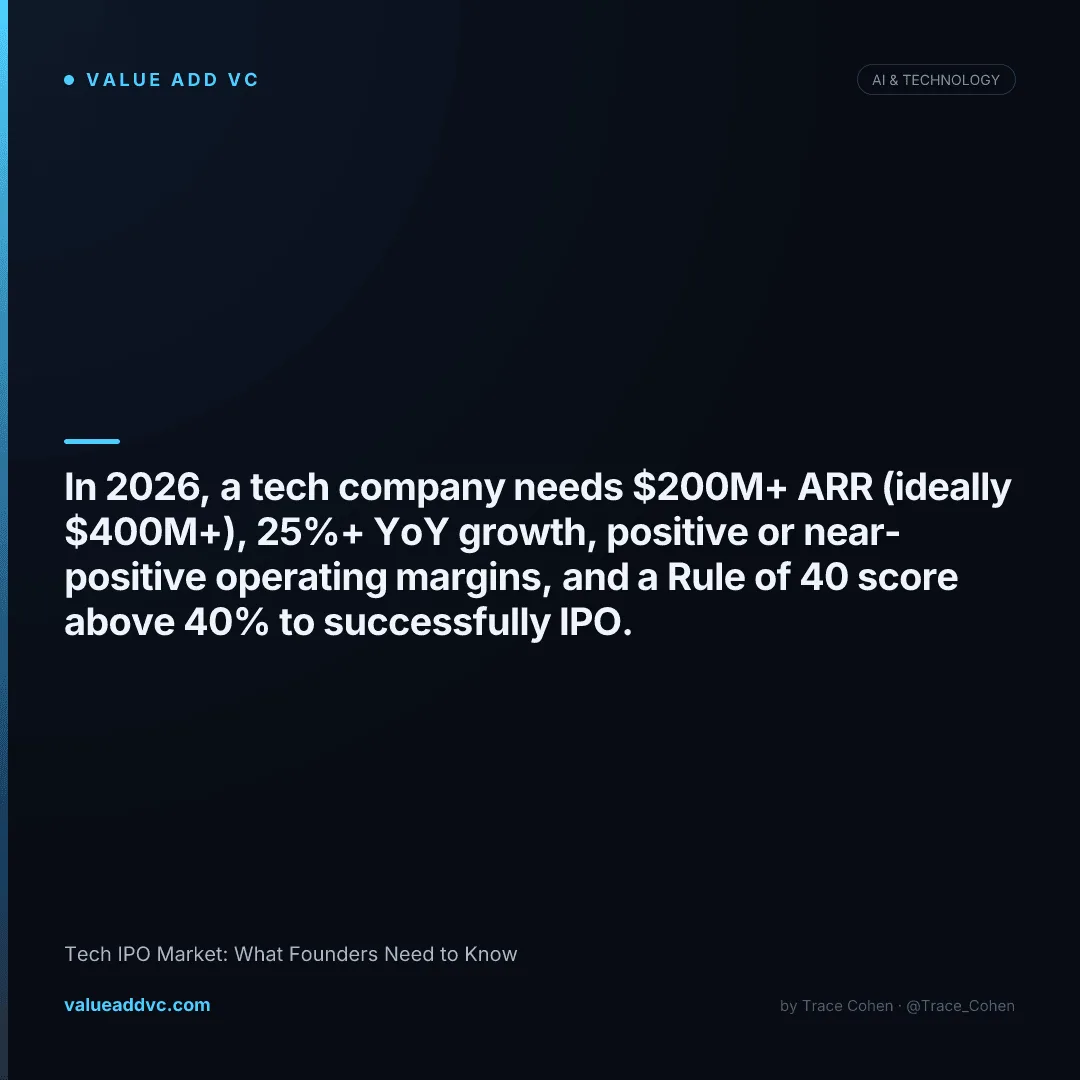
  • Revenue: Most successful tech IPOs in 2025-2026 had $200M+ in annual revenue at the time of listing. Some high-growth AI companies went public with $100-150M, but they had exceptional growth rates (100%+ year-over-year). The days of sub-$100M revenue IPOs are largely over.
  • Growth Rate: Public market investors want to see 30-50%+ year-over-year revenue growth, with 50%+ being the sweet spot. Companies growing below 30% need to compensate with strong profitability. The Rule of 40, where revenue growth rate plus profit margin should exceed 40%, has become the standard benchmark.
  • Profitability: GAAP profitability is no longer optional for most IPOs. At minimum, companies need to be free cash flow positive or demonstrate a clear path to profitability within 4-6 quarters of listing. The era of companies going public while burning hundreds of millions per year is over.
  • Net Revenue Retention: For SaaS companies, NRR above 120% is table stakes. This metric tells public investors that existing customers are spending more over time, which is the strongest signal of product-market fit and pricing power.
  • Market Size: Public market investors want to see a total addressable market large enough to support significant continued growth post-IPO. An IPO is not the finish line. It is a financing event, and investors are buying future growth.

Beyond the financial metrics, going public requires substantial organizational readiness. You need a CFO with public company experience, typically hired 12-18 months before the IPO. You need audited financials going back three years with SOX compliance infrastructure in place. You need a board of directors that meets public company governance requirements, including independent directors and audit, compensation, and nominating committees. You need an investor relations function, a legal team capable of handling SEC filings, and a communications team prepared for the scrutiny of being a public company. This infrastructure takes 18-24 months to build properly.

The IPO Process Timeline

The journey from deciding to IPO to actually ringing the bell typically takes 12-18 months. Here is how the process typically unfolds, broken into the major phases.

Phase 1: Preparation (6-12 Months Before Filing)

The preparation phase involves selecting underwriters (typically 2-4 investment banks), hiring or upgrading the CFO and finance team, completing financial audits, building SOX compliance infrastructure, forming board committees, and beginning the S-1 drafting process. This is also when the company conducts an organizational audit to ensure all aspects of the business can withstand public market scrutiny: contracts, IP, employment practices, regulatory compliance, and risk factors.

Phase 2: Filing and Review (2-4 Months)

The company files a confidential S-1 registration statement with the SEC. The SEC reviews the filing and provides comments, which the company addresses through amendments. This back-and-forth typically involves 2-3 rounds of comments over 6-12 weeks. Once the SEC clears the filing, the company makes it public, officially announcing the IPO to the market.

Phase 3: Roadshow and Pricing (2-3 Weeks)

The roadshow is the most intense period. The CEO and CFO spend 1-2 weeks meeting with institutional investors, presenting the company's story, and building the book of demand. Roadshows now include both in-person meetings in key financial centers and virtual presentations. Based on investor demand, the underwriters and company set a price range and eventually a final offering price. The pricing happens the night before the stock begins trading.

Phase 4: Trading and Post-IPO (Ongoing)

Once the stock begins trading, the company enters a new reality. Quarterly earnings calls, SEC filings, Regulation FD compliance, quiet periods, and the constant scrutiny of public market analysts and investors become permanent features of life. There is typically a 180-day lockup period during which insiders (including founders, employees, and VC investors) cannot sell shares. This lockup expiration often creates significant stock price volatility.

Direct Listings vs SPACs vs Traditional IPOs

Founders considering going public have three primary paths, each with distinct advantages and trade-offs. Understanding the differences is important for making the right strategic choice.

Traditional IPO

The traditional IPO remains the dominant path, accounting for roughly 80% of tech offerings in 2025-2026. In a traditional IPO, the company works with underwriting banks to issue new shares, raise capital, and begin public trading. The advantages are well- established: capital raising, analyst coverage from underwriting banks, institutional investor relationships built during the roadshow, and a structured, well-understood process. The disadvantages are cost (underwriting fees of 3-7% of proceeds), dilution from new share issuance, and the IPO pop, where underwriters often price shares below market value, effectively transferring wealth from the company to first-day investors.

Direct Listing

Pioneered by Spotify in 2018 and used by companies like Coinbase and Roblox, direct listings allow companies to go public without issuing new shares or using underwriters in the traditional sense. Existing shares become tradable directly on a stock exchange. The advantages are no dilution, no underwriting fees, and no lockup period for existing shareholders. The disadvantages are significant: no capital is raised in the process (though the NYSE now allows primary share issuance in direct listings), there is no guaranteed institutional allocation, and the first-day price discovery can be more volatile. Direct listings work best for well-known companies with strong brand recognition that do not need to raise additional capital.

SPACs: The Rise and Fall

Special Purpose Acquisition Companies were the hot path to public markets in 2020-2021, with over 600 SPACs raising $160 billion. The SPAC route promised faster timelines, more certainty on valuation, and the ability to share forward-looking projections that traditional IPOs cannot include. The reality was different. The vast majority of companies that went public via SPAC in 2020-2021 have dramatically underperformed, with many trading 70-90% below their initial valuations. Regulatory scrutiny from the SEC has increased, and the SPAC market has contracted to a fraction of its peak. In 2026, SPACs are effectively a non-factor for quality technology companies. The reputational damage to the SPAC path means that serious companies now avoid it, and investors view SPAC-listed companies with skepticism.

The 2025 IPO Class: How They Have Performed

The class of 2025 tech IPOs provides a useful case study for founders evaluating the public markets. Track all of them on our 2025 IPO Class Dashboard. Overall, the cohort has performed well relative to recent vintages, but with significant dispersion.

The standout performers share common characteristics: strong revenue growth (50%+ year-over- year), improving profitability metrics, clear market leadership positions, and compelling AI narratives. Several AI infrastructure and vertical AI companies that went public in 2025 are trading at significant premiums to their IPO prices, with revenue multiples of 15-25x reflecting public market enthusiasm for the AI theme.

The underperformers also share patterns: slower growth, unclear paths to profitability, competitive markets with multiple public comparables, and sectors that public investors are less excited about (consumer, general SaaS without AI differentiation). Several 2025 IPOs are trading below their offering price, a painful outcome for founders, employees, and investors who waited years for the liquidity event. The lesson is clear: going public is not a guaranteed positive outcome. Timing, market conditions, and company quality all matter enormously. The Tech IPO Tracker monitors aftermarket performance for all recent offerings.

Why Most Startups Will Exit via M&A, Not IPO

Here is the reality that every founder needs to internalize: the overwhelming majority of successful venture-backed startups will never IPO. Of the roughly 15,000 companies that receive venture funding each year in the US, fewer than 50 will eventually go public. That is a hit rate of approximately 0.3%. Even among companies that reach $50M+ in revenue, only a fraction will have the growth rate, profitability profile, and market conditions necessary to execute a successful IPO.

The vast majority of successful exits happen through M&A. Approximately 90% of venture- backed exits are acquisitions, not IPOs. And this is not a consolation prize. Many of the most successful venture outcomes in history were acquisitions: Instagram ($1B by Facebook), YouTube ($1.65B by Google), WhatsApp ($19B by Facebook), GitHub ($7.5B by Microsoft). A well-timed acquisition can generate extraordinary returns for founders, employees, and investors without the burden and cost of operating as a public company.

The M&A environment in 2026 is active, particularly for AI companies. Large technology platforms are aggressively acquiring AI capabilities through acqui-hires, tuck-in acquisitions, and strategic acquisitions. Regulatory scrutiny has increased for the largest deals, but transactions under $1 billion continue to close at a healthy pace. Private equity firms have also become significant acquirers of venture-backed companies, particularly those with $20-100M in revenue and strong margins.

What Founders Should Plan For

If you are building a venture-backed company, your exit planning should start much earlier than most founders realize. This does not mean you should be thinking about selling the company from day one. It means you should be building a company that has options and making strategic decisions that preserve those options.

Exit Planning Principles for Founders

  • Build a business, not just a product. Companies with strong revenue, margins, and customer relationships have options. Companies that are pre-revenue and burning cash are dependent on a narrow set of acquirers who are buying talent, not businesses.
  • Maintain clean financials and governance. Whether you end up pursuing an IPO or an acquisition, clean cap tables, audited financials, and proper governance make the process faster and less painful. Start this discipline early.
  • Build strategic relationships. The best acquisitions happen between companies that already have a working relationship: customer, partner, or ecosystem participant. Cultivate relationships with potential acquirers naturally through business development without being transactional about it.
  • Understand your investor timeline. Your VC investors have fund lifecycles that create exit pressure. A seed investor from a 2020 vintage fund will start thinking about exits by 2027-2028. Understanding this timeline helps you plan. As I explained in my piece on the state of VC funding, LP pressure for DPI is real and growing.
  • Do not optimize for one path. The founders who do best are those who build great businesses and let the exit path reveal itself. If you hit $200M+ in revenue with strong growth and profitability, the IPO option will be there. If a strategic acquirer offers a compelling price at $50M in revenue, that might be the right answer too. Keep your options open and make the decision when you have the most information.

The most important takeaway for founders is this: do not build your company around an IPO aspiration. Build the best possible business, focus on customers, maintain financial discipline, and the exit will take care of itself. The IPO market rewards great companies when conditions are right. But conditions are not always right, and having a company that can thrive regardless of public market sentiment is the strongest position you can be in.

The tech IPO market in 2026 is open but selective. The bar is high. The rewards for clearing that bar are substantial. And for the 99%+ of venture-backed companies that will never go public, the M&A market offers a robust alternative path to liquidity. Either way, the companies that succeed are the ones that build real businesses with real customers, real revenue, and real margin, regardless of which exit path they eventually take.

Track the IPO Market

Stay on top of the latest IPO activity with our free tools:

  • IPO Dashboard โ€” Track upcoming, recent, and rumored IPOs in real time.
  • 2025 IPO Class โ€” See how the class of 2025 is performing post-listing.
  • Tech IPO Tracker โ€” Monitor aftermarket performance for tech offerings.
  • SpaceX IPO Tracker โ€” Follow the most anticipated potential IPO in tech.

Explore 41+ free VC tools, dashboards, and recommended startup software.