The correct startup equity compensation structure is not complicated — but most founders still get it wrong because they copy what someone else did without understanding the mechanics.
Bad equity structures are one of the most common clean-up items before a Series A closes. The mistakes are usually made in the first 18 months and cost real time and real money to fix.
Here is a practical framework — with real benchmarks for grant sizes, option pool sizing, and the ISO/NSO decision that actually determines how much tax your employees pay at exit.
The Standard Startup Equity Compensation Structure
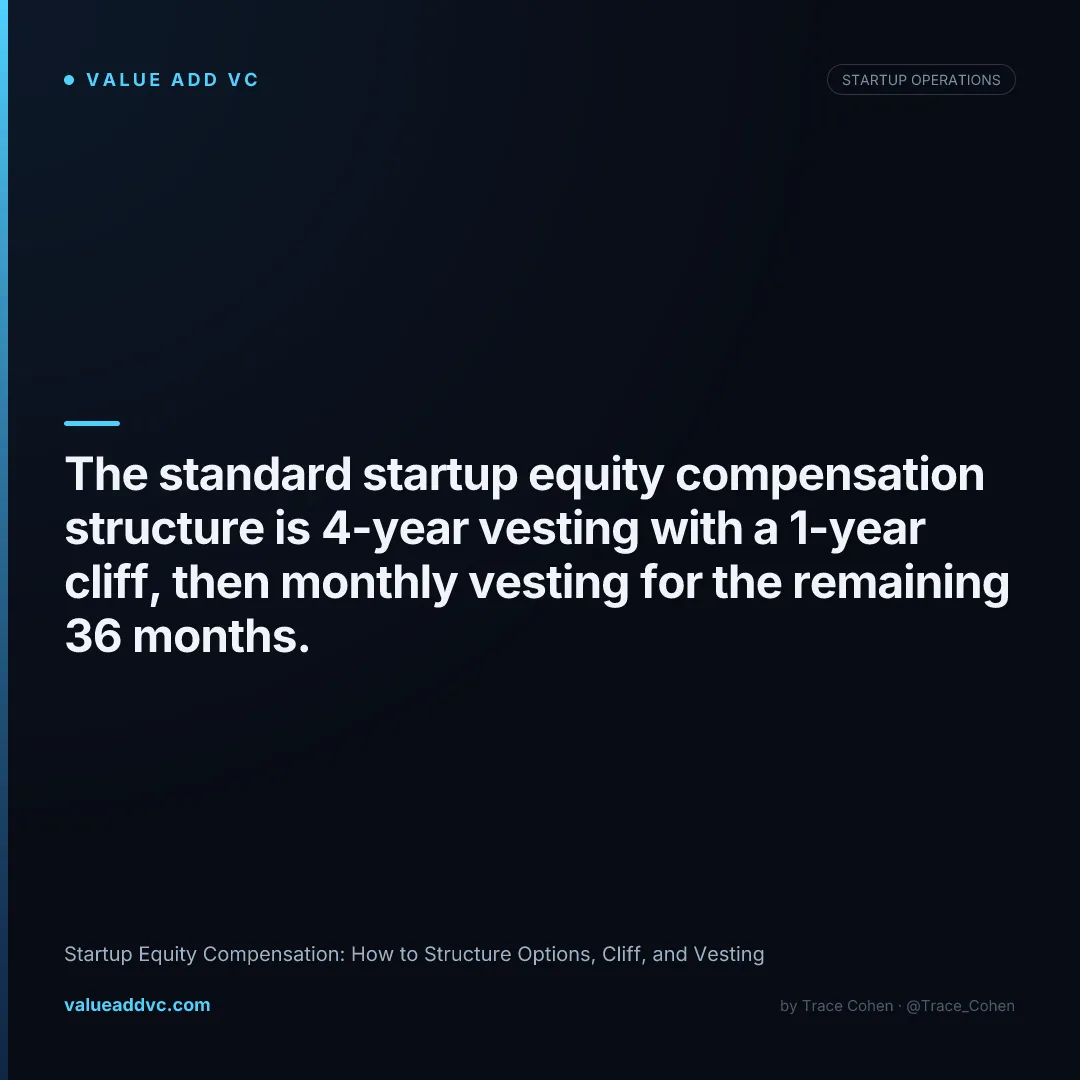
The structure is nearly universal across Silicon Valley, New York, and every startup ecosystem that has adopted YC norms: 4-year vesting with a 1-year cliff, monthly vesting thereafter. Deviating from this without a clear reason creates confusion, signals inexperience, and can complicate future fundraising.
On the 12-month anniversary, 25% of the grant vests in a single event. For a 10,000-share grant, that is 2,500 shares at once. From month 13 forward, approximately 208 shares vest each month until the grant is fully vested at month 48. Acceleration clauses — typically single-trigger (on acquisition) or double-trigger (on acquisition plus termination) — are layered on top for executives and negotiated separately.
ISO vs. NSO: The Decision That Affects Every Employee's Tax Bill
Employees should almost always receive ISOs (Incentive Stock Options). Contractors and advisors receive NSOs (Non-Qualified Stock Options) because the IRS does not allow ISOs for non-employees. The tax difference is significant:
Employees only. $100K annual vesting limit for favorable treatment.
Available to anyone: employees, advisors, contractors, directors.
The ISO AMT trap is real: if an employee exercises ISOs when the spread is large and the company has not yet had a liquidity event, AMT can create a tax bill on phantom income. Early exercise elections (83b) can eliminate this entirely if filed within 30 days of grant — this is one of the highest-leverage financial decisions an early employee can make.
Equity Grant Benchmarks by Role and Stage
These ranges reflect standard compensation survey data (Levels.fyi, Carta, AngelList). Use the lower end if you are paying at or near market cash salary; use the upper end if you are significantly below market:
| Role | Pre-Seed/Seed | Series A |
|---|---|---|
| CEO/Co-Founder | 15–35%* | — |
| CTO/Co-Founder | 10–25%* | — |
| VP Engineering | 1.0–3.0% | 0.4–0.8% |
| VP Product | 0.75–2.0% | 0.25–0.6% |
| VP Sales | 0.5–1.5% | 0.2–0.5% |
| Senior Engineer (#1–5) | 0.5–1.5% | 0.15–0.40% |
| Engineer (mid) | 0.25–0.75% | 0.05–0.20% |
| Advisor | 0.1–0.5% | 0.05–0.25% |
* Founder shares, not options. Percentages based on fully diluted cap table at time of grant.
The Option Pool: Size, Timing, and the Pre-Money Shuffle
Your option pool needs to be large enough to hire through your next funding round without requiring a mid-round refresh that triggers additional dilution. At seed, create an option pool of 10–15% of fully diluted shares. At Series A, VCs will want to see 15–20% available.
The critical negotiation: VCs almost universally require the option pool to be created pre-money, which means the dilution comes entirely from founders and existing shareholders — not from the new investor. A term sheet that says "$10M on a $40M pre-money with a 20% option pool" is structurally different from one where the pool is created post-money. This is one of several clauses where founders leave money on the table — our guide on how to negotiate a term sheet covers the full playbook.
The rule: model your hiring plan through the next 18 months. If you need 8 engineers and 2 executives, calculate the grants you will issue and make sure the option pool covers them. VCs use inflated pool requirements as a dilution mechanism — if you only need 12%, do not let them force you to 20%.
Common Startup Equity Compensation Mistakes
Benchmarking Your Equity Structure
The data on compensation and burn benchmarks across startup stages is available on the Benchmarking Dashboard at Value Add VC — use it to cross-check your compensation packages against companies at similar ARR and headcount. Equity as a percentage of total comp varies significantly by stage and sector, and founders consistently underestimate how much this benchmark matters to candidates evaluating competing offers.
For SaaS companies specifically, the equity benchmarks tie directly to how the company will be valued at the time an employee's options become valuable. Check the SaaS Valuations Dashboard for current multiples by ARR range — understanding the exit math helps employees and founders alike set realistic expectations about what the equity is actually worth.
Equity is not a cost. It is a retention contract.
Structure it correctly on day one and your best people will stay. Get it wrong and you will spend your Series A term sheet negotiation unwinding bad grants instead of closing.
Track startup compensation benchmarks on the Benchmarking Dashboard at Value Add VC. Originally published in the Trace Cohen newsletter.
Latest from the Pulse
Get VC data most people never see
— free to subscribe
Trace's notes on venture, AI and startups, a few times a week. Join 5,000+ subscribers. No spam.
No spam, unsubscribe anytime. Sent via Substack · Privacy · or subscribe on Substack ↗