
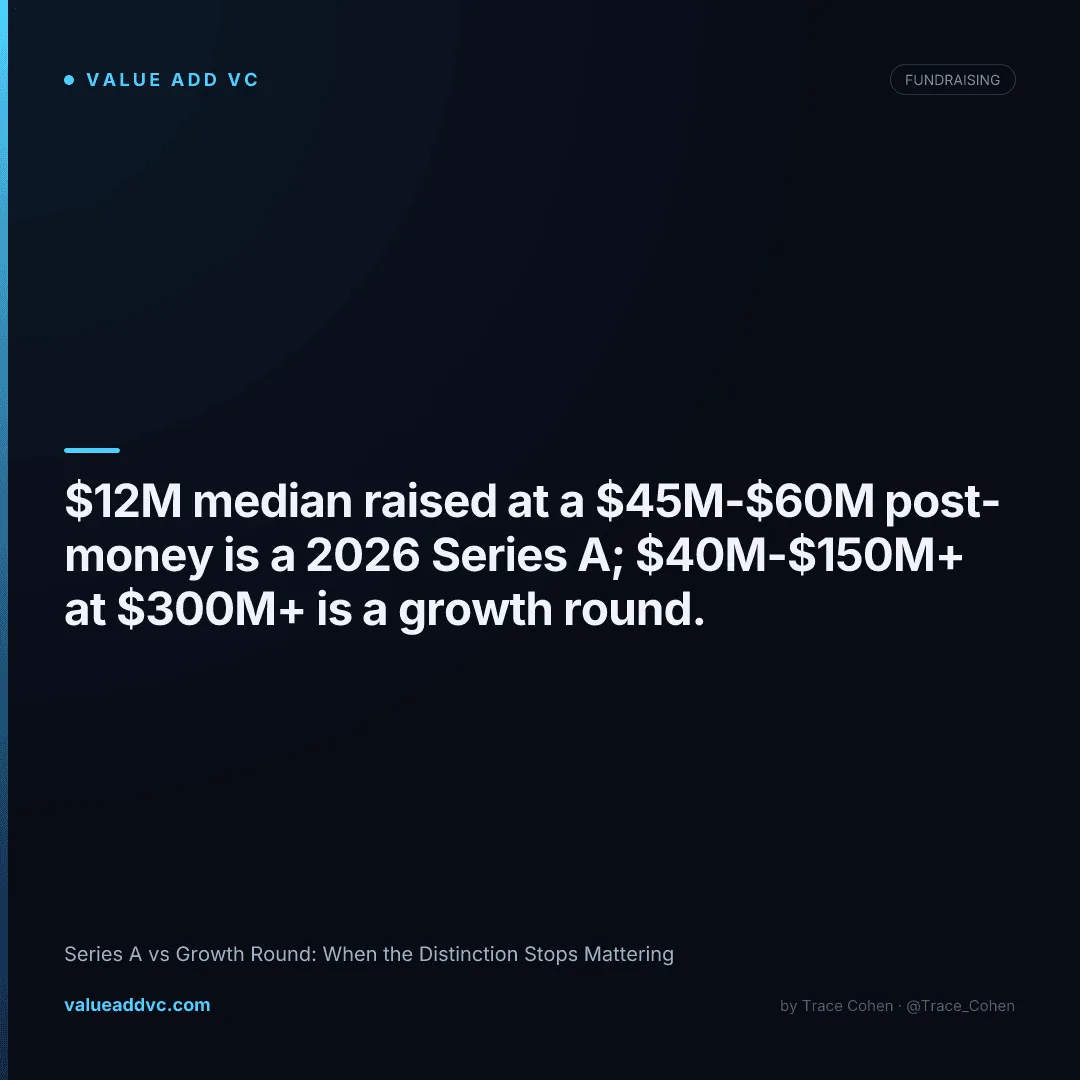
A 2026 Series A is roughly $12M raised at a $45M–$60M post-money valuation before $2M ARR; a growth round is $40M–$150M+ at $300M+ against $20M+ ARR and proven unit economics.
That's the short answer. The longer answer is more interesting — because the labels describe a round number, while the economics describe traction, and in 2026 those two things have stopped lining up. A handful of AI companies are raising “growth-sized” rounds at the Series A stage, and the old mental model breaks.
Series A vs Growth Round in 2026: The Side-by-Side
The difference between a Series A and a growth round in 2026 comes down to what the capital prices. A Series A prices conviction on a thesis with early signal — typically $12M at a $50M post-money before $2M ARR, diluting founders 18–25%. A growth round prices a working machine — $40M–$150M+ above a $300M valuation, against $20M+ ARR, diluting just 8–15%. One buys belief; the other buys a slice of proven revenue.
| Attribute | Series A | Growth Round |
|---|---|---|
| Typical round size | $8M–$15M (median ~$12M) | $40M–$150M+ |
| Post-money valuation | $45M–$60M | $300M–$3B+ |
| Revenue at raise | $0–$2M ARR | $20M+ ARR |
| Founder dilution (round) | 18%–25% | 8%–15% |
| What it prices | Thesis + early signal | Proven unit economics |
| Lead investor type | Early-stage VC partner | Growth equity / crossover |
| Board impact | New board seat | Often observer or no seat |
| Primary risk priced | Product-market fit | Scaling + competition |
Figures reflect 2026 US software medians; AI-native companies skew higher on valuation and lower on revenue-at-raise. Compare live multiples on the SaaS Valuations dashboard.
What a Series A Actually Prices
A Series A is the first priced institutional round, and it is fundamentally a bet on a thesis. The company usually has a product in market, some revenue — the 2026 bar has crept up to roughly $1M–$2M ARR for software — and a credible story about why this becomes a large business. The lead is buying the right to a meaningful slice (commonly 18–25%) before the outcome is knowable. That ownership target is exactly why dilution is highest at this stage.
The economics: $12M raised at a $48M post-money means the new investor owns 25%, the founders give up a quarter of the company, and the option pool gets topped up on top. The investor is underwriting product-market fit risk — the single hardest thing to predict — which is why the check is small relative to later rounds and the ownership ask is large relative to the dollars. A good Series A partner takes a board seat and spends real time on hiring, positioning, and the next raise.
Early signal, not proof
$0–$2M ARR with strong retention beats $5M ARR that churns
A thesis the fund believes
The lead is underwriting a market, not a spreadsheet
Founder ownership intact
Pre-A cap tables that are too crowded scare off A leads
A reason to move now
Competitive dynamics or a hiring window force the timing
What a Growth Round Actually Prices
A growth round prices a machine that already works. By the time a company raises growth capital — typically Series C and beyond, or a dedicated growth equity round — it has $20M+ in ARR growing 40%+ year over year, gross margins above 70%, and a sales motion that returns more than a dollar for every dollar of CAC. The investor is not betting on whether the thing works; they are buying a known rate of compounding. That is why a $100M check at a $1B valuation only costs the company about 10% dilution.
Growth investors — think the growth arms of Tiger, Insight, General Atlantic, or crossover funds re-entering late-stage after stepping back in 2022–2023 — underwrite scaling risk and competitive risk, not existence risk. They want to see the cohort curves, the net revenue retention above 110%, and the magic number that says every sales dollar pays back fast. The diligence is a spreadsheet exercise as much as a conviction exercise, which is the opposite of a Series A.
The trade-off for the founder is real but smaller per dollar: less control given up per check, but a high valuation that becomes a hurdle. Raise at $1B and the next round needs to clear $1B+ or it's a down round — and down rounds at the growth stage are punishing for morale and recruiting. You can see how public comparables set those expectations on the SaaS Valuations and Unicorns dashboards.
Why the Series A vs Growth Round Line Is Disappearing
Here is where the clean distinction breaks. Two forces are collapsing it in 2026.
AI traction curves
Companies like Cursor, Perplexity, and a dozen others are hitting $20M–$100M ARR in 12–18 months. They raise rounds that are 'growth-sized' in dollars — $100M+ — at what is technically a Series A or B by round count. The label says early; the revenue says growth.
Mega-fund check sizes
Funds like a16z and Sequoia now deploy $50M+ at the Series A stage to lock in ownership before the price runs away. A $40M Series A at a $400M valuation looks nothing like the $12M median — it walks and talks like a growth round wearing a Series A name tag.
Insider-led rounds
Existing investors increasingly pre-empt the next priced round entirely — extending a Series A into a 'Series A-1' at a flat or modest step-up, sized like a growth round, with no new lead and no real price discovery.
Structure creep
Growth-style terms — liquidation stacks above 1x, ratchets, structured PIPEs — are showing up earlier in the cap table, so a 'Series A' can carry the protective scaffolding that used to signal a late-stage growth deal.
The takeaway: stop reading the round name and read the inputs. A $50M raise at a $500M valuation against $8M ARR is a growth-priced bet on a Series A-stage business — regardless of what the press release calls it. The risk being priced is what matters, not the letter on the term sheet.
Series A or Growth Round: How Founders Should Decide
Raise a Series A when
- ✓ You have a thesis and early signal, not a proven motion
- ✓ ARR is under ~$5M and growth needs a partner, not just fuel
- ✓ You want a board-level partner who builds the company
- ✓ A modest valuation you can grow into beats a vanity mark
Raise a growth round when
- ✓ The motion works and capital is the only constraint
- ✓ ARR is $20M+ growing 40%+ with healthy retention
- ✓ You can defend a high valuation in the next round
- ✓ You want minimal dilution per dollar of capital raised
The most common, most expensive mistake is raising a growth-sized round on Series A fundamentals. Overcapitalizing at a valuation your metrics don't support sets a bar the business has to clear before anyone makes money — including you. The 2021 cohort learned this the hard way; thousands of companies are still digging out of valuations they raised into and couldn't grow past. Track how those vintages are recovering on the VC Performance dashboard.
The verdict: neither round wins — but the better discipline does.
Match the capital to the risk you're actually pricing. Raise a Series A when you're selling a thesis, a growth round when you're selling a machine, and ignore the label when the economics disagree with it.
Compare funding-stage benchmarks and valuations on the SaaS Valuations and VC Performance dashboards at Value Add VC. Originally published in the Trace Cohen newsletter.
Latest from the Pulse
Get VC data most people never see
— free to subscribe
Trace's notes on venture, AI and startups, a few times a week. Join 5,000+ subscribers. No spam.
No spam, unsubscribe anytime. Sent via Substack · Privacy · or subscribe on Substack ↗