
Sequoia Capital manages roughly $85 billion in AUM in 2026, and two positions alone — OpenAI, confirmed at an $852 billion valuation as of an August 2026 tender offer and reportedly in talks for a pre-IPO round near $1.4 trillion as of late September 2026, and Stripe at $159 billion — anchor a portfolio that's become 60%+ concentrated in AI since 2025. That's the short answer. The longer answer is that Sequoia's evergreen fund structure has quietly changed how the firm plays the game, and its 2025-2026 deal pace shows a firm doubling down on fewer, larger, more concentrated bets rather than spreading capital thin.
I track fund strategy and portfolio construction closely because it tells you where the smart money actually believes the outsized returns are going to come from next, not just where the headlines are. Sequoia's 2026 portfolio is a useful case study: a firm with nearly 55 years of history that's willing to write a $6 billion check into a single AI company while its evergreen structure lets it hold winners like Stripe for over a decade without a fund-life clock forcing an exit.
Updated Nov 2, 2026
Rechecked Nov 2, 2026: OpenAI’s valuation has moved well past the ~$500 billion figure this post originally cited. CNBC confirmed an $852 billion valuation via an August 2026 employee tender offer, and TechCrunch reported OpenAI was in talks for a $30B+ pre-IPO round at roughly $1.4 trillion as of September 29, 2026 — not yet closed as of this update. We also removed a Sequoia fund-performance IRR figure that traced to an unrelated public-markets fund rather than Sequoia Capital itself (see below). Stripe and xAI figures are unchanged versus the most recent sourced figures we could verify.
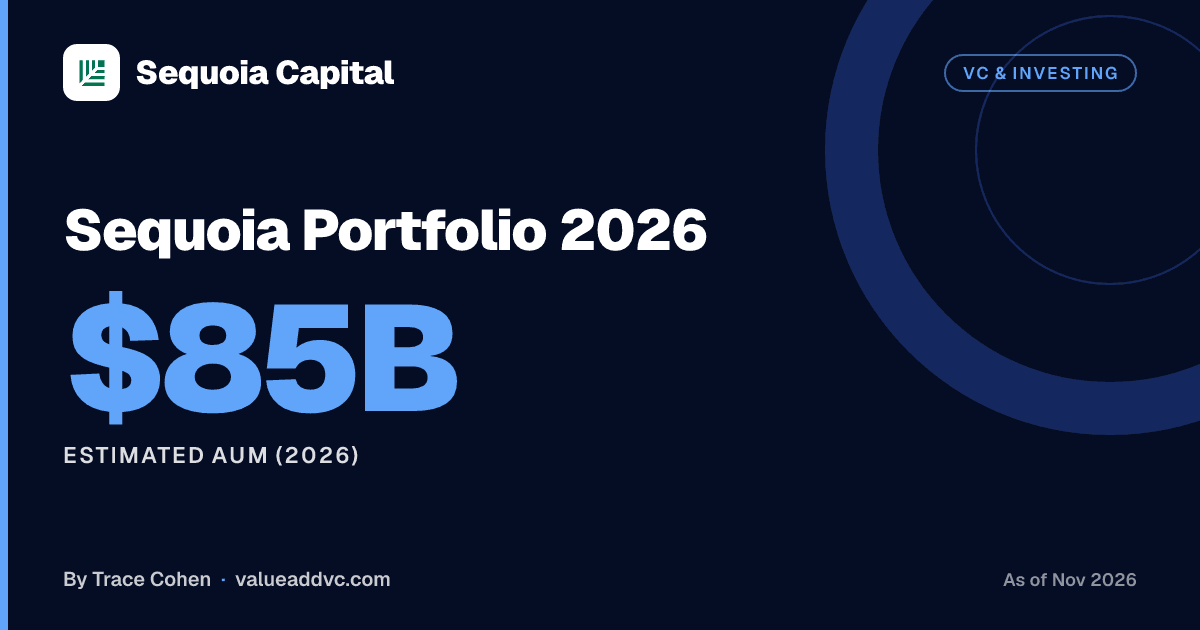
Figures are 2026 estimates blended from Dealroom, Tracxn, and PitchBook, cross-checked against CNBC and TechCrunch reporting on OpenAI's valuation. AUM estimates vary by source since Sequoia does not publish one consolidated figure, and Sequoia Capital does not publicly disclose fund-level IRR/TVPI.
What Does Sequoia Capital's Portfolio Look Like in 2026?
Sequoia Capital's 2026 portfolio is built around a small number of very large positions rather than broad diversification: OpenAI, confirmed at an $852 billion valuation via an August 2026 tender offer and reportedly in talks for a pre-IPO round near $1.4 trillion as of late September 2026, and Stripe at $159 billion (where Sequoia's roughly 13.5% stake is worth an estimated $21.5 billion) are the two anchor holdings. Beyond those two, the firm's most active 2025-2026 bets are concentrated in AI infrastructure and applications — xAI ($50B valuation, Sequoia led a $6.0 billion Series C in November 2025), Figure AI ($2.6B valuation after a $675M Series B), and Hugging Face ($4.5B valuation).
The firm's total AUM sits at an estimated $85 billion in 2026, though the exact figure is genuinely contested across sources — some aggregators cite figures as low as $56 billion in early 2025, while Sequoia's own evergreen Sequoia Capital Fund performance page shows that single vehicle growing from $13.6 billion in early 2023 to roughly $20 billion by early 2025. Unlike a traditional 10-year drawdown fund, that evergreen structure means Sequoia can hold a position like Stripe for well over a decade without an LP-driven exit clock, which materially changes how the firm underwrites long-duration bets. You can track how this compares across the broader manager landscape on our VC Performance dashboard.
Sequoia's Biggest Bets: OpenAI, Stripe, and the New AI Positions
Sequoia's exposure to OpenAI is the single largest driver of paper returns in the current portfolio — at an $852 billion valuation confirmed via an August 2026 tender offer, and reportedly in talks for a pre-IPO round near $1.4 trillion as of late September 2026, even a low-single-digit percentage stake would represent tens of billions in unrealized value, and Sequoia has been reported in talks to participate in Anthropic's proposed $25 billion round as of January 2026, suggesting the firm doesn't view its AI exposure as concentrated enough yet. Stripe remains the firm's clearest realized-value story: a $159 billion valuation with Sequoia's stake estimated at $21.5 billion gives the firm one of the largest single fintech positions held by any VC globally.
Sequoia's Notable 2025-2026 Positions by Company Valuation
OpenAI and Stripe dwarf every other position in Sequoia's portfolio — the next four notable holdings combined are worth less than one-tenth of OpenAI's valuation
Company valuations via TechCrunch, Bloomberg, CNBC, and company disclosures. OpenAI figure is the $852B valuation CNBC confirmed via an August 2026 tender offer (not the ~$1.4T figure TechCrunch reported as in-talks for a pending pre-IPO round in September 2026); other figures are as of Q1 2026. Figures are company-level valuations, not Sequoia's ownership stake value except where noted.
Data
| Item | Value |
|---|---|
| OpenAI | 852 |
| Stripe | 159 |
| xAI | 50 |
| Hugging Face | 4.5 |
| Figure AI | 2.6 |
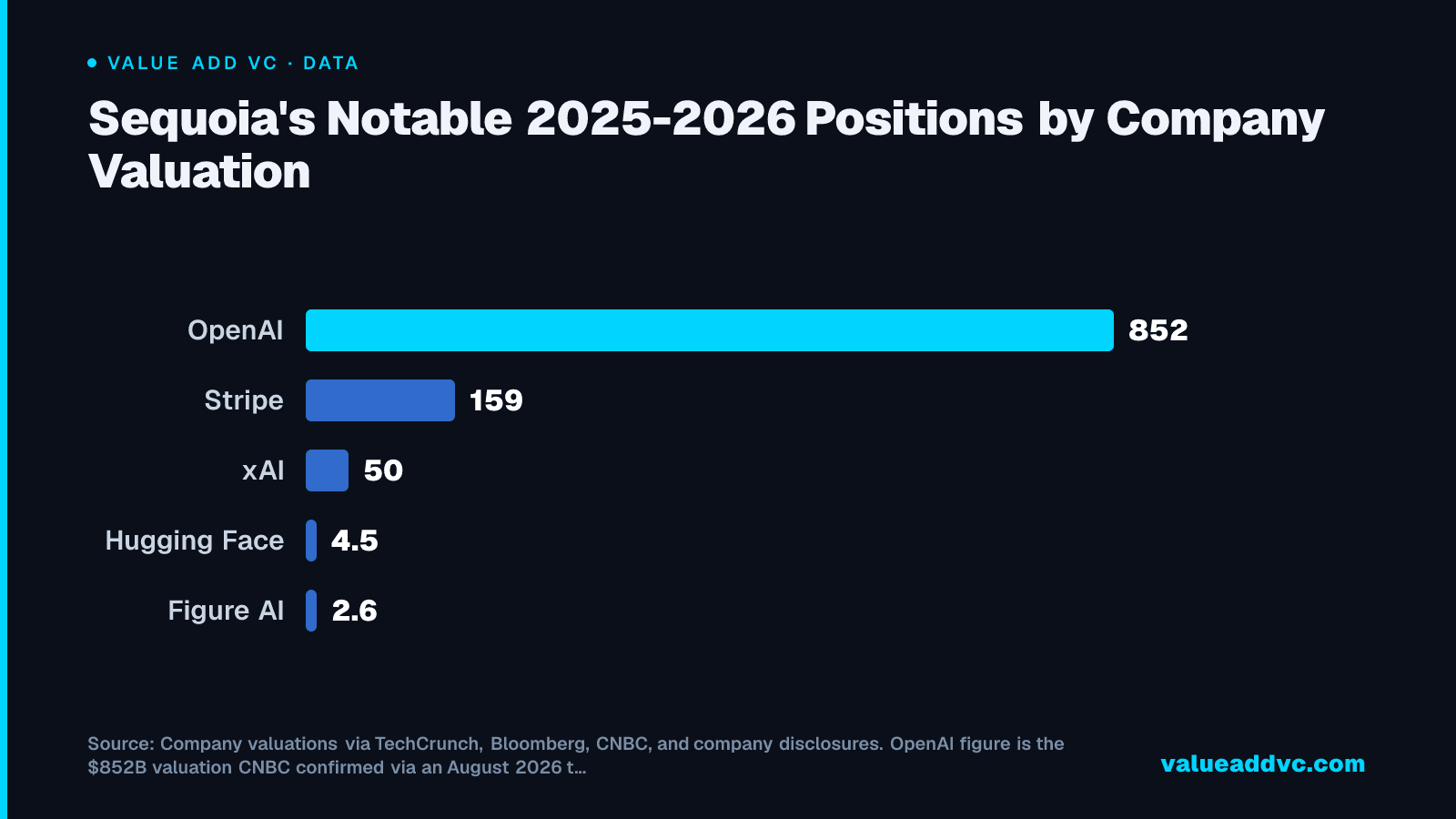
The xAI position is worth dwelling on because of how it was structured: Sequoia led a $6.0 billion Series C at a $50 billion valuation in November 2025, one of the largest single checks the firm has written into any company at any stage. That kind of concentrated, high-conviction check size — rather than a smaller allocation inside a syndicate — is consistent with roughly 60% of Sequoia's new capital since 2025 going into AI applications and infrastructure specifically, a concentration level that would have been unusual for the firm even five years ago.
Sequoia Capital Portfolio 2026 vs. Its Closest Peers
Sequoia's estimated $85 billion in AUM puts it in the same tier as Andreessen Horowitz, which reports $90-100 billion after closing a $15 billion Fund VII, but the two firms deploy very differently. Sequoia concentrates in a smaller number of massive positions; a16z runs a broader set of specialized vehicles across crypto, biotech, games, and growth equity. Further down the AUM scale, Kleiner Perkins sits at roughly $21 billion after its own March 2026 raise. Here's how the top tier of AI-era venture capital compares heading into the back half of 2026.
| Firm | Est. AUM (2026) | Fund Structure | Largest Notable Position |
|---|---|---|---|
| Sequoia Capital | ~$85B | Evergreen (Sequoia Fund) | OpenAI (~$852B) |
| Andreessen Horowitz | ~$90-100B | Traditional + specialized funds | OpenAI, xAI |
| Thrive Capital | ~$20-35B | Traditional drawdown | OpenAI |
| General Catalyst | ~$20-35B | Traditional + "Global" fund | Anthropic, Ramp |
| Founders Fund | ~$15-20B | Traditional drawdown | SpaceX, Anduril |
| Coatue | ~$25-30B | Crossover (public + private) | Nvidia, OpenAI |
Figures are 2026 estimates blended from Dealroom, Tracxn, PitchBook, Wikipedia fund disclosures, and public reporting on named positions. AUM figures for privately-held VC firms are directional, not audited.
What stands out is how many of the largest venture firms in 2026 now hold overlapping positions in the same handful of AI companies — OpenAI shows up as a notable holding for at least three of the six firms in that table. That convergence is itself a signal: the venture asset class's largest pools of capital have concluded there are only a handful of companies capable of returning a mega-fund at this point in the AI cycle, and they're all competing for allocation in the same rounds rather than differentiating on which company to back.
Sequoia's Deal Pace and Exit Activity in 2025-2026
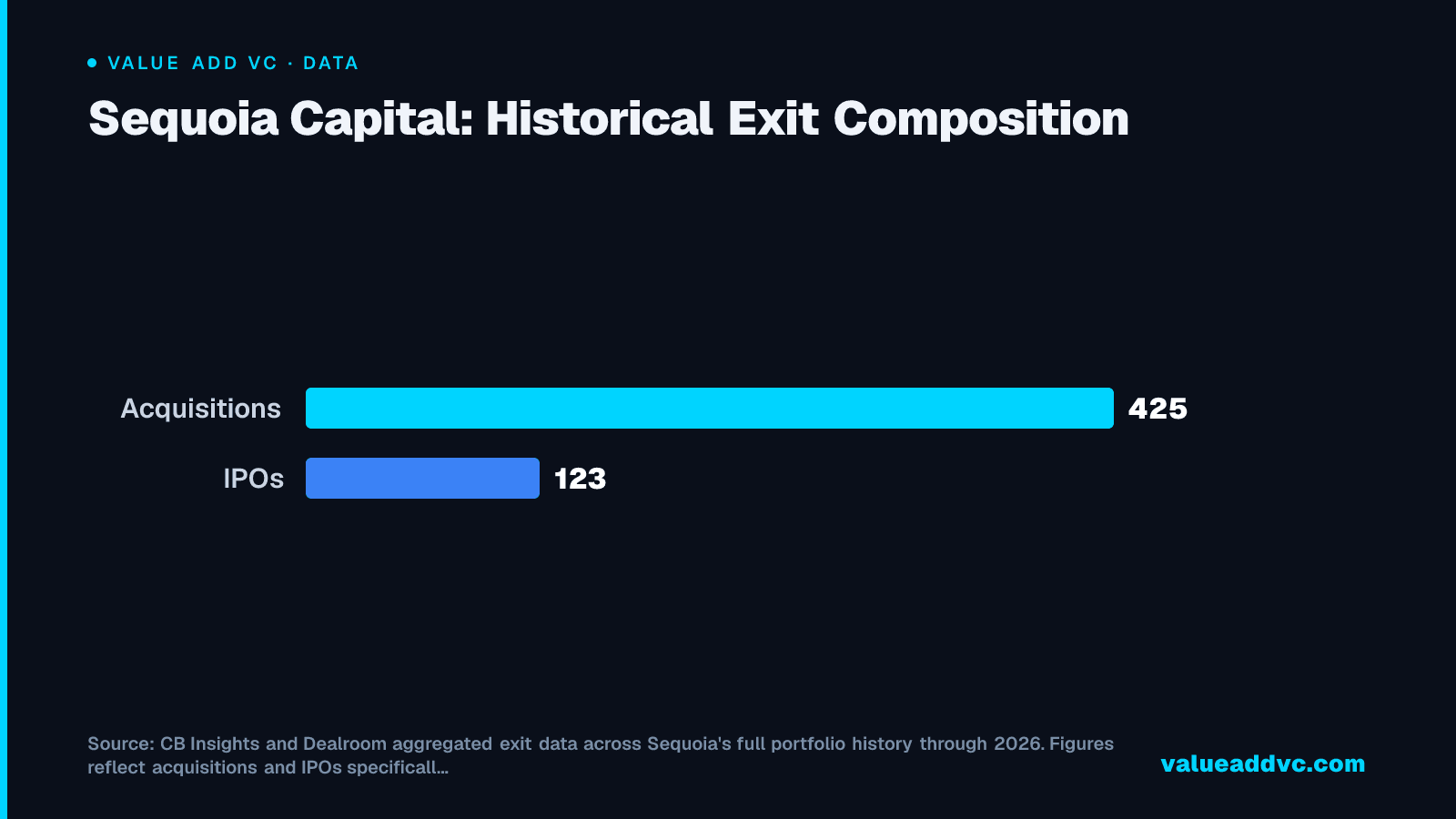
Sequoia made approximately 126 new investments in 2025 and had reached 66 through the first half of 2026 — a pace that tracks toward the firm's trailing 10-year average of roughly 82 new investments per year across its history of more than 1,694 total portfolio companies since founding in 1972. On the exit side, Sequoia's portfolio has produced an estimated 123 IPOs, 425 acquisitions, and 520 total exits across its history, including the $32 billion Wiz acquisition in 2025.
Sequoia Capital: Historical Exit Composition
CB Insights and Dealroom aggregated exit data across Sequoia's full portfolio history through 2026. Figures reflect acquisitions and IPOs specifically, not the full 520-exit total which includes other liquidity events.
Data
| Item | Value |
|---|---|
| Acquisitions | 425 |
| IPOs | 123 |
On fund performance, Sequoia Capital does not publicly disclose fund-level IRR or TVPI, and we found no pension-fund disclosure or SEC filing with current figures as of this update — a 14.78% since-inception IRR figure cited in an earlier version of this post traced back to “sequoiafund.com,” a domain that now belongs to the unrelated Sequoia ETF (run by Ruane Cunniff, a public-markets manager with no connection to Sequoia Capital), so we have removed it rather than let a misattributed number stand. What is well documented is that Sequoia's lifetime returns are highly concentrated in a handful of outlier vintages — most notably its 1996 fund, which included an early Google investment and has been widely reported as one of the best-performing venture funds in history — a reminder that even the best-known firm in venture capital produces most of its lifetime returns from a handful of funds, not a consistent baseline across every vintage.
What Sequoia's 2026 Portfolio Signals for the Rest of Venture Capital
Sequoia's shift toward fewer, larger, more concentrated AI bets — 60% of new capital since 2025, a $6 billion single check into xAI, reported interest in Anthropic's $25 billion round — is a bet that this AI cycle produces fewer, bigger winners than prior venture cycles did, not more diversified ones. That's a meaningfully different posture than the "spray and pray" seed-stage model that defined venture in 2020-2021, and it puts real pressure on smaller and mid-sized funds trying to compete for allocation in the same handful of marquee rounds.
For LPs and emerging managers, the practical read is that access to the handful of companies capable of returning a fund at this scale is increasingly gated by check size and relationship depth that only firms like Sequoia, a16z, and Thrive can offer. I track how this concentration shows up across the broader AI valuation landscape on our AI Valuations dashboard, where the same small set of companies keeps reappearing across every top-tier firm's disclosed portfolio.
There's a second-order effect worth flagging for founders, not just LPs: when the largest funds concentrate this heavily, the bar to get a Sequoia term sheet at all rises with it. A firm writing $6 billion checks into companies already valued at $50 billion isn't spending much partner time on a $3 million seed round, which is part of why Sequoia's seed and early-stage arms have quietly become smaller relative to the firm's total AUM even as headline deal count holds near its historical average of 82 investments a year. If you're raising a seed or Series A today, the realistic read is that Sequoia's brand halo is increasingly a growth-stage and AI-infrastructure story — not a signal about where the firm spends most of its actual attention at the earliest stages.
$85B in AUM, a $21.5B Stripe stake, and 60% of new capital going into AI since 2025.
Sequoia isn't diversifying its bets in this cycle — it's concentrating them.
The Bottom Line
Sequoia Capital's 2026 portfolio — an estimated $85 billion in AUM, anchored by OpenAI and a ~$21.5 billion Stripe stake, with 60% of new capital going into AI since 2025 — shows one of venture's most storied firms making its most concentrated bets in decades. The evergreen fund structure gives Sequoia the patience to hold winners indefinitely, but it also means the firm's returns now hinge more heavily than ever on a small number of AI mega-caps actually delivering.
Track more venture fund strategy and performance data on our VC Performance dashboard, or see how AI valuations compare across stages on AI Valuations.
Follow VC and startup market data on Value Add VC. Reach out at t@nyvp.com or @Trace_Cohen.
Latest from the Pulse
Get VC data most people never see
— free to subscribe
Trace's notes on venture, AI and startups, a few times a week. Join 5,000+ subscribers. No spam.
No spam, unsubscribe anytime. Sent via Substack · Privacy · or subscribe on Substack ↗