
Most people who want to run a company try to build one from scratch. A small but growing group of operators has figured out a smarter path: buy an already-profitable business and run it better.
That is the core idea behind the search fund — and the data on investor returns is difficult to ignore. Per the IESE Business School's ongoing study of the asset class, searchers who complete acquisitions have delivered aggregate pre-tax investor IRR of over 33% since the model was first formalized at Stanford in the 1980s. About 90% of completed acquisitions have returned capital.
It is not venture capital. It is not private equity. It is a category of its own, and it is worth understanding whether you are an aspiring operator, an angel investor, or an LP looking at alternatives.
How a Search Fund Works: The Two-Stage Model
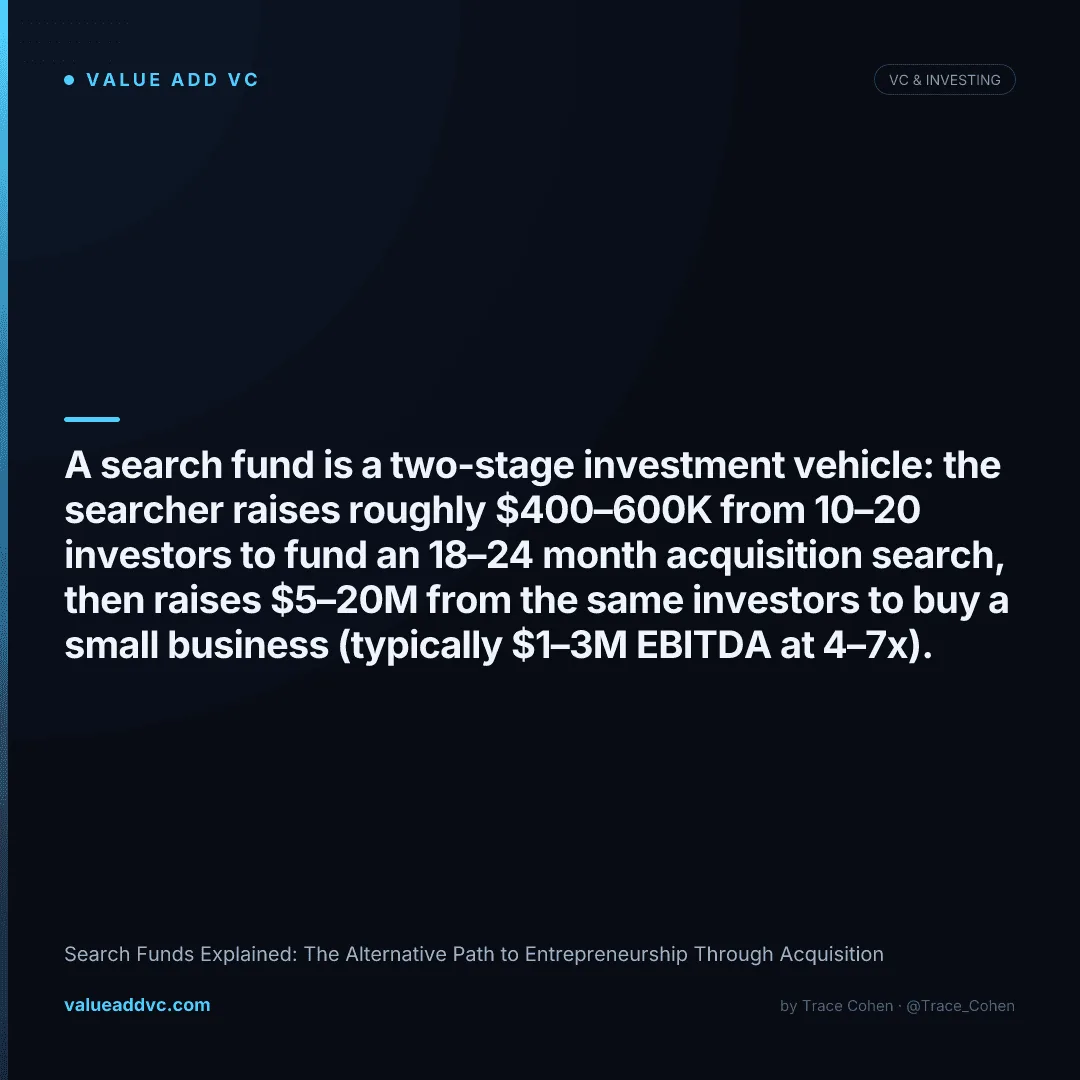
The mechanics are straightforward. The searcher — typically an MBA with 3–7 years of operating experience — raises a small pool of capital from investors to fund the search itself. Then, once a target is found, the same investor group decides whether to fund the acquisition.
Stage 1: Search Capital
$400K–$600K typicalThe searcher raises from 10–20 investors at $25K–$50K per check. This covers 18–24 months of salary (~$80–120K/year), deal sourcing costs, travel, and professional fees. In exchange, investors receive the right to pro-rata participation in any acquisition the searcher completes.
Stage 2: Acquisition Capital
$5M–$20M typicalOnce a target company is identified and under LOI, the searcher goes back to the investor group for acquisition financing. Total enterprise value is usually $5–30M at 4–7x EBITDA. Investors convert their search capital into equity (often at a discount) and participate in the equity raise.
The Target Profile: What Search Funds Buy
Search fund acquisitions cluster around a specific profile. These are not distressed businesses — they are boring, profitable, and often run by a founder who built something real over 20+ years and wants out.
| Attribute | Typical Range |
|---|---|
| EBITDA | $500K – $3M |
| Enterprise value | $3M – $20M |
| Acquisition multiple | 4x – 7x EBITDA |
| Revenue | $2M – $15M |
| Employee count | 10 – 75 |
| Business type | B2B services, SaaS, niche manufacturing |
| Growth rate | 5% – 20% organic |
| Customer concentration | No single customer > 20% of revenue |
Source: IESE Business School 2023 Search Fund Study (aggregate data since 1984)
The Search Fund Explained: Return Data That Matters
The IESE study is the most comprehensive longitudinal dataset available. Here is what the numbers show across decades of search fund activity:
~33%+
Aggregate pre-tax investor IRR
Across all completed acquisitions since 1984
5–7x
Median acquisition return on invested capital
For acquisitions that succeeded
~90%
% of completed acquisitions returning capital
Historical across all recorded transactions
30–40%
Search-to-acquisition conversion rate
Many searchers never close a deal
18–24 months
Median search duration
Before LOI on a target
$8M–$15M
Average total invested per deal
Search capital plus acquisition financing
The Searcher's Equity: How Compensation Works
The searcher is not just a hired CEO — they are an equity partner with a vesting schedule. Typical structures look like this:
20–30% equity granted
Granted from investor pool; searcher does not write a check in most structures
4–5 year vesting
Usually with a 1-year cliff; accelerates on change of control
+5–10% possible
Additional equity tranches tied to EBITDA growth or exit multiples
20–30% of proceeds
After investors receive preferred returns (typically 1–1.5x preference)
Search Fund vs. Self-Funded Search vs. PE Buyout
"Search fund" is often used loosely to describe all ETA activity, but there are meaningfully different structures:
Traditional Search Fund
Raise search capital from investors, then acquisition capital from same group. Searcher earns equity grant at close. Best for operators without personal capital who want investor mentorship.
Best for: First-time operators with strong investor networks
Self-Funded Search
Searcher funds their own time and acquires with SBA 7(a) or seller financing, retaining near-100% equity. No investor oversight, no equity sharing. Much higher personal financial risk.
Best for: Operators with savings or home equity who want maximum ownership
Sponsored Search
A PE firm or search fund sponsor provides upfront salary and deal sourcing support in exchange for priority rights to co-invest in acquisitions. Common in the lower middle market.
Best for: Operators with less investor network access but strong operating backgrounds
Small PE / Independent Sponsor
No committed fund; raise deal-by-deal. Targets are larger ($3M–$10M+ EBITDA) and buyers are more institutional. Returns are deal-specific, not search-fund-style.
Best for: Experienced operators or ex-PE professionals targeting larger assets
How to Evaluate a Searcher as an Investor
I have looked at dozens of search fund pitches. The variables that predict success are not always obvious from the deck.
Signals That Matter
- ✓ Specific industry thesis, not "I'll look at anything"
- ✓ Prior operating role where they managed P&L directly
- ✓ Existing relationships in a target sector
- ✓ Clear answer to "why would you run this for 5+ years?"
- ✓ Realistic on deal size — not hunting $50M targets
Red Flags
- ✕ Never run a P&L or managed a team directly
- ✕ Broad mandate with no industry preference
- ✕ Underestimates how hard sourcing proprietary deals is
- ✕ Looking for a "lifestyle business" — wrong mindset for investors
- ✕ Weak references from prior employers or investors
Where Search Funds Fit in a Portfolio
Search fund investments are illiquid (typically 4–7 year hold), high-variance (no acquisition = partial loss of search capital), and concentrated (one company per vehicle). They are not a core allocation for most LPs, but they belong in the conversation for:
- →Family offices and HNW individuals who can do 10–20 search fund investments per year to build diversification
- →Former operators who want to stay close to running companies without doing it full time
- →Institutional investors building emerging manager programs that include ETA
- →Anyone who finds small business operations intellectually interesting — the diligence is grounded, not speculative
Search funds are not a shortcut. They are a different kind of hard.
The best searchers win by going narrow, going deep, and being the most credible buyer in a boring category that everyone else ignores.
Explore VC and fund performance data on the VC Performance Dashboard and the Funds Tracker at Value Add VC. Originally published in the Trace Cohen newsletter.
Latest from the Pulse
Get VC data most people never see
— free to subscribe
Trace's notes on venture, AI and startups, a few times a week. Join 5,000+ subscribers. No spam.
No spam, unsubscribe anytime. Sent via Substack · Privacy · or subscribe on Substack ↗