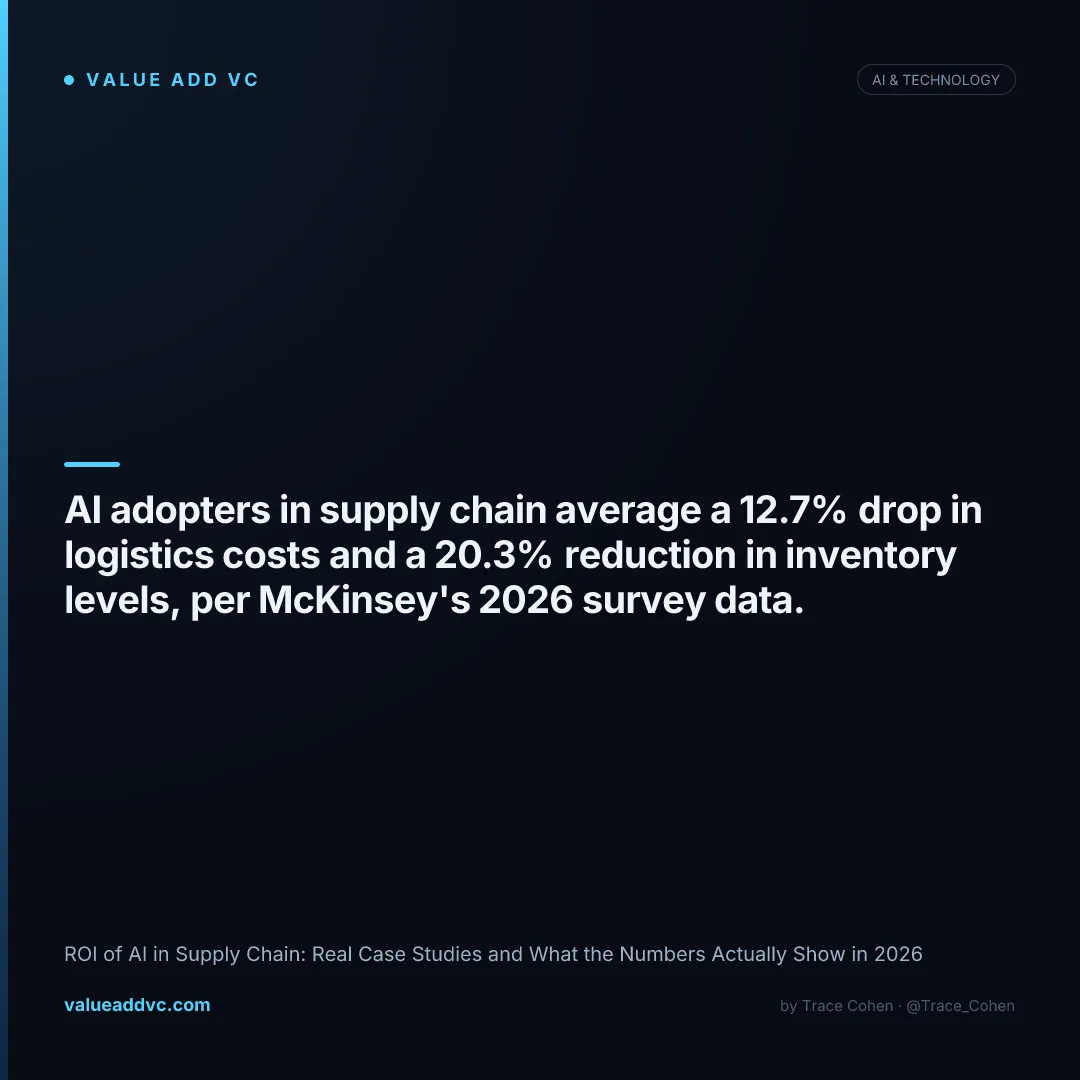
AI adopters in supply chain are averaging a 12.7% drop in logistics costs and a 20.3% reduction in inventory levels, per McKinsey's 2026 data — but only 6% of companies see any ROI within the first year.
That's the short answer. The longer answer is more interesting: the gap between the 94% of supply chain leaders who say they plan to use AI and the 23% who actually have a formal strategy is exactly where most of the wasted spend is happening. I've sat through enough vendor pitches promising instant payback to know the real numbers look messier — and more useful — than the marketing decks suggest.
What Is the Real ROI of AI in Supply Chain Management?
The real ROI of AI in supply chain management is a 12.7% average reduction in logistics costs and a 20.3% reduction in inventory levels among companies that have actually deployed AI, according to McKinsey's 2026 survey work. Gartner's separate data adds a profitability lens: AI-mature supply chains run 23% more profitably than peers, and 30% of AI-related spend in this category produces a 3x return. Those are real, audited numbers — not vendor projections — but they describe adopters who have already gotten past the pilot phase, which is a smaller group than the hype implies.
The honest caveat is that averages hide a bimodal distribution. Capgemini found 70% of adopters report ROI within 12 months, while McKinsey found only 6% do — the difference is almost certainly about what counts as "ROI" (a narrow cost-avoidance metric versus a fully loaded P&L view) and how mature the underlying data infrastructure was before AI got layered on top. Track the broader enterprise AI spending trend on our AI valuations dashboard, which benchmarks how public markets are pricing the infrastructure buildout behind these deployments.
Real Case Studies: What Companies Are Actually Reporting
Vendor case studies are self-selected and should be read skeptically, but a handful of disclosures are specific enough — named company, named metric, named timeframe — to take seriously as data points rather than marketing copy.
| Company / Study | AI Use Case | Reported Result | Timeframe |
|---|---|---|---|
| Fortune 500 automotive OEM | Transportation & delivery optimization | 22% transport cost cut, 25% better on-time delivery, 250% ROI | 2 years |
| General Mills | AI-driven shipment optimization (5,000+ daily) | $20M+ in cumulative savings | Since FY2024 |
| McKinsey survey aggregate | Logistics & inventory AI (all adopters) | 12.7% logistics cost drop, 20.3% inventory reduction | 2025-2026 |
| Gartner survey aggregate | AI-mature supply chain orgs | 23% higher profitability than peers | 2026 |
| Accenture distribution study | AI-enabled distribution operations | 5-20% logistics cost cut, 20-30% inventory cut, 5-15% procurement cut | 2024-2026 |
| Capgemini adopter survey | Mixed AI supply chain deployments | 15-20% average cost savings | 12 months |
| S&OP forecast accuracy studies | Machine learning demand forecasting | 20-40% forecast accuracy improvement | Ongoing |
Figures are 2025-2026 estimates blended from McKinsey, Gartner, Accenture, and Capgemini published survey data, plus company-disclosed case studies. Individual company results are not independently audited and may reflect selective disclosure.
The 2026 AI Supply Chain Adoption Gap
The single most important number in this space isn't a cost-savings percentage — it's the gap between stated intent and actual formal strategy. 94% of supply chain companies plan to use AI or generative AI for decision support within two years, per industry surveys, but only 23% currently have a formal AI strategy according to Gartner, and a Sage 2026 report found just 10% of 200 surveyed retail and wholesale operators had AI actually live in production workflows.
Gartner forecasts that by the end of 2026, over 60% of Fortune 1000 supply chains will run on generative AI-driven orchestration platforms, up from just 18% in 2023 — which means the funnel above is a snapshot mid-transition, not a steady state. The companies moving fastest through that funnel are the ones treating AI as an operating-model change, not a bolt-on tool.
Where the ROI Actually Comes From: Function-Level Breakdown
Not every supply chain function returns the same ROI. Accenture's function-level breakdown, backed up by Capgemini and McKinsey aggregates, shows inventory optimization consistently outperforming logistics and procurement on a percentage basis — inventory carrying costs are a bigger, more direct lever than transportation spend for most mid-market operators.
Demand forecasting deserves its own callout because it's the input that makes the other three categories work: machine learning embedded into S&OP processes is producing 20-40% improvements in forecast accuracy, which flows directly into lower safety stock, fewer stockouts, and better working capital efficiency. A company that skips straight to logistics-routing AI without fixing forecasting first is optimizing the wrong end of the pipe.
The Startup and Funding Angle Behind AI Supply Chain ROI
The market backing this shift is growing fast even if adoption inside large enterprises is uneven. The AI-in-supply-chain market has gone from roughly $6.5-7.3 billion in 2022-2024 to nearly $20 billion in 2026, with multiple forecasts putting it above $63-70 billion by 2030 — a compound annual growth rate north of 40%. That's attracting real venture capital into a category that used to be considered unsexy relative to consumer or fintech AI.
Well-capitalized players span the stack: project44 has raised over $200M for supply chain visibility and predictive analytics, GreyOrange has raised over $90M for autonomous warehouse robotics, and a wave of newer entrants — including narrower tools like Guac for grocery demand forecasting — are chasing the same inventory-optimization ROI numbers cited above at a fraction of enterprise-software price points. For investors tracking where AI infrastructure capital is actually flowing, our big tech earnings tracker shows how much of the underlying compute buildout is being absorbed by exactly these kinds of vertical AI workloads.
Why Most AI Supply Chain Projects Still Underdeliver on ROI
Gartner's 2026 research is blunt about the roadblocks: technology integration and talent are the two most commonly cited reasons AI pilots stall before reaching production, and a separate Gartner survey found AI is not yet driving meaningful operating-model transformation at most of the organizations that claim to be using it. That mismatch between disclosed investment and structural change is the biggest reason the 85% of companies increasing AI spend year over year haven't translated that spend into the 12.7%-22.3% cost improvements the leaders are reporting.
Three failure modes show up repeatedly in the survey data. First, data quality: legacy ERP and warehouse-management systems weren't built to feed a forecasting model, and companies that skip a data-cleanup phase see forecast accuracy gains far below the 20-40% range McKinsey and S&OP studies report. Second, org-model mismatch: AI orchestration tools assume a level of cross-functional coordination between procurement, logistics, and demand planning that most mid-market operators simply don't have, which is part of why Gartner still finds only 23% of organizations have a formal AI strategy despite years of vendor pressure. Third, premature measurement: teams that benchmark ROI at the six-month mark against McKinsey's 2-4 year typical payback window kill projects that were on track, which is likely a meaningful contributor to why only 6% of companies report fast ROI even though the underlying technology performs consistently once deployed correctly.
How to Actually Get ROI From AI in Your Supply Chain
Based on the case studies above and conversations with operators running these deployments, five patterns separate the 6% fast-ROI group from the multi-year majority:
1. Fix demand forecasting before anything else
20-40% forecast accuracy gains compound into every downstream metric — inventory, procurement, and logistics all get easier to optimize once the demand signal is trustworthy.
2. Formalize the strategy before scaling pilots
Only 23% of organizations have a formal AI strategy, and Gartner's data shows that group is disproportionately represented among the 3x-ROI outcomes — an ungoverned patchwork of pilots rarely compounds into enterprise-wide savings.
3. Target inventory optimization first for fastest payback
Inventory carries the largest share of reported AI supply chain savings (roughly 38% of the total in blended industry data), ahead of logistics, forecasting, and procurement individually.
4. Set a 2-4 year ROI expectation, not a 12-month one
McKinsey's data says most companies need 2-4 years for satisfactory ROI — setting board expectations around that timeline avoids the premature kill decisions that waste the sunk pilot cost.
5. Measure against a real cost baseline, not a vendor's demo
The gap between Capgemini's 70% one-year-ROI figure and McKinsey's 6% figure is almost entirely a measurement-methodology gap — insist on a fully loaded cost comparison, not a narrow before/after on one KPI.
The Bottom Line on AI Supply Chain ROI
The real ROI of AI in supply chain is genuine and measurable — 12.7% average logistics cost cuts, 20.3% inventory reductions, and standout cases like a Fortune 500 automaker hitting 250% ROI in two years. But it is not fast, and it is not evenly distributed: only 6-10% of companies are actually live in production with a formal strategy, and most of the reported gains belong to that smaller, more disciplined group rather than the 94% who merely intend to adopt.
For founders building in this space and investors evaluating them, the durable opportunity is in the tools that fix forecasting and inventory first — the two functions producing the largest, most reliably reported share of savings — rather than the flashier agentic-orchestration pitches that dominate the conference circuit but still lack the multi-year case-study base to back them up.
12.7% average logistics cost reduction and 20.3% inventory reduction from AI adopters in supply chain — but only 6% of companies see ROI within a year.
The tools work. The discipline to deploy them well is still the scarce resource.
Explore more AI and venture data on Value Add VC and in the Trace Cohen newsletter.
Latest from the Pulse
Get VC data most people never see
— free to subscribe
Trace's notes on venture, AI and startups, a few times a week. Join 5,000+ subscribers. No spam.
No spam, unsubscribe anytime. Sent via Substack · Privacy · or subscribe on Substack ↗