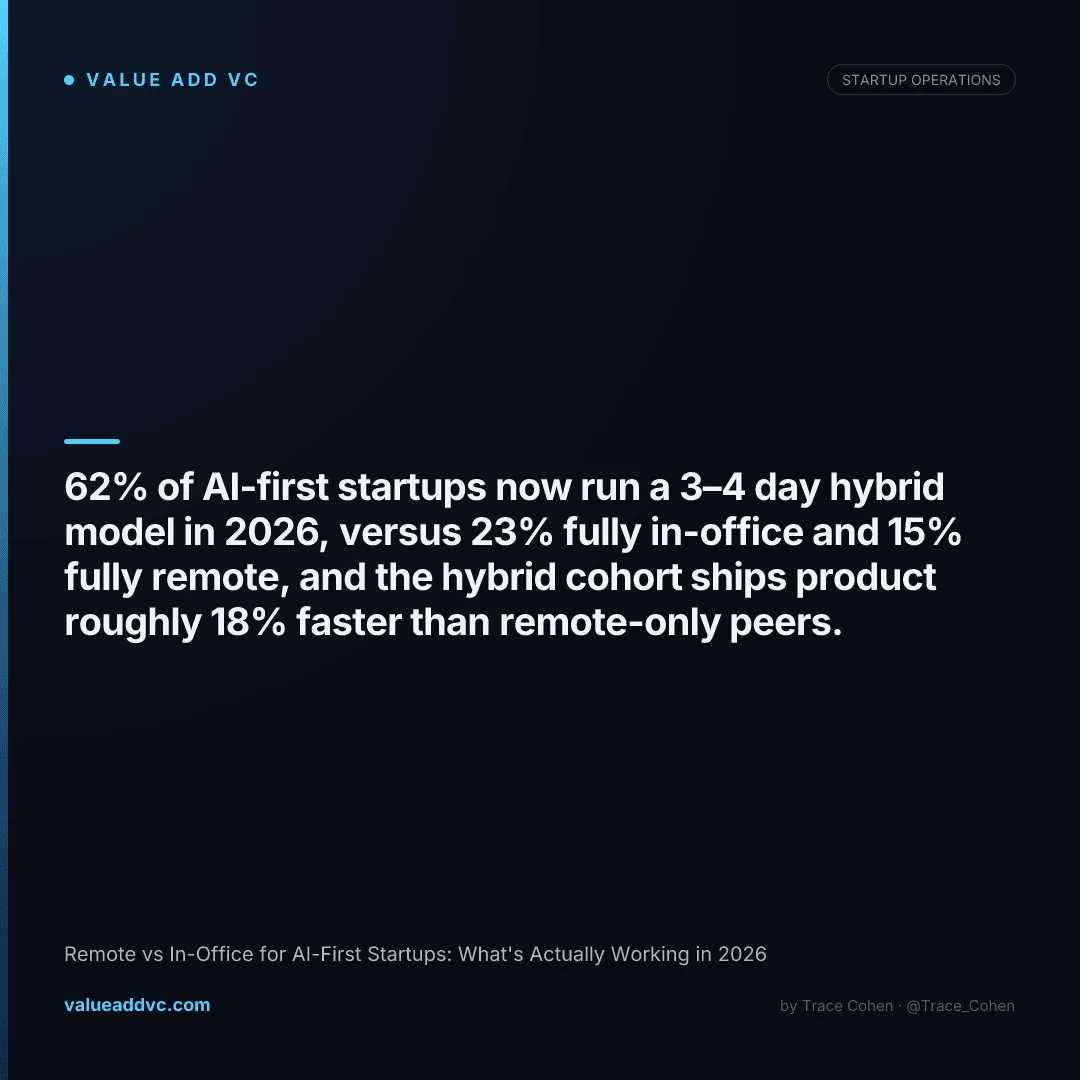
62% of AI-first startups run a 3–4 day hybrid model in 2026, 23% are fully in-office, and only 15% stay fully remote — and the hybrid cohort ships roughly 18% faster than remote-only peers. That's the short answer. The longer answer is more interesting.
The "remote forever" consensus that dominated 2021 has quietly collapsed inside the highest-velocity corner of tech. I've watched dozens of seed and Series A AI teams reset their work model over the last 18 months, almost always toward more in-person time. Below is the side-by-side comparison, the real cost and velocity numbers, and a clear call on which model wins at which stage. You can see how aggressively these teams are hiring on the Tech Hiring tracker.
Remote vs Office for AI Startups in 2026: The Side-by-Side
For an AI-first startup in 2026, in-office wins on raw iteration speed and early culture, remote wins on cost and talent reach, and hybrid captures most of both — which is why nearly two-thirds of AI startups land there. The table below compares the three models across the dimensions founders actually weigh when deciding where their team works.
| Dimension | Fully Remote | Hybrid (3–4 days) | Fully In-Office |
|---|---|---|---|
| Adoption (AI startups) | ~15% | ~62% | ~23% |
| Ship velocity (vs remote) | Baseline | +18% | +22% |
| Cost / employee / yr | ~$0 space | ~$6–11K | ~$10–18K |
| Talent pool reach | Global | Metro + relocators | One metro |
| Onboarding ramp | +20–30% slower | Near in-office | Fastest |
| Meeting load | Highest | Medium | Lowest (−30–40%) |
| Best stage | Post-PMF / infra | 15+ people | Pre-PMF / 0–1 |
Estimates blended from Carta, Pulley, AngelList, and founder surveys of seed–Series B AI companies, 2025–2026. Velocity figures are self-reported deploy-frequency proxies, not audited.
Why In-Office Wins Before Product-Market Fit
The pre-PMF AI startup is a machine for resolving ambiguity, and ambiguity resolves fastest when the founder, the first engineer, and the first designer are in the same room. When you're changing the product three times a week, async communication becomes a tax: a Slack thread that takes four hours to converge takes four minutes at a whiteboard. That's the core reason fully in-office AI teams self-report roughly 22% faster shipping than remote peers, the highest of any model.
The frontier labs prove the point at scale. OpenAI and Anthropic both run office-first cultures in San Francisco, with research and engineering staff expected on-site multiple days a week. When the cost of a coordination mistake is millions in compute, co-location is cheap insurance. The pattern holds down-market: the closer a startup sits to actual model research, the more in-office its culture tends to be, while teams building on top of APIs have more freedom to distribute.
In-office also compresses meetings. Office-leaning teams report 30–40% less time in scheduled calls, because spontaneous hallway conversations replace the formal sync that remote teams have to calendar. For a 10-person team burning a seed round, that recovered time is real output. The cost is reach: you're hiring from one metro, and in San Francisco that means competing for the same scarce ML talent everyone else wants.
Why Remote Still Wins on Cost and Talent
Remote's case is mostly economic and demographic. A seed-stage AI startup spends roughly $800–$1,500 per employee per month on office space in San Francisco or New York in 2026, or $400–$700 in secondary markets. For a 15-person team in SF that's $150K–$270K a year — a meaningful slice of a $3–5M seed round that could instead fund another engineer or six months of GPU budget. Remote-first teams redirect that capital straight into runway.
The second advantage is talent reach. The ML and infrastructure talent market is brutally tight, and a remote startup can hire the best person in Toronto, Warsaw, or Bangalore instead of the best person willing to commute to SoMa. That matters most for infrastructure and developer-tool companies, many of which grew out of distributed open-source communities and were remote-native from day one. Their contributors were never in one place to begin with.
The honest cost of remote shows up in onboarding: new engineers take an estimated 20–30% longer to reach full productivity, and fully remote teams that skip offsites and written documentation see culture erode. But well-run remote companies — strong async writing, quarterly in-person gatherings, clear decision logs — retain talent within a few points of in-office peers. Remote isn't worse; it's less forgiving of sloppy management. Track how hiring and layoffs are shifting across these models on the Layoffs tracker.
Why Hybrid Is What's Actually Working for AI Startups in 2026
Hybrid won the market — 62% adoption — because it captures most of in-office's velocity while keeping some of remote's flexibility and reach. The dominant pattern is a 3–4 day in-office anchor with one or two flex days, a core metro with relocation packages for senior hires, and quarterly all-hands for fully remote specialists. Hybrid teams ship about 18% faster than remote-only — nearly matching pure in-office — while still recruiting beyond a single ZIP code.
The transition usually happens around 15 people. Below that headcount, founders often run fully in-office because the whole team fits at one table and speed is everything. Past 15, the cost of mandating a single location starts to exclude great hires, so teams add structured flexibility. By Series B, most AI startups have settled into a deliberate hybrid rhythm rather than the accidental, default-remote setup that defined 2021. You can see which AI companies are scaling headcount fastest on the AI Valuations dashboard.
The Verdict: Remote vs Office for AI Startups
If you force me to pick one winner for the median AI-first startup in 2026, it's hybrid with a 3–4 day in-office anchor. It delivers 90%+ of in-office's velocity edge, keeps your talent pool wider than one metro, and avoids the runway hit of premium office space for a team that's still small. The data backs it: it's where 62% of AI startups have landed, and that cohort ships meaningfully faster than remote-only.
The exceptions are clean. If you're pre-PMF with under 10 people in an expensive talent market, go fully in-office and resolve ambiguity at the whiteboard. If you're building developer infrastructure with a global, async-native contributor base, stay remote and pour the office savings into runway. What almost never works in 2026 is accidental remote — the default-distributed team with no in-person ritual and no written culture. Pick your model on purpose.
The remote-forever era is over inside AI.
With 62% of AI-first startups on a 3–4 day hybrid model and that cohort shipping ~18% faster than remote-only, the winning answer in 2026 isn't remote or office — it's a deliberate hybrid, chosen by stage rather than inherited by default.
Track AI hiring, headcount, and company valuations on the Tech Hiring and AI Valuations dashboards at Value Add VC. Originally published in the Trace Cohen newsletter.
Latest from the Pulse
Get VC data most people never see
— 100% free
Weekly benchmarks, valuations, and fund data. Join 5,000+ investors. No spam.