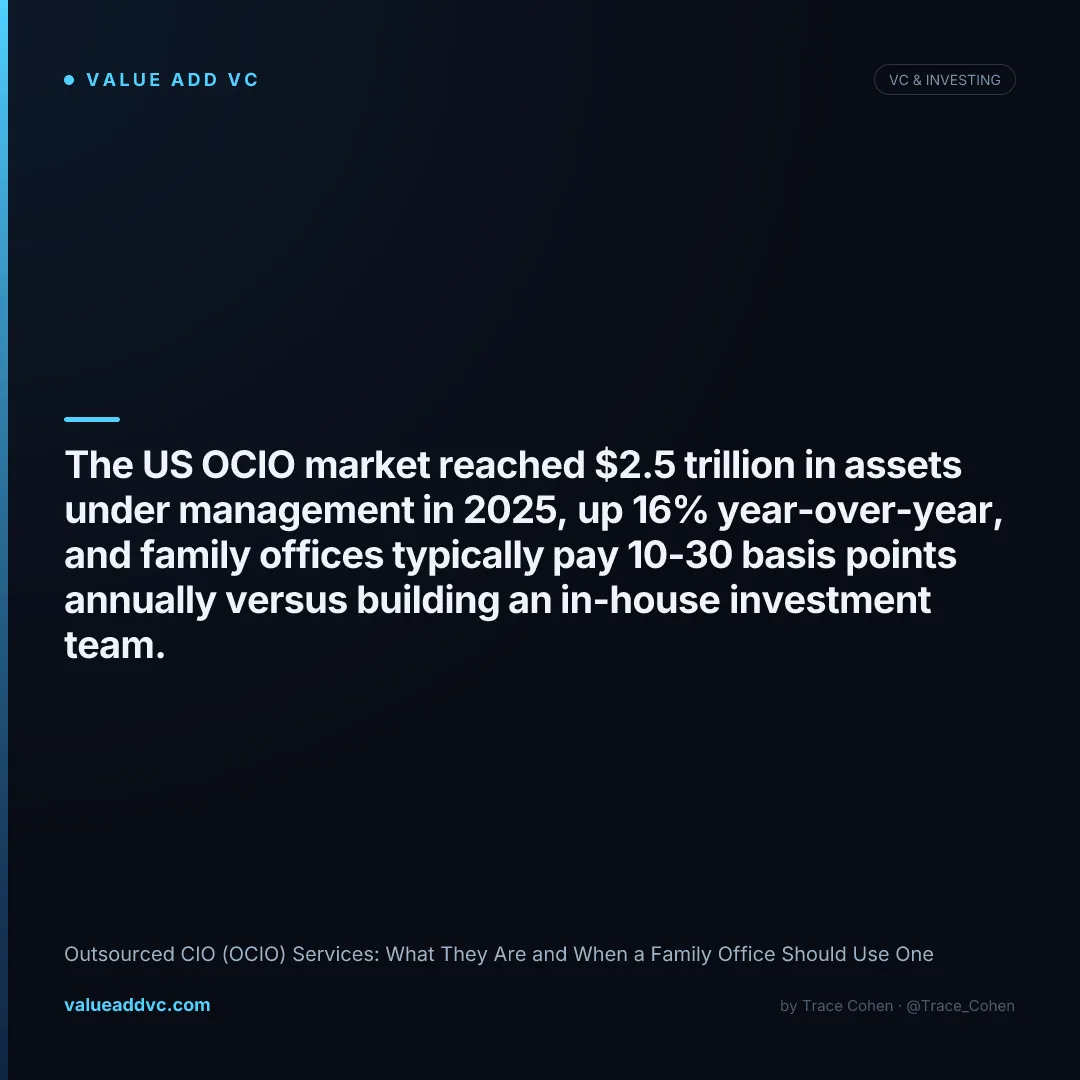
The US OCIO market reached $2.5 trillion in assets under management in 2025, up 16% year-over-year, and family offices typically pay just 10-30 basis points a year for a service that would cost $800K to $2M+ to replicate in-house. That's the short answer. The longer answer is what an OCIO actually does day-to-day and where the break-even point sits for your specific family office.
Outsourced CIO arrangements used to be a niche solution for small pensions and endowments that couldn't justify a full internal investment staff. That's changed. Cerulli Associates projects the global OCIO industry will grow to $5.6 trillion by roughly 2029-2030, a 10.6% average annual growth rate, and family offices are now one of the fastest-growing client segments driving that expansion — precisely because more families are getting wealthier and their portfolios are getting more complex faster than they can hire to match.
Figures from Chestnut Advisory Solutions' 2025-2026 OCIO Market Leader Awards, Cerulli Associates' US OCIO industry research, and Chief Investment Officer magazine reporting on 2025 AUM data.
What Is an Outsourced CIO (OCIO) and What Does It Actually Do?
An outsourced CIO is a third-party firm hired to take over discretionary investment management for a family office, endowment, foundation, or pension — asset allocation, manager selection and due diligence, rebalancing, risk oversight, and performance reporting — functioning as the family's investment office without the family building that staff itself. The OCIO takes on full or partial discretion, meaning it can execute trades and rebalance the portfolio directly against an agreed investment policy statement, rather than simply advising and waiting for sign-off on every decision the way a traditional investment consultant does.
The distinction from a traditional advisor matters. A consultant makes recommendations; an OCIO implements them. For a family office managing venture and private market exposure alongside public equities, fixed income, real estate, and alternatives, that implementation speed is often the whole point — capital calls, manager onboarding, and rebalancing across a 15-25 manager portfolio is a full-time operational job that most single-family offices underestimate until they're three years into building it themselves.
Bank of America was named the No. 1 nonprofit OCIO provider globally in 2025, and Morgan Stanley topped the US-specific ranking with $246.9 billion in domestic OCIO assets, according to Chestnut Advisory Solutions' 2025-2026 rankings — evidence that both bank-affiliated platforms and independent consultants (Mercer, Cambridge Associates, Willett Advisors) are competing hard for the same family office dollars.
OCIO Fees: What Family Offices Actually Pay
OCIO fees are quoted in basis points of assets under management and scale down as the account grows. Larger institutional mandates frequently pay below 10 basis points (0.10%), while smaller family office accounts more commonly land in the 20-30 basis point range, per industry fee surveys cited by Waterloo Capital and Cornerstone Portfolio Research. That fee typically covers the full scope — allocation, manager selection, rebalancing, and reporting — though performance-based or tiered structures exist for more complex or alternatives-heavy mandates.
| Portfolio Size | Typical OCIO Fee | Annual Cost | In-House Team Alternative |
|---|---|---|---|
| $50M | 25-30 bps | $125K-$150K | Not viable — too small for 1 FT hire |
| $100M | 20-25 bps | $200K-$250K | ~1 analyst, no full CIO |
| $250M | 15-20 bps | $375K-$500K | CIO + 1-2 analysts (~$800K-$1.2M) |
| $500M | 10-15 bps | $500K-$750K | CIO + 3-4 staff (~$1.5M-$2M) |
| $1B | 8-12 bps | $800K-$1.2M | Full internal team (~$2M-$3M+) |
| $2B+ | 5-10 bps | $1M-$2M | Hybrid model common at this scale |
Figures are 2026 estimates blended from Waterloo Capital's OCIO fee guide, Cornerstone Portfolio Research fee benchmarking, and typical family office staffing cost surveys. Actual fees vary by mandate complexity, alternatives exposure, and provider.
When Should a Family Office Use an OCIO Instead of Building In-House?
The break-even point most practitioners cite sits around $100-250 million in investable assets — below that, hiring even a lean 1-2 person internal team rarely pencils out against a 20-30 basis point OCIO fee, and the family gets access to institutional manager relationships, due diligence infrastructure, and reporting technology it couldn't build alone at that size. Above roughly $1-2 billion, the math starts to favor at least a partial in-house build, since fixed staffing costs get diluted across a larger base and some families want direct control over manager selection and deal flow, particularly for venture and private market allocations.
Complexity matters as much as size. A family office with a straightforward 60/40 public markets portfolio has less need for an OCIO than one juggling direct co-investments, multiple VC fund commitments, real estate, and illiquid alternatives across a dozen or more manager relationships — the operational burden of that complexity is exactly what OCIOs are built to absorb. Families going through a liquidity event (a business sale or IPO) and suddenly managing nine figures for the first time are also classic OCIO candidates, since they need institutional infrastructure immediately and don't yet have the internal team or track record to build it themselves.
The tradeoff is control and customization. An OCIO operates within an agreed investment policy statement and reports back, but day-to-day manager selection and rebalancing decisions happen at the OCIO, not the family — a real shift for families used to hands-on involvement in every allocation decision. Some families resolve this with a hybrid model: OCIO for public markets and manager due diligence, in-house for direct deals and relationship-driven venture allocations where the family's own network is the edge.
Who Are the Largest OCIO Providers in 2026?
By global outsourced AUM, Mercer leads the market at roughly $670 billion, followed by Goldman Sachs Asset Management at about $450 billion, BlackRock near $400 billion, and Russell Investments around $355 billion, per Chestnut Advisory Solutions' 2025-2026 Market Leader Awards. For the US market specifically, Morgan Stanley ranks first with $246.9 billion in domestic OCIO AUM, reflecting how bank-affiliated wealth platforms have built out dedicated OCIO arms to compete with the traditional consulting-heritage providers.
The provider landscape splits roughly into three types: global consulting-heritage firms (Mercer, Cambridge Associates, Willis Towers Watson) that built OCIO practices out of pension and endowment consulting; asset managers running OCIO as a distribution channel (Goldman Sachs, BlackRock, Russell); and boutique or family-office-specific providers (Willett Advisors, various RIA-affiliated OCIOs) that compete on customization and relationship depth rather than scale. Family offices evaluating providers should weigh scale and resources against how much of a boutique, high-touch relationship they actually want — a $150M family office is often a rounding error to a $670B global platform.
How to Evaluate and Select an OCIO Provider
Most family offices run a structured RFP process before hiring an OCIO, and the questions that separate a good fit from a bad one rarely show up in a marketing deck. First, ask about discretion level — full discretion means the OCIO can rebalance and execute without sign-off on every trade, while advisory-plus-implementation models require the family's approval before capital moves. Second, ask how the OCIO is compensated: some earn revenue purely on the basis-point management fee, while others also collect distribution fees or revenue-sharing from underlying fund managers they recommend, a conflict that ILPA and industry fiduciary standards increasingly require providers to disclose upfront.
Track record transparency matters more than a provider's total AUM. A $670 billion platform like Mercer manages dozens of distinct client mandates with different risk targets, so the headline AUM number says little about how a specific family office's portfolio actually performed. Ask for performance net of all fees, benchmarked against a custom blend that matches the family's actual risk tolerance and liquidity needs — not a generic 60/40 benchmark that flatters an OCIO's track record but has nothing to do with the family's real portfolio.
Finally, ask how the OCIO handles venture capital and private market allocations specifically, since this is where OCIO quality varies most. Some providers have deep private markets due diligence teams and direct access to top-tier VC funds; others primarily place clients into fund-of-funds vehicles with an extra layer of fees. A family office with existing VC relationships or deal flow should ask explicitly whether the OCIO will defer to the family's own sourcing on venture allocations or insist on running that sleeve through its own recommended managers.
OCIO vs In-House CIO: The Real Tradeoffs Beyond Cost
Cost is the easiest variable to compare, but it isn't the only one. An in-house CIO and internal team offer something an OCIO structurally cannot: full-time attention devoted to one family's specific goals, tax situation, and multi-generational planning horizon, with no other clients competing for that attention. A dedicated CIO can also build institutional knowledge over years — understanding exactly why a family holds a concentrated legacy position or how a specific trust structure constrains what can be sold — in a way that's harder to replicate through an OCIO relationship manager juggling dozens of accounts.
The OCIO advantage is scale economics and bench depth. A single internal CIO is a key-person risk — if that person leaves, the family office can lose years of institutional knowledge overnight — while an OCIO platform has redundancy built in, plus access to manager due diligence infrastructure, risk systems, and research teams that would cost far more than 10-30 basis points to replicate internally at any but the very largest family office scale. This is why the fastest-growing segment of the OCIO market by client count is exactly the $100-500 million family office tier: large enough to need institutional infrastructure, not yet large enough to build a full internal bench and absorb key-person risk comfortably.
The honest answer for most families crossing the $250 million to $1 billion range is that the OCIO-versus-in-house decision isn't permanent. Family offices commonly start with a full OCIO relationship during a liquidity event or early wealth-building years, then gradually bring functions in-house — often starting with direct venture and real estate allocations where relationship-driven deal flow matters most — as the family's own team and network mature.
Bottom line: The US OCIO market's $2.5 trillion in AUM and 16% growth in 2025 reflect a real structural shift — more family offices are choosing to outsource the CIO function rather than build it, and the fee math (10-30 basis points versus $800K-$2M+ in internal staffing) makes that choice increasingly obvious below roughly $250 million in investable assets. Above that threshold, the decision gets more nuanced, and the right answer for most growing family offices is a hybrid model rather than an all-or-nothing choice.
Latest from the Pulse
Get VC data most people never see
— free to subscribe
Trace's notes on venture, AI and startups, a few times a week. Join 5,000+ subscribers. No spam.