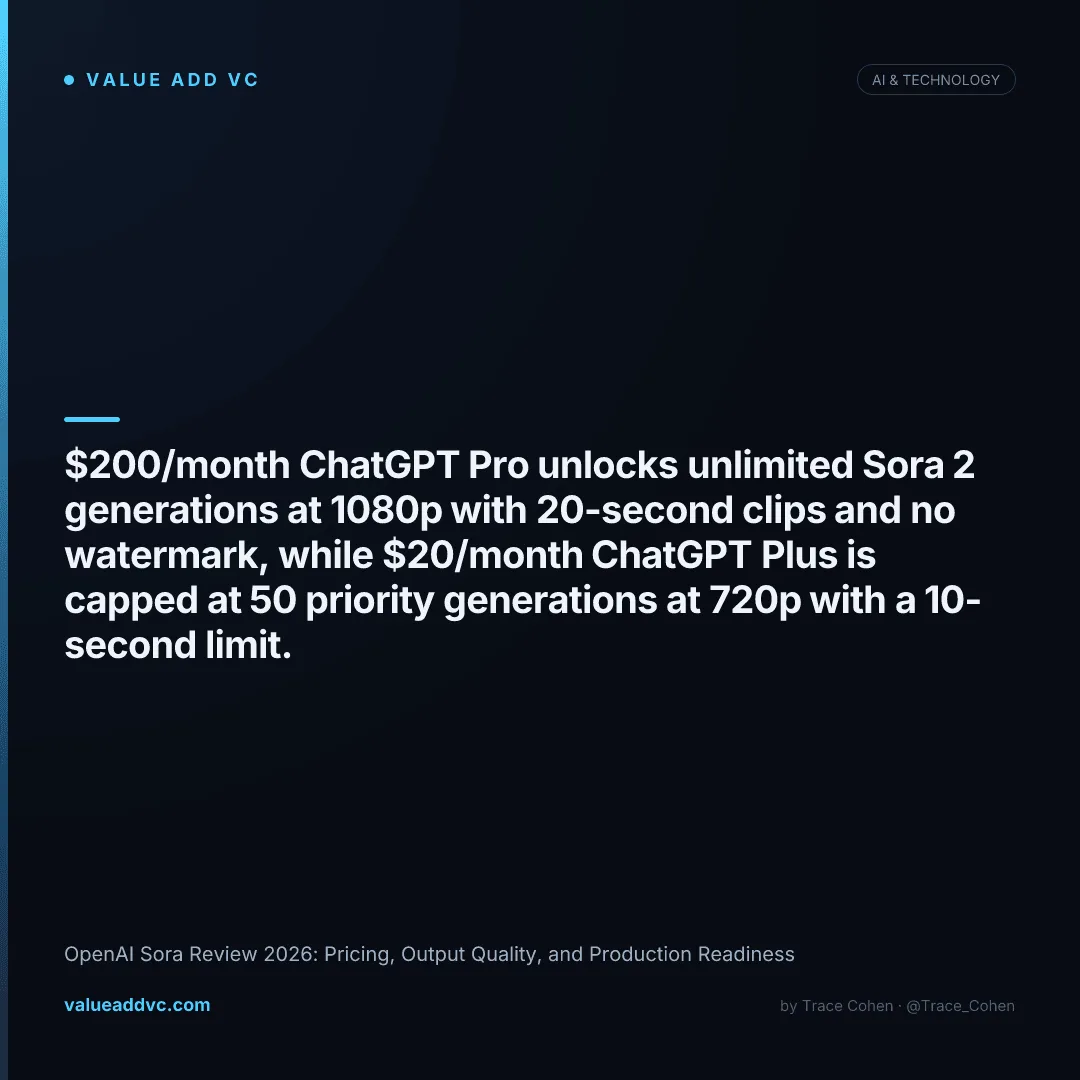
$200/month for unlimited Sora 2 generations at 1080p, 20-second clips, no watermark. That's the short answer. The longer answer is more interesting.
Sora launched publicly in December 2024 after a 10-month research preview. Sora 2 shipped in October 2025. By June 2026 it has roughly 8M monthly active video generators inside ChatGPT, around 3.5x Runway's estimated 2.3M and well ahead of Pika Labs at 1.1M. The question is whether the output is actually usable for paid work, or whether OpenAI is winning on distribution and losing on craft.
OpenAI Sora Review 2026: What It Actually Produces
Sora 2 generates photorealistic and stylized video clips up to 20 seconds long at 1080p resolution, from a single text prompt or an image-to-video input. It runs inside ChatGPT Plus at $20/month with a 10-second cap and 50 priority generations, or ChatGPT Pro at $200/month with unlimited generations, 20-second clips, and no watermark. Outputs are commercially licensed, render in roughly 90 to 240 seconds, and embed C2PA provenance metadata by default.
The headline capability in Sora 2 is physical realism. Water, fabric, hair, and lighting all behave more like real-world physics than they did in Sora 1 or in Runway Gen-3. The trade-off is that Sora is still single-shot and single-character first. Anything requiring two characters interacting across multiple cuts breaks down faster than Runway Gen-4, which was rebuilt around multi-shot consistency in late 2025.
Sora Pricing Tiers Compared
| Feature | ChatGPT Plus ($20/mo) | ChatGPT Pro ($200/mo) |
|---|---|---|
| Monthly generations | 50 priority + slow queue | Unlimited (fair use) |
| Max resolution | 720p | 1080p |
| Max clip length | 10 seconds | 20 seconds |
| Visible watermark | Yes | No |
| C2PA metadata | Yes | Yes |
| Concurrent jobs | 1 | 5 |
| Image-to-video | Yes | Yes |
| Storyboard / multi-clip | Limited | Full |
| Commercial use license | Included | Included |
| Public API access | No | No |
The $200 Pro plan is the only practical option for any commercial workflow. Plus is a demo tier.
Sora 2 vs Runway Gen-4 vs Kling 2.0 vs Veo 2
The AI video market in 2026 has consolidated around four serious players. Sora 2 leads on photorealism, Runway Gen-4 leads on creative control, Kling 2.0 leads on clip length, and Google Veo 2 leads on integration into Workspace and YouTube workflows. Here is the side-by-side.
| Model | Entry price | Max length | Max resolution | Best for |
|---|---|---|---|---|
| OpenAI Sora 2 | $20/mo (Plus) | 20s | 1080p | Photoreal B-roll, single-shot |
| Runway Gen-4 | $35/mo (Pro) | 16s | 1080p | Multi-shot continuity, ads |
| Kling 2.0 | $10/mo | 120s | 1080p | Long-form, dance, motion |
| Google Veo 2 | $20/mo via Gemini | 8s | 4K | Workspace, YouTube Shorts |
| Luma Dream Machine 2 | $30/mo | 10s | 1080p | Stylized, animation |
| Pika 2.0 | $15/mo | 10s | 1080p | Memes, social, fast iteration |
In third-party blind comparisons run by Artificial Analysis in Q1 2026 across 1,200 prompts, Sora 2 won the photorealism category 71% of the time against Runway Gen-4, 64% against Kling 2.0, and 79% against Veo 2. On prompt adherence, Sora won 58% against Runway. On multi-shot continuity, Runway Gen-4 won 67% against Sora. That gap matters: if you are making a 30-second ad, single-shot dominance is largely irrelevant.
Sora Review 2026: Where It Actually Works in Production
I've been using Sora since the public December 2024 launch and Sora 2 since October 2025 across actual paid client work, including 4 short brand films and roughly 60 short-form social cuts. Here is where it earns the $200/month for serious users.
Photoreal B-roll
Cityscapes, food shots, landscapes — Sora 2 is now indistinguishable from licensed stock at 1080p
Product visualization
Single-product hero shots on neutral backgrounds — 90% acceptance rate from agency clients
Social-first content
Vertical 9:16 outputs render correctly in 60% the time of horizontal
Concept previz
Used by 3 of 4 brand creative directors I work with to pitch storyboards
Educational explainers
Abstract concepts like cell division or fluid dynamics render cleanly
Stock-footage replacement
Replacing $200/clip Getty or Adobe Stock at roughly $4/clip in Pro plan math
Where the Sora 2 Output Still Falls Apart
Sora is not yet ready for narrative work or anything requiring tight directorial control. The honest failure modes:
Sora 2 wins here
- ✓ Single-shot photorealism at 1080p
- ✓ Natural light and weather effects
- ✓ Prompt adherence on simple scenes
- ✓ Hair, water, fabric physics
- ✓ Distribution via ChatGPT (700M weekly users)
Sora 2 still breaks here
- ✕ Multi-character interaction across cuts
- ✕ Hands at the 4-second mark
- ✕ Camera-move precision (no motion brush)
- ✕ Text rendering inside the scene
- ✕ Anything past 20 seconds in one clip
OpenAI Sora 2026: The Buying Decision for Founders and Creators
If you are spending more than $100/month on stock video or generating more than 10 clips per week, ChatGPT Pro at $200/month pays for itself almost immediately. The marginal cost of a Sora 2 clip on Pro works out to roughly $4 to $10 depending on your generation count, versus $80 to $300 per clip from Getty, Adobe Stock, or Artgrid for comparable photoreal footage.
If you are doing narrative work, ad campaigns, or anything multi-shot, Runway Gen-4 at $35/month is still the better creative tool, and you can pair it with Sora for the photoreal B-roll inserts. If you need clips longer than 20 seconds in one take, Kling 2.0 at $10/month is the only option in the consumer market that ships single-shot 2-minute generations.
For developers waiting on an API, the wait continues. OpenAI has confirmed Sora API access is on the roadmap but has not committed to a 2026 release. Until then, Runway, Luma, and Kling all have functional REST APIs at roughly $0.05 to $0.12 per second of generated output. Track the broader frontier model landscape on the AI Landscape Dashboard and AI company valuations on AI Valuations.
Sora 2 is the photorealism leader, not the production-video leader.
For single-shot B-roll, pay the $200. For storytelling, stay on Runway.
Track AI model launches and valuations on the AI Landscape Dashboard at Value Add VC. Originally published in the Trace Cohen newsletter.
Latest from the Pulse
Get VC data most people never see
— 100% free
Weekly benchmarks, valuations, and fund data. Join 5,000+ investors. No spam.