
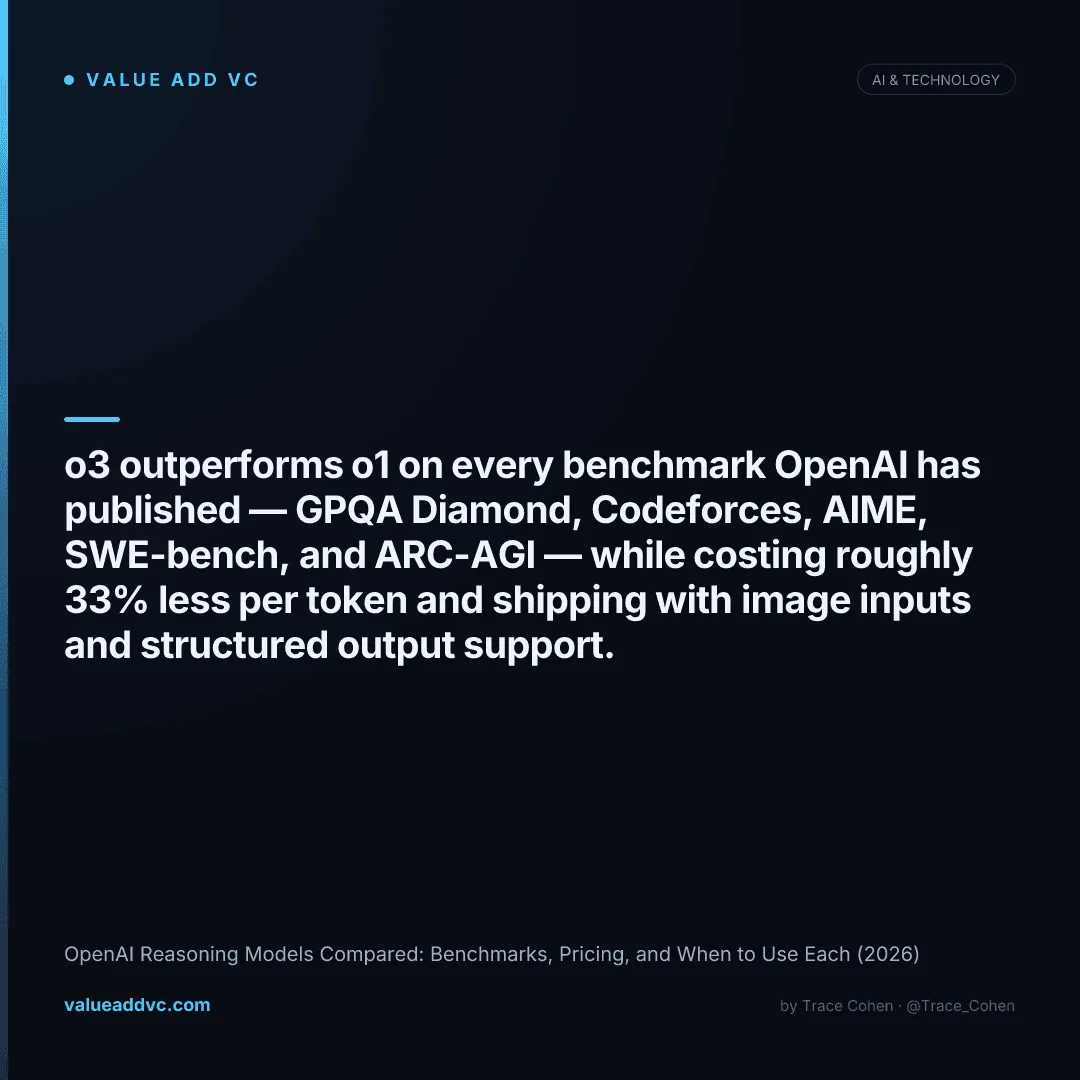
o3 beats o1 on every benchmark OpenAI has published — 87.7% vs 78.0% on GPQA Diamond, 96.7% vs 83.3% on AIME 2024, and 2,727 vs 1,891 Codeforces Elo — and costs 33% less per token.
That's the short answer. The longer answer is more interesting — because the latency, cost-per-task math, and tool support change which model you actually want in production.
OpenAI o3 vs o1: The Full Benchmark and Pricing Comparison
OpenAI o3 outperforms o1 on every public benchmark by 8 to 50+ percentage points, costs roughly 33% less per million tokens ($10 input / $40 output vs $15 / $60), and adds image input support that o1 lacks. The trade-off is latency: o3's default reasoning effort burns 25% more thinking tokens than o1, pushing typical response times from 9 seconds to 12 seconds. For most production use cases, that's an easy trade. That generational leapfrogging hasn't stopped — today's frontier reasoning models push those same benchmarks even further.
| Metric | o3 | o1 | Winner |
|---|---|---|---|
| GPQA Diamond (PhD science) | 87.7% | 78.0% | o3 (+9.7pp) |
| AIME 2024 (math) | 96.7% | 83.3% | o3 (+13.4pp) |
| Codeforces Elo (competitive coding) | 2,727 | 1,891 | o3 (+836) |
| SWE-Bench Verified (real bugs) | 71.7% | 48.9% | o3 (+22.8pp) |
| ARC-AGI (semi-private) | 87.5% | 32.0% | o3 (+55.5pp) |
| Input price / 1M tokens | $10.00 | $15.00 | o3 (-33%) |
| Output price / 1M tokens | $40.00 | $60.00 | o3 (-33%) |
| Context window | 200K | 200K | Tie |
| Max output tokens | 100K | 100K | Tie |
| Image inputs | Yes | Yes | Tie |
| Function calling | Yes | Yes | Tie |
| Structured outputs | Yes | Yes | Tie |
| Reasoning effort param | low/medium/high | none | o3 |
| Avg latency (medium effort) | ~12s | ~9s | o1 (-25%) |
Source: OpenAI o3 system card (December 2024), o1 system card (December 2024), and OpenAI API pricing page as of June 2026.
Where o3 Wins Decisively Over o1
The headline benchmark numbers undersell what o3 actually does differently in production. Four areas matter the most.
Real-world coding tasks (SWE-Bench Verified)
+22.8ppo3 solves 71.7% of SWE-Bench Verified problems vs 48.9% for o1. That's the closest benchmark we have to 'fix a real bug in a real repo' — Princeton's verified split, GitHub issues from 12 popular Python projects. The 22.8 percentage point gap is the difference between an autonomous coding agent that ships and one that needs a human pair every other commit. If you're building a Cursor-style or Devin-style tool on top of OpenAI, o3 is non-negotiable.
Visual reasoning and chart interpretation
+35–40ppo3 supports image inputs natively and scores 78.6% on MMMU vs ~52% for early o1 image-enabled runs. For analyst-style work — reading 10-K charts, interpreting financial schematics, parsing dashboard screenshots — o3 is the first OpenAI reasoning model that's actually usable. Anthropic Claude Sonnet was the previous standard here; o3 closes most of that gap.
Abstract reasoning (ARC-AGI)
+55.5ppo3 scored 87.5% on the ARC-AGI semi-private set with high compute, vs 32% for o1. ARC-AGI is the closest thing to a 'novel reasoning' benchmark — patterns the model has never seen. The high-compute mode burns $5,000+ per task, so this isn't production-relevant on price, but it tells you the model has genuinely better abstraction. Low-compute mode still beat o1 by 18pp at a tractable price.
Math at the elite level (AIME, IMO-adjacent)
+13.4ppo3 hits 96.7% on AIME 2024 vs 83.3% for o1. AIME is the qualifier for the USA Math Olympiad — 15 problems, 3 hours, integer answers 0–999. 96.7% means o3 misses roughly half a problem on a test where the median high-school competitor scores 4 out of 15. For any client building math tutoring, quantitative finance research, or scientific computing tools, this is the model.
The Real Cost: o3 vs o1 Per-Task Math
Token pricing is misleading because reasoning models charge for invisible chain-of-thought tokens. On a typical medium-complexity prompt — a SWE-Bench-style bug fix or a 5-paragraph research question — here's what an end-to-end request actually costs.
| Component | o3 (medium effort) | o1 (default) | GPT-4 |
|---|---|---|---|
| Input tokens | 2,000 @ $10/M = $0.020 | 2,000 @ $15/M = $0.030 | 2,000 @ $2.50/M = $0.005 |
| Reasoning tokens | 8,000 @ $40/M = $0.320 | 6,400 @ $60/M = $0.384 | 0 |
| Visible output tokens | 600 @ $40/M = $0.024 | 600 @ $60/M = $0.036 | 600 @ $10/M = $0.006 |
| Total per request | $0.364 | $0.450 | $0.011 |
| Avg latency | 12s | 9s | 1.8s |
| Cost per 1,000 requests | $364 | $450 | $11 |
o3 costs 19% less per request than o1 at medium reasoning effort. But both reasoning models cost 33–40x more than GPT-4 on the same prompt. The right architecture is almost always: route easy queries to GPT-4, escalate hard ones to o3, never default to o3 for everything. Tracking this build-vs-buy math is the same logic that drives AI startup valuations in 2026 — the winners route compute, they don't spray it.
When to Use o3 vs o1 vs GPT-4
Use o3 when
- ✓ Building coding agents on SWE-Bench-style tasks
- ✓ Math, physics, or quantitative analysis
- ✓ Multi-step planning with image inputs
- ✓ Anything where 12 seconds of latency is acceptable
- ✓ Net new builds in 2026 (default choice)
Use o1 when
- ✓ Your evals are locked-in on o1 outputs
- ✓ Procurement contract names o1 specifically
- ✓ You need slightly faster latency (9s vs 12s)
- ✓ Migration cost > cost savings from o3
- ✓ Edge cases where o1's style works better
Use GPT-4 when
- ✓ Latency matters more than accuracy
- ✓ Cost-sensitive consumer apps
- ✓ Customer-facing chat under 2s
- ✓ Tool-heavy workflows (no reasoning needed)
- ✓ Volume above 100K requests/day
OpenAI's o3-mini vs o1-mini: The Cheaper Reasoning Models
Both o3 and o1 ship with mini variants. OpenAI's o3-mini is priced at $1.10 per million input tokens and $4.40 per million output tokens — about 9x cheaper than full o3 and competitive with GPT-4-mini on price. o1-mini sits at $3.00 / $12.00 per million tokens. The mini tiers are where the cost math actually works for high-volume production reasoning.
| Model | Input / 1M | Output / 1M | GPQA | AIME 2024 | Codeforces |
|---|---|---|---|---|---|
| o3 (full) | $10.00 | $40.00 | 87.7% | 96.7% | 2,727 |
| OpenAI's o3-mini (high) | $1.10 | $4.40 | 79.7% | 87.3% | 2,130 |
| o1 (full) | $15.00 | $60.00 | 78.0% | 83.3% | 1,891 |
| o1-mini | $3.00 | $12.00 | 60.0% | 70.0% | 1,650 |
| GPT-4 | $2.50 | $10.00 | 53.6% | 13.4% | 808 |
The interesting line is OpenAI's o3-mini high — it beats full o1 on GPQA (79.7% vs 78.0%) and AIME (87.3% vs 83.3%) while costing 14x less. For most production reasoning workloads, OpenAI's o3-mini high is the right starting point. Only escalate to full o3 when accuracy on the hardest 5–10% of queries actually moves a business metric.
How OpenAI o3 Compares to Claude and Gemini Reasoning
Three reasoning model families are competitive at the frontier in 2026: OpenAI o3, Anthropic Claude 3.7 Sonnet with extended thinking, and Google Gemini Pro. Here's how they actually stack up on the benchmarks buyers care about.
| Benchmark | OpenAI o3 | Claude 3.7 Sonnet | Gemini Pro |
|---|---|---|---|
| GPQA Diamond | 87.7% | 84.8% | 84.0% |
| SWE-Bench Verified | 71.7% | 70.3% | 63.8% |
| AIME 2024 | 96.7% | 80.0% | 92.0% |
| MMMU (multimodal) | 78.6% | 75.0% | 81.7% |
| Input / 1M tokens | $10.00 | $3.00 | $1.25 |
| Output / 1M tokens | $40.00 | $15.00 | $10.00 |
| Context window | 200K | 200K | 1M+ |
o3 leads on raw benchmarks but Claude 3.7 Sonnet costs 3.3x less on input and 2.7x less on output for nearly identical SWE-Bench performance. Gemini Pro is the cheapest reasoning model at the frontier and has the largest context window (1M+ tokens), making it the right pick for long-document analysis. For pure coding agents, the right architecture in 2026 is usually o3 for hard plans and Claude Sonnet for execution — the same way AI landscape buyers are routing across providers, not standardizing on one.
The Migration Path: o1 to o3 in Production
If you're already running o1 in production, the migration to o3 is mechanically simple but evaluatively non-trivial. Three things to know:
API surface is identical
Same endpoint (/v1/chat/completions), same request shape, same response shape. Swap model: 'o1' for model: 'o3' and the call works. Function calling, structured outputs, and image inputs all behave the same way.
Reasoning effort is the new lever
o3 introduces a reasoning_effort parameter with three values: low, medium (default), high. Low cuts latency 40% and cost 50% with minimal accuracy loss on easy queries. Always start at medium, profile your workload, then push easier queries to low. Don't default to high — it triples token cost.
Re-run your evals before cutover
o3's response style is subtly different — typically more concise, sometimes more terse than o1. If your downstream parsing or UI expects a specific output shape, regression-test it. Teams have shipped 'silent quality wins' on benchmarks while breaking a single brittle regex in production. Run 1,000 representative queries through both, diff the outputs, and only cut over when the diff makes sense.
o3 wins on every benchmark. OpenAI's o3-mini high wins on price-per-quality.
For 95% of new builds in 2026, start with OpenAI's o3-mini high. Escalate to full o3 only when a business metric actually moves.
Track AI model valuations and the reasoning model market on the AI Valuations Dashboard and AI Landscape at Value Add VC. Originally published in the Trace Cohen newsletter.
Latest from the Pulse
Get VC data most people never see
— free to subscribe
Trace's notes on venture, AI and startups, a few times a week. Join 5,000+ subscribers. No spam.
No spam, unsubscribe anytime. Sent via Substack · Privacy · or subscribe on Substack ↗