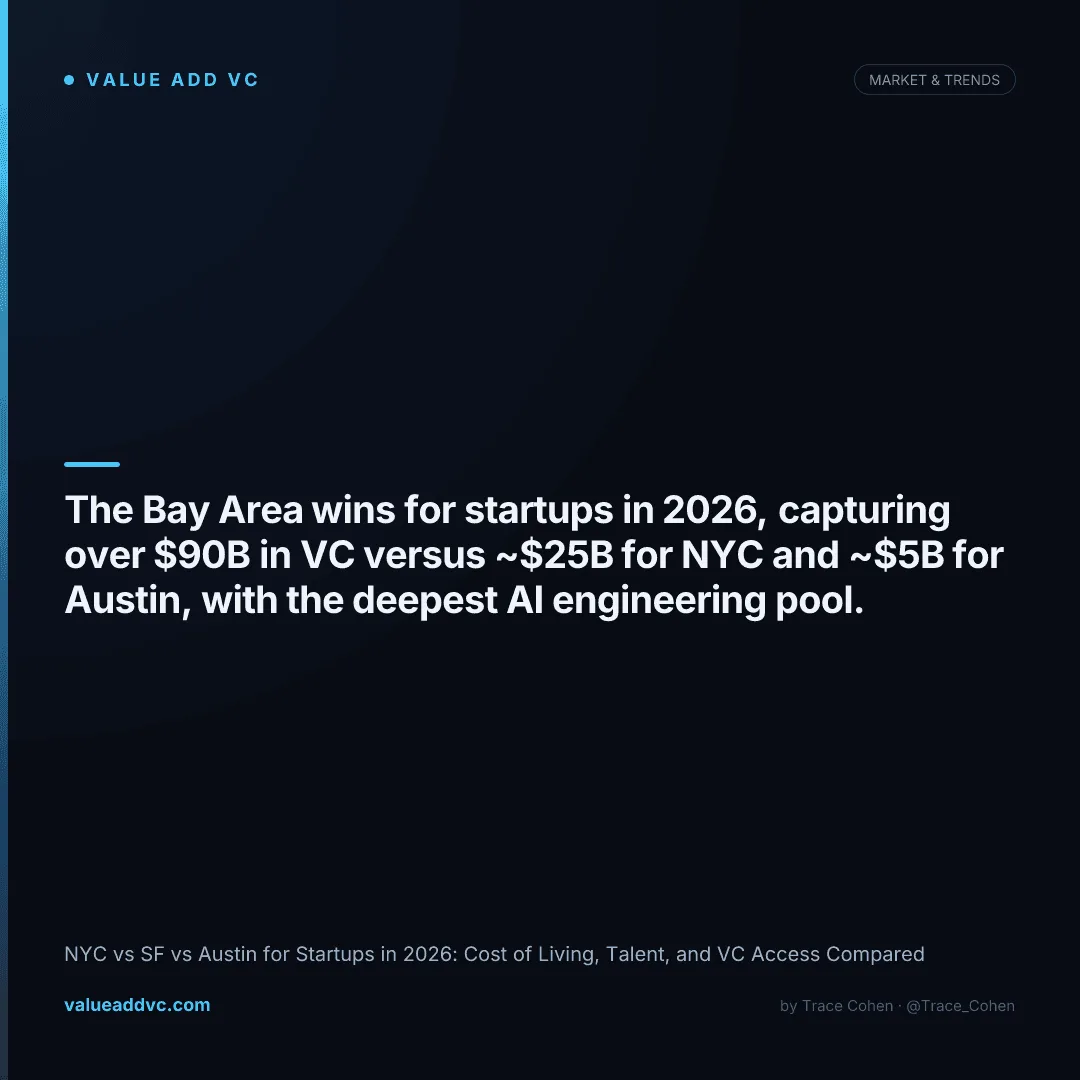
In 2026 the Bay Area still wins for venture-scale startups — it took in over $90B of US VC in 2025 versus ~$25B for NYC and ~$5B for Austin — but NYC wins on customer access and Austin wins on burn rate. That's the short answer. The longer answer is more interesting.
“Where should I build my startup?” is one of the most over-debated and under-quantified questions a founder asks. After 65+ investments and three companies of my own, my view is that the right city depends almost entirely on what you're building and who you need to be near. Below is the actual data, not the vibes.
NYC vs SF vs Austin for Startups in 2026: The Side-by-Side
For startups in 2026, San Francisco offers the most capital and the deepest AI talent but the highest cost; New York offers the second-deepest VC market and unmatched customer proximity for fintech and enterprise; Austin offers the lowest burn with no state income tax but the thinnest late-stage funding and specialized talent. The table makes the tradeoffs explicit.
| Factor | San Francisco / Bay Area | New York City | Austin |
|---|---|---|---|
| 2025 VC raised | $90B+ | ~$25B | ~$5B |
| Senior engineer salary | $200K–$280K | $180K–$240K | $150K–$190K |
| 1-BR rent (avg/mo) | ~$3,300 | ~$4,200 | ~$1,650 |
| State income tax (top) | 13.3% | 10.9% | 0% |
| Dominant sectors | AI, deep tech, infra | Fintech, media, SaaS | Hardware, consumer, crypto |
| Active VC firms (HQ) | ~700 | ~350 | ~70 |
| Unicorns headquartered | ~370 | ~130 | ~15 |
Sources: PitchBook, Crunchbase, Carta, and Numbeo cost-of-living indices, 2025–2026. Figures are approximate and rounded for comparison.
VC Access: Where the Money Actually Is
Capital concentration is the single most lopsided factor. The Bay Area absorbed more than half of all US venture dollars in 2025 — over $90B — and an even larger share of frontier AI funding, where roughly 50% of all AI investment lands within a 50-mile radius of San Francisco. NYC's ~$25B is a strong #2, and it punches well above its weight in fintech and enterprise. Austin's ~$5B is real but thin once you get past Series A.
$90B+
Bay Area
~700 VC firms HQ'd locally; the default for AI and deep tech
~$25B
New York
~350 firms; fintech, media, enterprise SaaS lead
~$5B
Austin
~70 firms; strong seed, thin Series B+
The practical implication: if you're raising a $2M seed, all three cities work — capital crosses state lines easily now. If you're raising a $50M Series C in deep tech, the Bay Area's density of growth funds is hard to replicate. You can track how returns differ by ecosystem on the VC Performance dashboard.
Talent and Cost of Living: The Burn-Rate Equation
Talent depth and cost move in opposite directions. The Bay Area has the deepest pool of senior AI engineers — and charges for it, with senior salaries of $200K–$280K and one-bedroom rents near $3,300. NYC has the broadest non-engineering talent (sales, finance, design, ops) but the highest rent at ~$4,200. Austin offers salaries 25–35% lower, rent under $1,700, and no state income tax — Texas's 0% versus California's 13.3% top rate is a meaningful founder-comp difference.
Cheaper to operate
- ✓ Austin: ~30% lower fully-loaded headcount cost
- ✓ Austin: 0% state income tax stretches founder pay
- ✓ A 5-person seed team gains 6–9 months of runway
- ✓ NYC/SF rents alone can add $40K+/yr per relocated hire
Deeper talent
- ✓ SF: densest senior AI/ML engineering pool in the world
- ✓ SF: every frontier lab and most infra startups nearby
- ✓ NYC: deepest finance, sales, design, and media talent
- ✓ NYC: best for non-technical co-founder GTM hires
Which City Wins for Which Founder in 2026
The honest answer to “NYC vs SF vs Austin for startups in 2026” is that there is no single winner — there's a winner per archetype. Match the city to what you're building.
Choose San Francisco if
You're building frontier AI, infrastructure, or deep tech and need the densest engineering pool and the most growth capital. The cost is worth it when capital and talent are your binding constraints.
Choose New York if
You're in fintech, media, adtech, healthcare, or enterprise SaaS and your customers are your constraint. Being a subway ride from Wall Street and Fortune 500 buyers compounds.
Choose Austin if
You're early, capital-efficient, or building hardware/consumer/crypto and want maximum runway per dollar. The 0% income tax and low rent are real, durable advantages.
If I had to declare one overall winner in 2026, it's still the Bay Area —
$90B+ in capital and the deepest AI talent beat lower burn for venture-scale ambition. But pick NYC for customers and Austin for runway.
Compare valuations and returns across ecosystems on the SaaS Valuations and VC Performance dashboards at Value Add VC. Originally published in the Trace Cohen newsletter.
Latest from the Pulse
Get VC data most people never see
— 100% free
Weekly benchmarks, valuations, and fund data. Join 5,000+ investors. No spam.