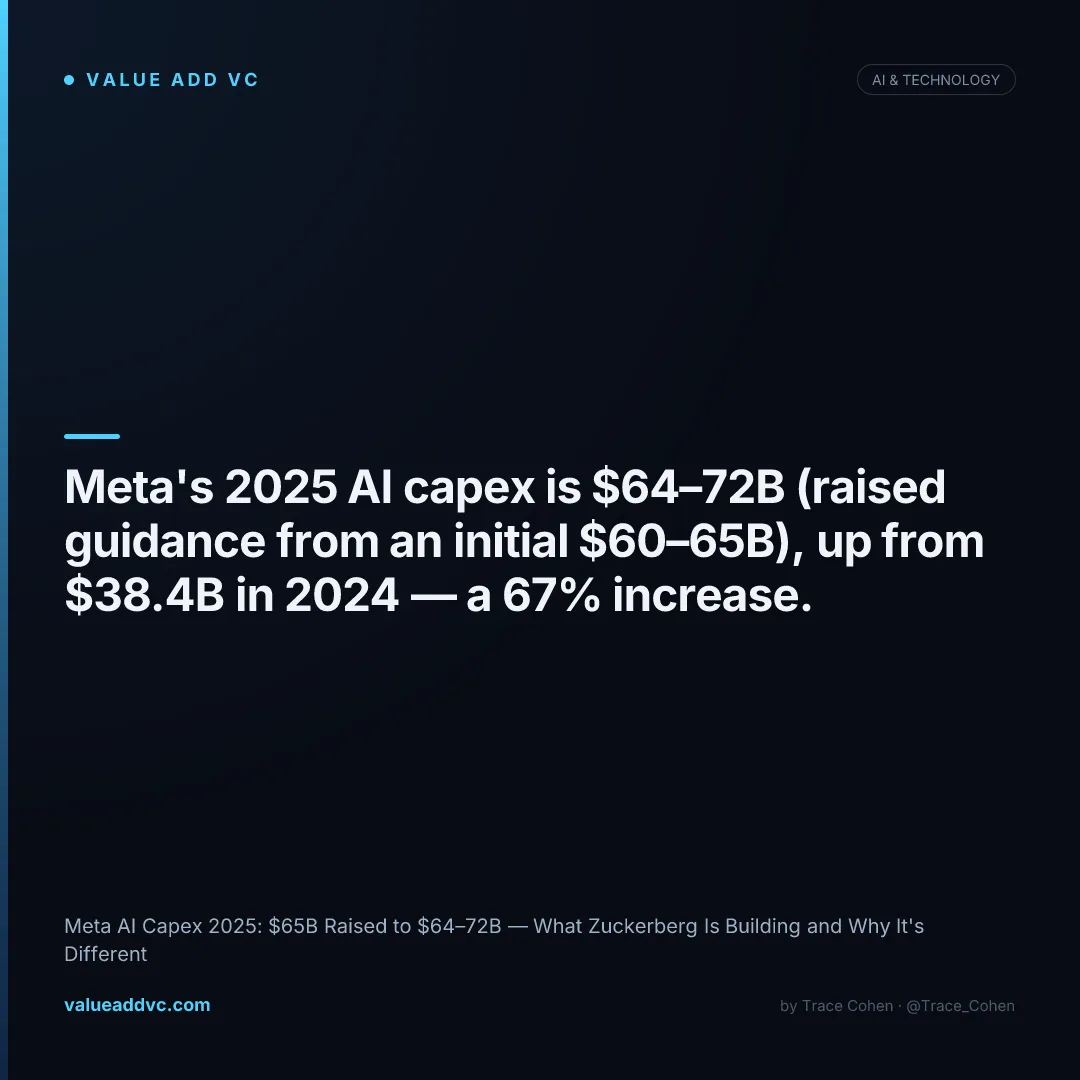
Meta's 2025 AI capex started at $60–65B and got raised to $64–72B before Q1 was over. That's not a rounding error — it's Zuckerberg telling the market he's not done.
For context: Meta spent $38.4B on capex in all of 2024. The 2025 raise represents a ~67% jump in a single year. And unlike Microsoft or Google, Meta earns zero cloud revenue to offset it. Every dollar has to come back through ads, engagement, or consumer AI — which makes this one of the highest-stakes unilateral infrastructure bets in corporate history.
Meta AI Capex 2025 vs. Prior Years
| Year | Total Capex | YoY Change | Primary Driver |
|---|---|---|---|
| 2022 | $32.0B | +20% | Data centers, VR (Reality Labs) |
| 2023 | $28.1B | −12% | Efficiency year — headcount cuts |
| 2024 | $38.4B | +37% | AI infrastructure ramp begins |
| 2025E | $64–72B | +67–88% | GPU clusters, Llama training, Meta AI serving |
Where the $65B+ Is Actually Going
Meta's capex has four primary buckets. The weighting has shifted dramatically toward AI compute since 2023:
Why Meta's AI Strategy Is Structurally Different
Microsoft and Google sell cloud compute. That creates a natural feedback loop: more infrastructure spending → more cloud revenue → justifies more spending. Meta has no equivalent. Its capex logic is entirely internal:
Distribution moat, not cloud revenue
3.27B daily active users across Facebook, Instagram, WhatsApp, and Messenger. Every AI improvement ships to more people than any cloud provider serves.
Ad ROI compounds quietly
Meta's 2024 revenue was $164.5B — 91% from ads. A 1% improvement in targeting efficiency adds ~$1.6B. AI-driven feed ranking and ad relevance already drove a 7% engagement increase in 2024.
Llama as competitive moat via commoditization
By open-sourcing Llama 3 and Llama, Meta forces every competitor to spend billions training models anyone can download. The real moat is Meta's proprietary social graph and behavioral data — which no open-source release transfers.
Self-funded at scale
Meta generated $62.4B in net income in 2024. It can fund $65–72B in capex from a single year of profits without diluting equity or raising debt — a position most AI companies can only dream of.
Meta AI: The Consumer Product That Has to Justify This
Meta AI — the assistant embedded across all Meta apps — is the single most important vehicle for converting GPU spend into consumer value. Zuckerberg set a target of 1 billion monthly active users for Meta AI in 2025. By Q1 2025, he claimed 700M+ MAUs, making it larger than ChatGPT by user count even if usage depth differs significantly.
The business model here isn't a subscription — it's engagement. Every interaction with Meta AI keeps users inside the Meta app ecosystem longer, generating more ad impressions. The AI assistant doesn't need to monetize directly if it reduces churn and increases session time.
Meta also deployed AI across its core ad products: generative ad creative, automated audience targeting, and AI-based bidding optimization. These are already measurable in revenue. The incremental gains from Llama powering ranking models may not show up in a press release but they show up in the $164B top line. Track the ad revenue per user trend on the Big Tech Earnings Dashboard and see the latest numbers in our Q1 2026 earnings recap.
The Risks Nobody Is Pricing
Bear Case
- ✕ AI assistants commoditize; Meta AI has no differentiated reason to use vs. ChatGPT or Gemini
- ✕ Ad spend shifts to AI-native platforms that generate higher-intent clicks
- ✕ Regulatory risk: EU DMA, FTC scrutiny on data use for AI training
- ✕ Reality Labs has lost $60B+ over five years with no clear path to profitability
Bull Case
- ✓ Distribution advantage is real: 3B+ daily users means even modest AI improvements have massive aggregate value
- ✓ Llama open-source strategy establishes Meta as infrastructure-layer — not just an app
- ✓ $62B/year in net income means Meta can sustain this spending for 5+ years without financial strain
- ✓ Social graph + behavioral data is genuinely unique training signal no competitor can replicate
Meta's bet isn't that AI assistants win the market.
It's that AI makes 3 billion people more engaged — and Zuckerberg can afford to find out if he's right.
Track Meta and big tech AI spending on the Big Tech Earnings Dashboard, AI Spending Tracker, and AI Valuations at Value Add VC. For the full hyperscaler comparison, see AI Hyperscaler Capex Compared and Big Tech AI Capex 2026. Originally published in the Trace Cohen newsletter.
Get VC data most people never see — free.
Weekly benchmarks, valuations, and fund data. No spam, unsubscribe anytime.