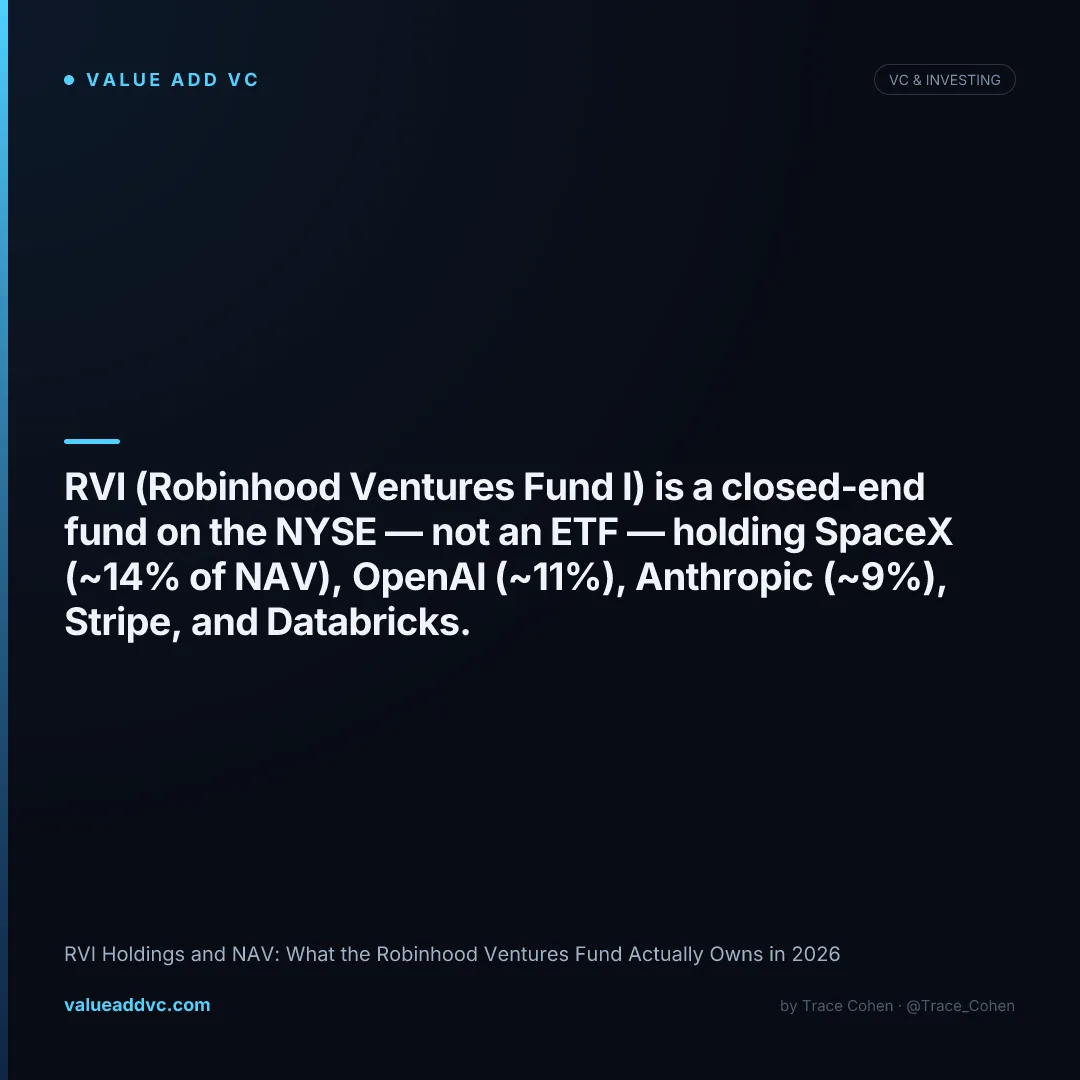
RVI holds Databricks (12.71%), OpenAI (11.00%), Stripe (4.33%) and a residual 1.25% SpaceX position — with 31.77% of the fund in cash as of the June 30, 2026 disclosure. It listed at $25 in March 2026 and recently traded around $27. That's the short answer. The longer answer is more interesting.
Robinhood launched the Ventures Fund (ticker: RVI) as a closed-end fund listed on the NYSE on March 6, 2026 — giving ordinary retail investors a liquid, exchange-traded security backed by stakes in the most sought-after private companies in the world. Databricks. OpenAI. Stripe. Names that have been off-limits to anyone without an institutional relationship or accredited investor status plus a six-figure minimum. RVI changes that. But the mechanics of how it's structured — and what happens when its biggest holdings stop being private — are worth understanding before you click buy.
Robinhood Ventures Fund II (RVII) Is Coming
RVI is no longer the only Robinhood Ventures fund. Fund II — ticker RVII — is expected to begin trading on the NYSE on August 13, 2026 at the same $25 sticker price RVI listed at, offering up to 8 million shares (including up to 400,000 sold by Robinhood Markets itself). Instead of RVI's concentrated late-stage positions, RVII holds 80 early-stage companies that are all Y Combinator-connected, near-equally weighted at ~1.12% each.
On the numbers this page cares about — fees and NAV mechanics — RVII is a step up in cost: a 2.00% base management fee plus a 20% incentive fee on realized capital gains, for an estimated 4.18% total annual expense ratio, versus RVI's ~2.5% gross with no carry. Same closed-end wrapper, same premium/discount physics, materially heavier drag. Everything we've confirmed (and what's still undisclosed) lives on the RVII flagship page: launch date, holdings, and how it differs from RVI, with all 80 portfolio companies broken down on the interactive RVII dashboard.
RVI Is a Closed-End Fund, Not an ETF
The most important thing to understand about RVI: it is not an ETF. The distinction is structural, and it has real consequences for how you experience the investment.
| Feature | ETF | RVI (Closed-End Fund) |
|---|---|---|
| Share creation/redemption | Continuous via APs | Fixed share count at IPO |
| Price vs NAV | Tracks NAV closely (<0.5%) | Can trade well above NAV |
| Underlying liquidity | Usually liquid public assets | Illiquid private company stakes |
| Expense ratio range | 0.03–0.75% | ~2.5% total |
| Redemption mechanism | Any time at near-NAV | Secondary market only |
The ETF structure has a built-in arbitrage mechanism that keeps trading prices close to NAV. Closed-end funds don't — which is why RVI has persistently traded at a premium since launch.
For RVI specifically, the closed-end structure is the only legal way to do this at all. The SEC requires that retail-accessible vehicles holding more than 15% in illiquid private securities use the 1940 Act closed-end structure. Late-stage private stakes like OpenAI and Databricks are illiquid by definition — they can't be sold on demand — so an ETF wrapper is impossible. The CEF wrapper is the price of admission for retail. The catch: RVI's NAV updates periodically based on private marks, while the share price updates in real time on the NYSE. That mismatch is exactly what creates the premium.
The RVI Expense Ratio: What You're Actually Paying
The total expense ratio for RVI is approximately 2.5% annually — though the net expense ratio is 2.13% through August 27, 2026 while Robinhood Ventures waives half its management fee (2% cut to 1%). This is not a hidden number — it's disclosed in the fund documents — but most retail investors don't think carefully about what it means in compounding terms. One genuine point in RVI's favor: there is no carried interest, unlike a typical 2-and-20 venture fund.
Management fee
Paid to Robinhood/fund manager for selecting and sourcing positions
Fund operating expenses
Legal, audit, custody, admin, and secondary transaction costs
Estimated total expense ratio
Charged on NAV annually — the real cost is higher when you buy at a premium
Here's the math that matters: if you buy RVI at a 20% premium to NAV and hold it for five years, your breakeven on the premium alone requires the underlying portfolio to compound at roughly 4% per year just to offset what you paid above intrinsic value — before fees. On top of that, the 2.5% annual drag compounds separately. You need significant portfolio appreciation to come out ahead of what a direct secondary position in the same assets would deliver.
What RVI Actually Holds
RVI acquires secondary-market stakes in late-stage private companies — typically companies that are Series D or beyond, have demonstrated significant revenue or traction, and are considered likely IPO or M&A candidates within a 3–7 year horizon.
SpaceX (1.25% of NAV)
Largest position. Lists on Nasdaq June 12, 2026 at $135/share — a $1.77T valuation and $75B raise, the largest IPO ever
OpenAI (~11% of NAV)
RVI bought ~$75M of OpenAI common stock on April 17, 2026. Filed confidentially for a September 2026 IPO targeting $730–850B
Cash & equivalents (31.77% of fund)
The single largest line in the disclosure — you are paying the expense ratio on this
Stripe (~8% of NAV)
Payments giant; still private
Databricks (~7% of NAV)
AI/data infrastructure; raised at $62B in late 2024
Other late-stage + cash
Mix of fintech, AI, defense, and enterprise software, plus cash for follow-ons
Holdings are disclosed quarterly. The concentration in a handful of mega-cap private names means RVI's performance is heavily tied to the fortunes of SpaceX and OpenAI specifically — see how large that OpenAI stake really is. Diversification across the private market is minimal at current allocations. Track real-time data on the Robinhood RVI Fund dashboard.
The 2026 IPO Wave: RVI's Top Three Holdings Are All Going Public
This is the story that changes everything about the RVI thesis. The fund's three largest disclosed positions — roughly a third of NAV combined — are all hitting the public markets in 2026:
SpaceX — June 12, 2026
Lists on Nasdaq at $135/share, a $1.77T valuation, raising $75B — the largest IPO in history. At 1.25% of RVI's fund as of the June 30, 2026 disclosure, the markup from the fund's private marks flows directly into NAV on listing.
OpenAI — September 2026 target
Filed confidentially targeting a $730–850B valuation. RVI holds ~11% of NAV in OpenAI, including the ~$75M common-stock purchase made in April 2026.
The two forces pull in opposite directions. On one hand, the IPO valuations imply substantial NAV markups: SpaceX at $1.77T and OpenAI at $730–850B are far above where private closed-end funds were carrying these names. When those marks reset, RVI's reported NAV jumps.
On the other hand, the entire justification for RVI's premium — scarcity — evaporates the moment these companies trade publicly. Why pay ~90% over NAV for indirect SpaceX exposure when you can buy SpaceX stock in the same brokerage account on June 12? Once a holding goes public, RVI becomes a high-fee wrapper around stocks you can own directly. Closed-end fund history says premiums collapse when the scarcity story dies — and a premium collapse from ~90% toward zero is a far bigger move than any plausible NAV markup.
The post-IPO scenario
An RVI shareholder can experience NAV appreciation and share-price depreciation simultaneously: the underlying marks go up while the premium compresses. If NAV rises 30% on IPO markups but the premium falls from 90% to 20%, the share price drops roughly 18% even though the portfolio gained value. Watch the lockup calendars too — RVI can't necessarily sell its stakes at the IPO print.
The NAV Premium Problem
The most common confusion about RVI is treating it like a stock price that reflects fair value. It doesn't. It reflects supply and demand for the shares — and demand from retail investors who have no other way to access these names has consistently outstripped supply. The numbers make the point: RVI listed March 6, 2026 at $25.00 against a $24.70 NAV (reported March 4), returned 6.16% on share price in its first few trading weeks against a NAV return of just 0.85% for the period since fund operations began in September 2025, and hit $57.02 by May 27 — roughly 90% above the last reported NAV.
This isn't unique to RVI. Many closed-end funds in niche asset classes trade at persistent premiums. The Grayscale Bitcoin Trust (GBTC) famously traded at a 40–80% premium before ETF conversion made the structure irrelevant. Destiny Tech100 (DXYZ) — the closest peer, a NYSE-listed CEF for private tech launched in March 2024 — traded at premiums as high as 800% in its first year before settling far lower, a useful warning about what happens to CEF premiums after retail FOMO subsides. The structural premium in illiquid closed-end funds reflects real demand, but it also means buyers are overpaying for the same assets they could theoretically access through other means. Worth remembering too: none of that gain shows up as cash — RVI pays no dividend at all, so every dollar of return has to come from the share price itself, which is why the fund's payout history reads as a flat zero so far.
The premium math
If RVI trades at a 25% premium and the portfolio returns 15% in year one, your realized gain is approximately (1.15 / 1.25) - 1 = -8% before fees — negative even with strong portfolio performance. The premium you paid on entry is the most important variable in your return, not the underlying asset performance.
Who Should Buy RVI (and Who Shouldn't)
RVI makes sense if you are:
- ✓ Non-accredited with no other private market access
- ✓ Allocating a small speculative portion (<5%) of your portfolio
- ✓ Specifically bullish on SpaceX or OpenAI pre-IPO
- ✓ Comfortable with illiquidity and fee drag over 5+ years
- ✓ Buying at or near NAV (rare, but possible during selloffs)
RVI is a bad deal if you are:
- ✕ An accredited investor who can access direct secondaries
- ✕ Paying a 20%+ premium to NAV at time of purchase
- ✕ Expecting ETF-like liquidity or price efficiency
- ✕ Treating it as a diversified private market allocation
- ✕ Sensitive to fee drag (2.5% annually is expensive)
How RVI Compares to Other Private Market Access Vehicles
| Vehicle | Accreditation Required | Typical Fee | NAV Premium Risk |
|---|---|---|---|
| RVI (Robinhood Ventures Fund) | No | ~2.5%/yr (2.13% net thru Aug 2026) | Very high (~90% in May 2026) |
| SPV via AngelList/Forge | Yes | 2% mgmt + 20% carry | None (direct) |
| VC fund-of-funds | Yes + $250K+ minimum | 1.5% + 10% carry | None (direct) |
| Nasdaq Private Market / Forge | Yes | Transaction fees only | None (direct) |
| Traditional VC fund LP | Yes + $1M+ minimum | 2% + 20% carry | None (direct) |
RVI is the most accessible private market vehicle ever created for retail investors.
But "accessible" and "cheap" are not the same thing. With 31.77% of the fund in cash and SpaceX down to 1.25%, check the current disclosure before deciding what the access is worth.
Track RVI's NAV, premium/discount, and holdings on the Robinhood RVI Fund dashboard at Value Add VC. For deeper analysis on private market structures, see the VC Performance tracker. Originally published in the Trace Cohen newsletter.
Latest from the Pulse
Get VC data most people never see
— 100% free
Weekly benchmarks, valuations, and fund data. Join 5,000+ investors. No spam.