The investor update is the single highest-ROI communication a founder sends — and most founders get it completely wrong.
A great investor update takes 45 minutes to write and can unlock a key hire intro, a warm customer intro, or a bridge check from an existing investor in 48 hours. A bad one — wall of text, no ask, all good news — gets a mental "noted" and no action.
I've been on both sides of this. As a 3x founder I've written hundreds of these. As an investor across 65+ investments, I've read thousands. The pattern is clear: the updates that actually move the needle follow a specific structure that takes 10 minutes to learn and 6 months to fully internalize.
Why Most Investor Updates Fail
Three failure modes account for 90% of bad investor updates:
The update reads like a newsletter. Investors don't know what you need so they do nothing. Every update should end with one specific, actionable ask.
Polished updates that omit problems read as insecure or deceptive. VCs know things go wrong. Sharing a real challenge builds trust and unlocks their network.
A 1,200-word update with eight sections gets skimmed to the last paragraph. Under 400 words forces you to prioritize what actually matters.
The Investor Update Template That Works
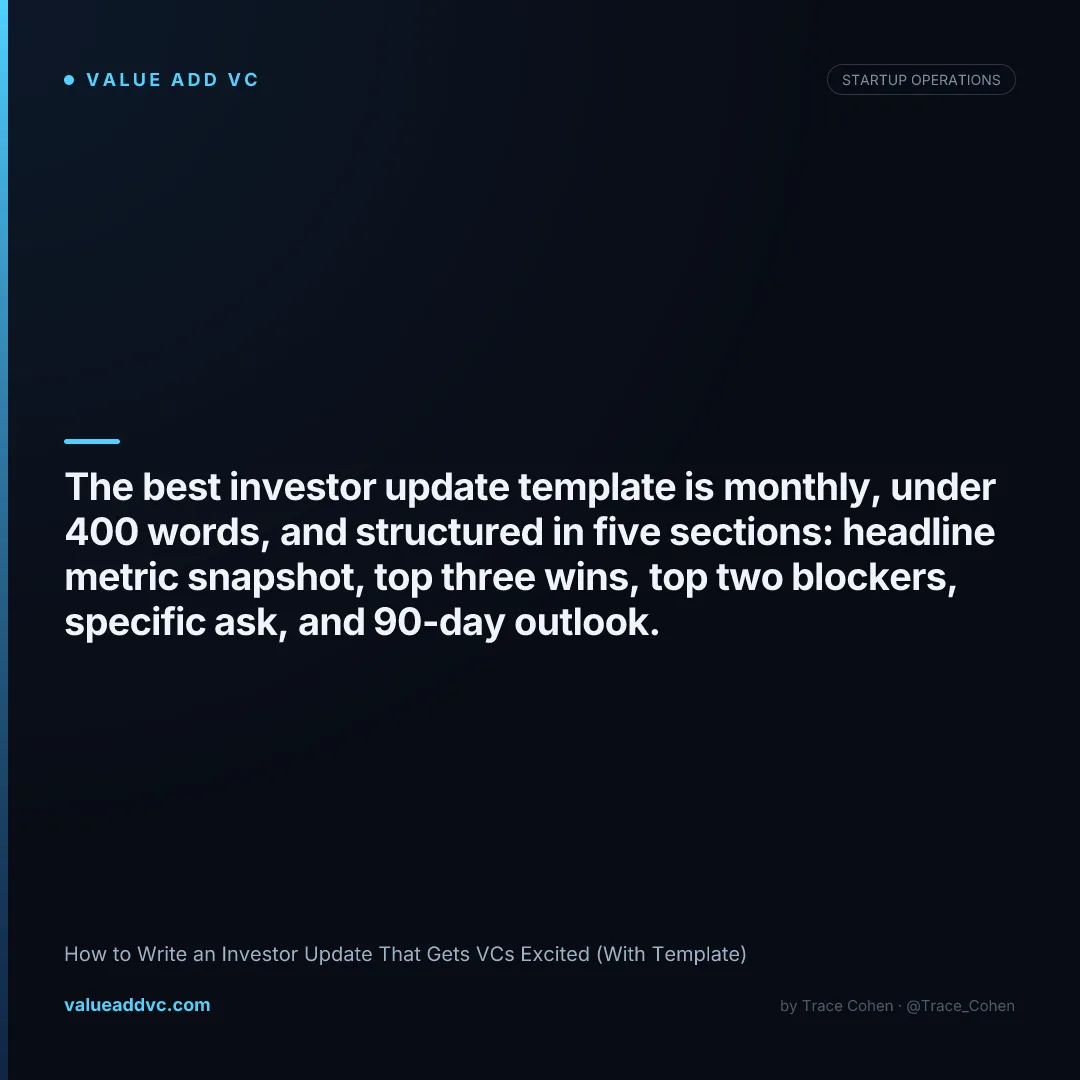
Five sections, under 400 words, sent monthly. This is the format that generates responses.
MRR or ARR (and MoM/YoY growth %), burn rate, runway in months, and one or two secondary metrics that matter for your stage (pipeline value, DAUs, NRR). Nothing else. If you're pre-revenue, replace with user/pilot numbers.
MRR: $84K (+12% MoM, +380% YoY) | Burn: $115K/mo | Runway: 18 months
Specific, not vague. Not 'great momentum' — 'closed $24K ACV enterprise deal with Acme Corp, signed 3 new pilots in legal vertical, promoted first VP of Sales from within.' VCs share wins internally. Make them quotable.
Closed largest deal to date ($28K ACV). Onboarded 2 reference customers in target segment. Hired Head of Eng from Stripe.
Real problems you're working through. Not 'competition is tough' — 'struggling to close enterprise deals with legal teams, cycle is 90+ days; exploring whether to hire a procurement specialist.' Specificity earns trust and unlocks help.
1. Enterprise legal reviews are killing deal velocity — need a warm intro to a GC who has navigated this. 2. Struggling to find senior ML eng candidates in NYC — pipeline is weak.
One specific thing you need. Not 'any help appreciated' — 'looking for an intro to VP of Sales at Salesforce-stage company who has scaled a mid-market motion.' One ask. If you have three, send three separate emails to the right investors.
Ask: Intro to anyone who has built a B2B sales team from 2 to 20 reps in SaaS. Specifically looking for someone at Rippling or Ramp who navigated this.
Three bullet targets for next quarter. These become accountability points. When you hit them, your next update leads with that. When you miss, you address it — which is how trust compounds over time.
Next 90 days: reach $105K MRR, close 2 enterprise pilots in healthcare, hire first dedicated CSM.
Sending Cadence and Mechanics
Monthly is the standard. Every first or second week of the month. Send to your full investor list — board members, lead investors, angels, and your most active advisors. Visible.vc data shows founders who send monthly updates raise their next round 40% faster than those who send quarterly or ad-hoc.
| Stage | Frequency | Primary focus | Length |
|---|---|---|---|
| Pre-seed / Seed | Monthly | Progress signals, asks | 250–350 words |
| Series A | Monthly | Metrics, hiring, GTM | 350–450 words |
| Series B+ | Monthly or Quarterly | Cohort metrics, unit econ, burns | 400–600 words + table |
What the Best Investor Updates Have in Common
After reading thousands of investor updates across 65+ portfolio companies, the pattern is obvious:
- →They open with a number, not a sentence. '→ $84K MRR (+12% MoM)' takes 3 seconds to parse.
- →They treat investors as humans, not report recipients. A brief personal note at the top ('we almost lost our biggest customer this month — here's what happened') creates emotional resonance.
- →The ask is specific enough that one investor knows immediately if they can help. 'Looking for a product-led growth expert' is too vague. 'Intro to anyone who built PLG at Notion, Figma, or Calendly' is actionable.
- →They acknowledge misses from last month's targets. Nothing builds investor confidence faster than a founder who holds themselves accountable publicly.
- →They're sent on a consistent day — same week every month. This alone signals operational discipline.
Tools for Sending Investor Updates
A plain email works fine at pre-seed. As you scale to 20+ investors, use a dedicated tool:
Visible.vc
Most popular. Metric charts, email delivery, CRM-lite. $50–200/mo.
Carta Updates
Integrated with your cap table. Convenient if already on Carta.
Plain email (BCC)
Works great pre-seed. Gmail + Mailmeteor for personalization. Free.
The investor update is not a report card. It's a sales process.
You are selling your investors on continuing to help you. Every month. The best founders treat it that way — and they get dramatically more value from their cap table as a result.
Track your fund performance and benchmarks at the VC Performance Dashboard on Value Add VC.
Originally published in the Trace Cohen newsletter. Trace is a 3x founder and has made 65+ investments across pre-seed through Series B.
Latest from the Pulse
Get VC data most people never see
— 100% free
Weekly benchmarks, valuations, and fund data. Join 5,000+ investors. No spam.