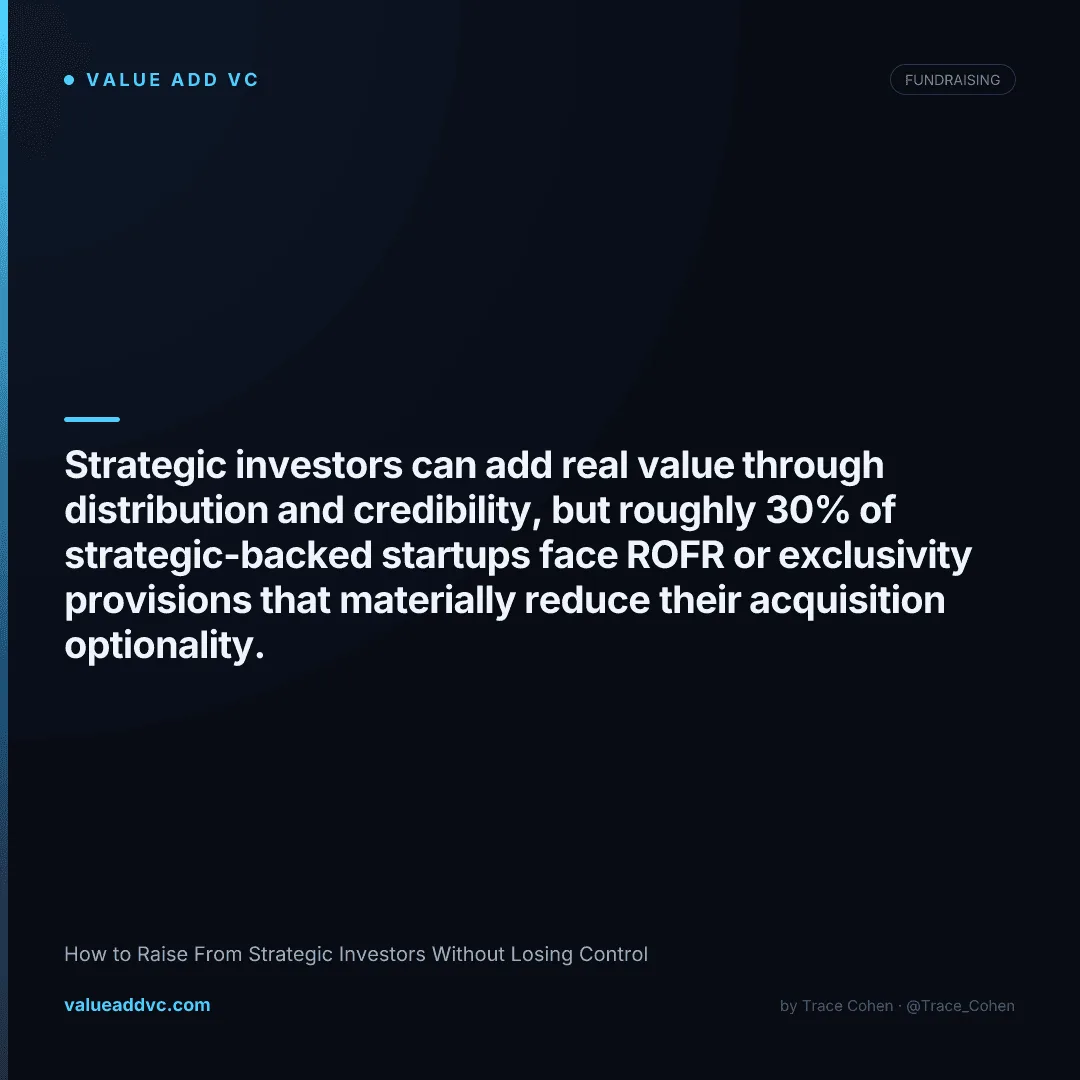
The corporate venture check arrives with a brand name, a warm intro to their enterprise sales team, and a slide deck about "strategic alignment." It is the most dangerous money in venture — not because it is bad, but because founders underestimate what comes with it.
I have seen it across 65+ investments. A founder takes a check from a Fortune 500 corporate VC arm. The value-add is real — a pilot customer, a distribution partnership, a co-marketing deal that accelerates revenue. Then two years later they are in an acquisition process and the strategic's ROFR clause has made every other buyer walk before the first term sheet arrives.
Strategic capital is not inherently toxic. It is misunderstood. Here is how to take it without losing the company.
What Strategics Actually Want
Corporate venture arms are not optimizing for the same outcome you are. Their mandate is typically a combination of financial return and strategic optionality — which means they want to stay close to your technology in case they want to acquire it later, block a competitor from doing so first, and get information about your market that their internal R&D teams cannot generate.
"We want to support your growth"
They want acquisition optionality without paying acquisition prices today
"We offer strategic distribution"
Their sales team will prioritize their own product — pilots are real, but scale is not guaranteed
"We take a long-term view"
Their fund has a 5-7 year mandate; if their parent company strategy shifts, your champion disappears
"We are founder-friendly"
Their legal team wrote standard terms that protect the parent company — not you
The Five Terms That Kill Exits
Roughly 30% of startup deals include at least one strategic investor. The following provisions appear in the majority of corporate VC term sheets — and most founders do not fight them hard enough:
Right of First Refusal (ROFR) on Acquisitions
Critical RiskAllows the strategic to match any acquisition offer. In practice, serious acquirers — especially competitors of the strategic — will not enter a process where they can be matched at the finish line. ROFR provisions directly reduce the competitive tension that drives acquisition prices up.
Enhanced Information Rights
High RiskStandard VC information rights include quarterly financials and an annual audit. Strategics often ask for monthly pipeline data, customer lists, and competitive intelligence — information that benefits their operating business, not just their investment. This data has a way of reaching the wrong parts of a corporate parent.
Most-Favored-Nation (MFN) on Commercial Terms
High RiskIf the strategic is also a customer or partner, MFN clauses guarantee they get your best pricing forever. This is crippling when you are trying to build a pricing model that reflects your actual market value — and it becomes a negotiation anchor in every future enterprise deal.
Anti-Dilution Provisions
Moderate RiskFull ratchet anti-dilution protections — more common in corporate VC terms than institutional VC terms — can create serious cap table problems in down rounds. Broad-based weighted average is the industry standard; anything stronger should be rejected.
Consent Rights on Future Financings
Critical RiskSome corporate VCs ask for the right to approve or veto future funding rounds — sometimes framed as a requirement that future investors meet certain criteria. This is a structural veto on your fundraising path and is almost never acceptable.
How to Structure a Strategic Investment to Protect Yourself
Strategic investors are not monolithic. The terms you accept are negotiable — especially if you have a competitive process with financial VCs already underway. The leverage is real. Use it.
- →
Run a parallel financial VC process
Never take strategic money as your only option. A term sheet from Sequoia or Andreessen gives you negotiating leverage to strip down the governance terms from a strategic. Without that leverage, you are accepting whatever they propose.
- →
Cap information rights at the same level as financial VCs
Agree to quarterly financials and a board observer seat. Full stop. Monthly operational data, customer names, and competitive pipeline information are operating intelligence, not investor rights.
- →
Kill the ROFR or add a short sunset
The ideal outcome is no ROFR at all. If you cannot eliminate it, negotiate a sunset provision — typically 18-24 months or triggered by the strategic's ownership falling below a threshold (e.g., 5%). This limits the long-term damage to your exit optionality.
- →
Separate the commercial and investment relationships
If the strategic is both an investor and a customer, document both relationships completely independently. Investment economics should not influence pricing or contract terms, and vice versa. Get this in writing.
- →
Understand the fund's mandate and lifecycle
Ask directly: how long does your fund have to run? Who approves investment decisions — your team or the corporate parent? What happens to your board seat if the parent company restructures? These questions reveal how stable the relationship actually is.
When Strategic Investment Actually Makes Sense
I am not anti-strategic. I have backed founders who used corporate VC money tactically and came out with better outcomes than a purely financial cap table would have produced. The scenarios where it genuinely works:
Take the Strategic Check When...
- ✓ The strategic is NOT a likely acquirer or competitor
- ✓ They bring a signed enterprise pilot, not just a promise
- ✓ You have financial VCs in the round setting governance norms
- ✓ Terms are clean — no ROFR, no consent rights on future rounds
- ✓ The check fills a gap that would otherwise require a down round
Walk Away When...
- ✕ They are a direct competitor or likely acquirer of your company
- ✕ They insist on a board seat at under 15% ownership
- ✕ They want ROFR rights on acquisitions and will not remove them
- ✕ Information rights go beyond quarterly financials
- ✕ You have no financial VC in the round to balance their influence
Strategic money is not free money.
Every right you grant a strategic today is a tax on every exit conversation you will ever have. Negotiate like your future M&A process depends on it — because it does.
Latest from the Pulse
Get VC data most people never see
— 100% free
Weekly benchmarks, valuations, and fund data. Join 5,000+ investors. No spam.