Most people walk into a VC partner negotiation treating it like a corporate job offer. It is not. You are negotiating a stake in a long-duration asset with a 10-year lockup and returns that compound — or don't.
I have been on both sides of this conversation — as a GP at an emerging fund and as an operator who joined an investment platform. The advice you read online is almost always wrong because it applies corporate negotiation logic to a structure that runs on carry, not salary.
What You Are Actually Negotiating
A partner offer at a VC or PE firm has five distinct components. Most candidates only focus on two. Skipping the other three is where the real value gets left on the table.
Base Salary
Cost of living; not where wealth is made
Carry Allocation
The primary wealth-creation mechanism; negotiate hard here
Carry Vesting Schedule
What happens if you leave or fund underperforms
GP vs Partner Title
Determines whether you share fund economics or just salary
Co-Investment Rights
Ability to put personal capital into portfolio companies
The Carry Math — Why Getting 1% vs 5% Matters Enormously
Here is why the carry negotiation is the one that matters most. A $150M fund with a 2.5x net return generates $150M in profit above the return of capital. The 20% carry on that is $30M. If you have 5% of the carry pool, you receive $1.5M. If you negotiated 15%, you receive $4.5M. On a top-quartile fund with 3.5x returns, the gap between 5% and 15% carry is over $10M.
This math is why experienced operators and investors spend disproportionate time on carry allocation rather than salary. The numbers are compounding over 10+ years.
| Fund Size | Net Multiple | Fund Profit | Total Carry (20%) | Your 5% Share | Your 15% Share |
|---|---|---|---|---|---|
| $75M | 2.0x | $75M | $15M | $750K | $2.25M |
| $150M | 2.5x | $225M | $30M | $1.5M | $4.5M |
| $300M | 3.0x | $600M | $60M | $3M | $9M |
| $500M | 2.5x | $750M | $75M | $3.75M | $11.25M |
How to Negotiate a Partner Role: The Framework
The negotiation should be structured in two phases. Phase one anchors the economics. Phase two closes the operating terms.
Phase 1: Anchor the Economics
- → Benchmark base against fund AUM using management fee math (1.5–2% of fund size typically funds all operations including salaries)
- → Request the total carry pool breakdown across all partners before accepting any allocation offer
- → Push for carry that vests linearly over 3 years, not 5 — each year of additional vesting is a year of leverage they hold over you
- → Clarify GP commit expectations — typically 1% of fund size, sometimes waived for operational partners
Phase 2: Negotiate the Operating Terms
- → Get explicit deal authority in writing: solo sign-off threshold, investment committee vote requirements, veto rights
- → Negotiate pro-rata co-investment rights on all investments you source or lead
- → Ask for a title review at Fund II — partner economics often do not automatically carry forward between fund vehicles
- → Clarify key-man provisions: if you leave, what happens to your carry in deals you sourced?
Red Flags in the Partner Negotiation
I have seen people accept offers with all of these — and regret it within two fund cycles.
⚠ Carry vests over 7–10 years
Nearly impossible to vest fully; structural golden handcuff
⚠ No carry in current fund vehicle
You join mid-fund with no economics on existing deals
⚠ "Partner" title without GP entity
Title without economics; get GP status or negotiate separately
⚠ Carry allocation not disclosed pre-offer
If they won't show you the pool, assume your allocation is small
⚠ No co-investment rights in writing
Verbal promises on co-invests disappear when deals get competitive
⚠ Salary-only offer 'until Fund II closes'
Fund II may take 2–4 years; you are working on carry that isn't yours yet
The GP Commit Question
Most new partner offers include an expectation that you commit 1–2% of fund capital as GP commit — this is the skin-in-the-game requirement that LPs look for. On a $100M fund, that is $1–2M of personal capital.
What most candidates do not know: GP commits are frequently financed through preferred equity loans from banks (SVB historically led this; other institutions now offer it), and the GP commit often earns the same returns as LP capital — meaning it is a leveraged bet on your own fund performance.
If you cannot afford the GP commit, negotiate for a waived or reduced commit in exchange for a lower carry allocation, or ask whether the firm will fund the GP commit through a deferred carry arrangement. Many emerging managers accommodate this.
Benchmark: What Partners at VC Firms Are Actually Paid
Micro/Emerging Manager (<$75M)
Base
$150–250K
Carry
10–30% of pool (smaller pool)
GP Commit
Often waived or minimal
Mid-Size Fund ($75M–$200M)
Base
$250–350K
Carry
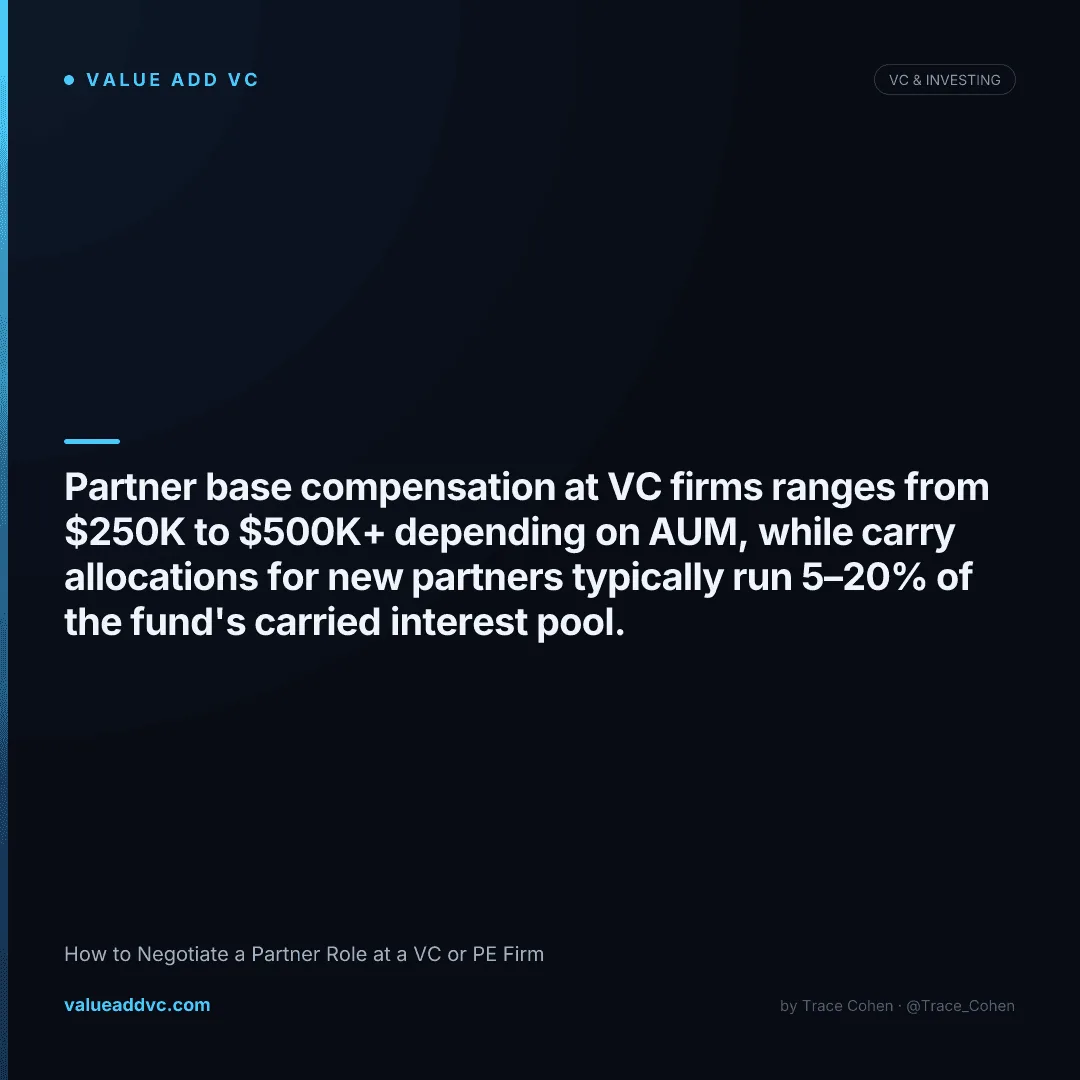
5–20% of pool
GP Commit
1–2% of fund size
Established Fund ($200M–$500M)
Base
$350–500K
Carry
5–15% of pool
GP Commit
1–2% of fund size
Large/Institutional ($500M+)
Base
$500K–$800K+
Carry
2–10% of pool (larger absolute $)
GP Commit
1% of fund size, often financed
Sources: Heidrick & Struggles 2025 Compensation Survey, Korn Ferry VC/PE Benchmarks, VC Performance data at Value Add VC.
The base salary is not the negotiation.
The carry pool, vesting schedule, and GP title are the negotiation — and most people accept the first offer without touching any of them.
Track venture fund benchmarks and partner-level compensation data on the VC Performance Dashboard and Fund Benchmarking tools at Value Add VC. Originally published in the Trace Cohen newsletter.
Latest from the Pulse
Get VC data most people never see
— 100% free
Weekly benchmarks, valuations, and fund data. Join 5,000+ investors. No spam.