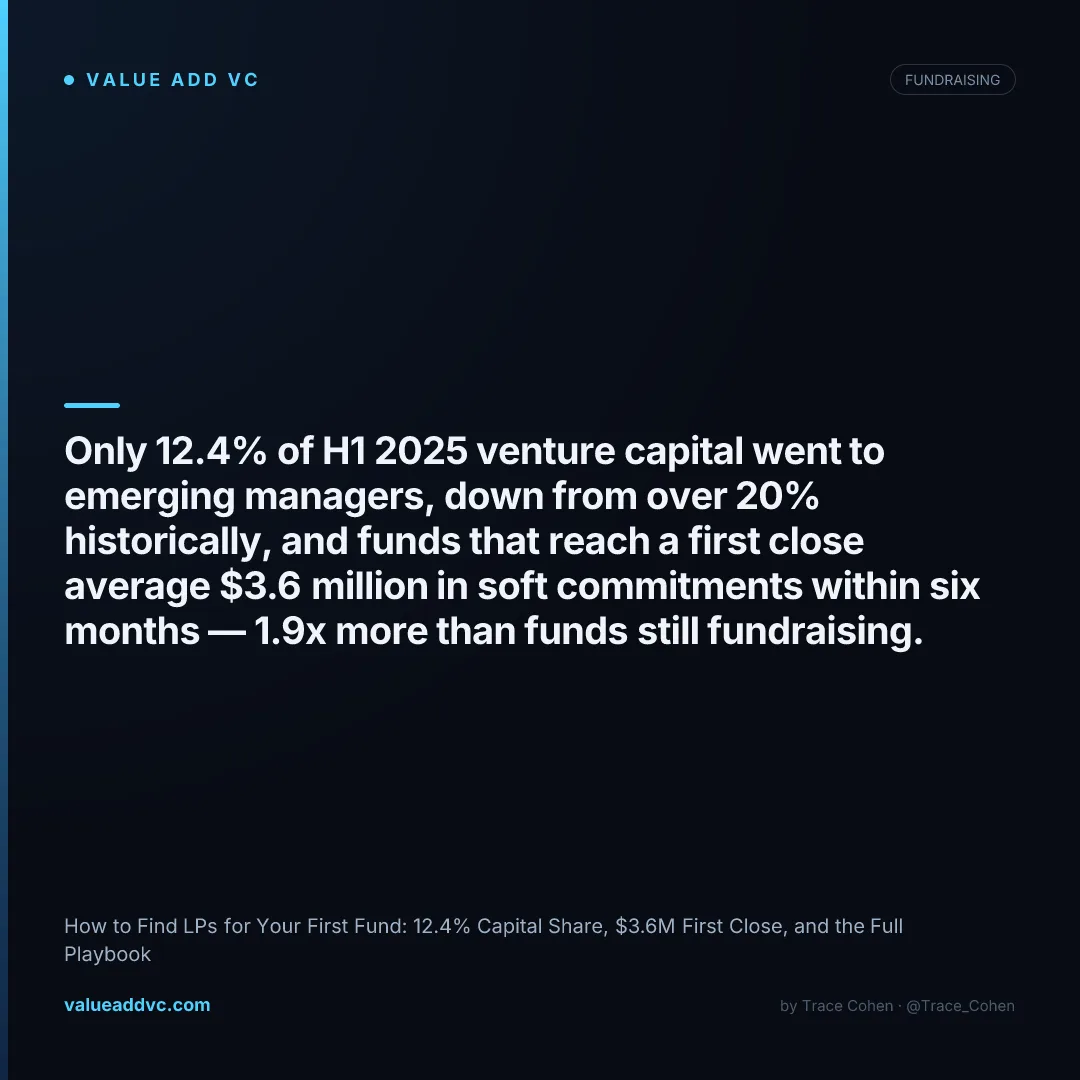
Only 12.4% of venture capital committed in H1 2025 went to emerging managers, down from historical averages north of 20% — yet the funds that do get to a first close average $3.6 million in soft commitments within their first six months, 1.9 times more than funds still grinding past that window. That's the short answer. The longer answer is exactly where those LPs come from and in what order you should approach them.
Raising a first fund is fundamentally a sourcing problem before it's a pitching problem — most first-time managers waste months cold-emailing institutional LPs who never write first-fund checks, when the actual path to a first close runs through a much narrower, more findable set of investors. Here's the full playbook: who to approach first, what the 2026 data says about fund size and timing, and where the real LP databases and introduction paths live.
Figures are 2025-2026 data blended from VC Lab's Emerging Manager Performance Data report, PipelineRoad's State of Capital Raising, and the OpenVC Emerging Manager Fundraising Guide.
How to Find LPs for a VC Fund When You're Raising Your First One
The fastest way to find LPs for a first-time VC fund is to work outward from your existing angel-investing network before approaching institutional LPs cold — managers who successfully close a first fund average 6-10 prior angel investments, compared to just 3-5 for managers whose raises stall, because those checks are what build the relationships that later convert into fund commitments. Family offices, other angels in your deal syndicates, and operators at companies you've backed personally are, in that order, the highest-conversion first calls for almost every emerging manager, well ahead of pension funds, endowments, or fund-of-funds that rarely write first-fund checks at all.
Institutional LPs — the ones covered in our piece on anchor LPs — do matter, but almost always as a second-wave source once a manager already has soft commitments and a track record to show, not as the first outreach target.
Why So Few LPs Are Funding Emerging Managers in 2026
The backdrop makes this harder than it used to be: only 12.4% of venture capital committed in H1 2025 went to emerging managers, down from a historical average north of 20%, as LPs consolidated commitments into existing relationships with proven multi-fund managers. That said, the emerging manager segment specifically has been on a genuine upswing since — 2025 was already a strong year for emerging VC fundraising, and February through May 2026 each posted between 1.2x and 2.2x higher fundraising volume than the same months in 2025, among the top five months recorded in the past four years.
The practical read: the overall pool of LP dollars going to first-time managers has shrunk as a share of total VC capital, but the managers who are getting funded within that smaller pool are raising faster and in greater numbers than in prior years — meaning the bar for a compelling pitch and a credible pipeline has gone up, not down.
What Fund Size Makes It Easiest to Find LPs and Close a First Fund
The data is unambiguous on target size: sub-$2 million funds are 2-2.5x more likely to reach a first close than funds targeting $2-15 million, and the overall market has shifted toward smaller vehicles — 58.4% of new funds set targets below $10 million in 2025, up from 51.8% the year before, and nearly 90% of LP commitments in Q1-Q2 2026 went to funds under $15 million. For a first-time manager finding LPs from scratch, a smaller, more concentrated target size is directly easier to fill from a personal network alone, without needing the institutional LP relationships that larger funds require.
| LP Source | Typical Check Size | When to Approach | Conversion Likelihood |
|---|---|---|---|
| Your own angel co-investors | $25K-$250K | First outreach wave | High |
| Single-family offices in your network | $100K-$1M | First outreach wave | High |
| Operators from portfolio companies | $25K-$500K | First outreach wave | Medium-High |
| Multi-family offices / RIAs | $250K-$2M | Second wave, after soft commits | Medium |
| Fund-of-funds specializing in emerging managers | $500K-$5M | Second wave, needs track record | Medium |
| University endowments | $1M-$10M | Rarely for Fund I | Low |
| Pension funds / sovereign wealth | $5M-$50M+ | Almost never for Fund I | Very Low |
Check-size ranges are blended estimates from VC Lab's Emerging Manager Guide, PipelineRoad's State of Capital Raising, and typical LP allocation patterns reported for Fund I vehicles under $15M in 2025-2026.
The LP Outreach Timeline: What to Expect Month by Month
A typical first-time fund raise runs 12-18 months from initial prep to first close, with the active LP outreach phase itself concentrated into a 3-6 month window once materials — deck, data room, and GP commit structure — are ready. See our companion piece on what LPs want in your deck and data room for that prep-stage detail. The single strongest predictor of eventually closing is early soft-commitment momentum: funds that build $3.6 million in soft commitments within the first six months close at roughly 1.9x the rate of funds still fundraising past that point, because early momentum is itself a signal other LPs use to de-risk their own decision.
Notably, the data does not support "more meetings" as the lever that matters — GP age, team composition, and raw LP pitch volume were all statistically indistinguishable between managers who closed and managers who struggled. What differed was pipeline discipline: tracking every LP conversation, following up on a fixed cadence, and refining the pitch based on specific objections rather than repeating the same pitch to a wider list.
In practice that means a simple CRM or spreadsheet tracking every LP by stage (introduced, first meeting, diligence, soft commit, wired), a fixed follow-up cadence of roughly two to three weeks per active LP, and a running log of the specific objection each LP raised so the pitch and data room evolve with every conversation rather than staying static across fifty identical meetings.
Do You Need a Placement Agent to Find LPs?
For almost every first-time VC manager, no. Placement agent success fees run 1.5-2.5% of committed capital for larger, established managers but climb to 3-5% for emerging managers and venture-specific mandates, on top of a $25,000-$100,000 upfront retainer and $10,000-$50,000 per month during the engagement, plus a 0.25-1% annual trailing fee for 3-7 years after close. On a $200 million fund, total placement costs can exceed $8-13 million over the fund's life — economics that only make sense once a target size is large enough (generally well above $50 million) to justify institutional-grade distribution. Below that, direct outreach through your own network, described above, remains both cheaper and, per the data on angel-investing track records, more effective for a Fund I.
Our VC & PE performance dashboard and benchmarking tool are also useful here — LPs increasingly ask emerging managers to show where their angel or fund-level returns sit against public benchmarks before committing, and being able to answer that in the first meeting shortens the entire outreach cycle.
Where to Find LP Databases and Introduction Paths Beyond Your Own Network
Once your own angel and family-office network is exhausted — usually somewhere in the first two to three months of active outreach — the next tier is LP-matching platforms and databases built specifically for emerging managers, which surface family offices, fund-of-funds, and RIAs that have disclosed an appetite for Fund I-III vehicles. These platforms don't replace warm introductions, but they materially widen the pipeline once you already have a track record and a handful of soft commitments to point to, which is the same trust signal a warm intro provides. Fund administrators and fund-formation lawyers who've worked with dozens of emerging managers are also an underused introduction source — they see which LPs are actively writing Fund I checks in real time, often before that appetite shows up publicly anywhere.
The mistake most first-time managers make at this stage is treating an LP database as a cold-email list rather than a research tool — the data above on angel-investing track records and pipeline discipline mattering more than volume applies here too. A database entry is a starting point for a warm introduction request through a mutual connection, not a mail-merge target.
Bottom line: Finding LPs for a first fund in 2026 means working your own angel network first, targeting a smaller fund size (sub-$2M funds close 2-2.5x more often than $2-15M funds), and building soft-commitment momentum in the first six months rather than maximizing meeting count — the data shows pipeline discipline beats pitch volume every time. With only 12.4% of capital going to emerging managers, the LPs who do fund Fund I vehicles are overwhelmingly people who already know you, not names pulled from a cold outreach list built the week before your raise starts.
Latest from the Pulse
Get VC data most people never see
— free to subscribe
Trace's notes on venture, AI and startups, a few times a week. Join 5,000+ subscribers. No spam.
No spam, unsubscribe anytime. Sent via Substack · Privacy · or subscribe on Substack ↗