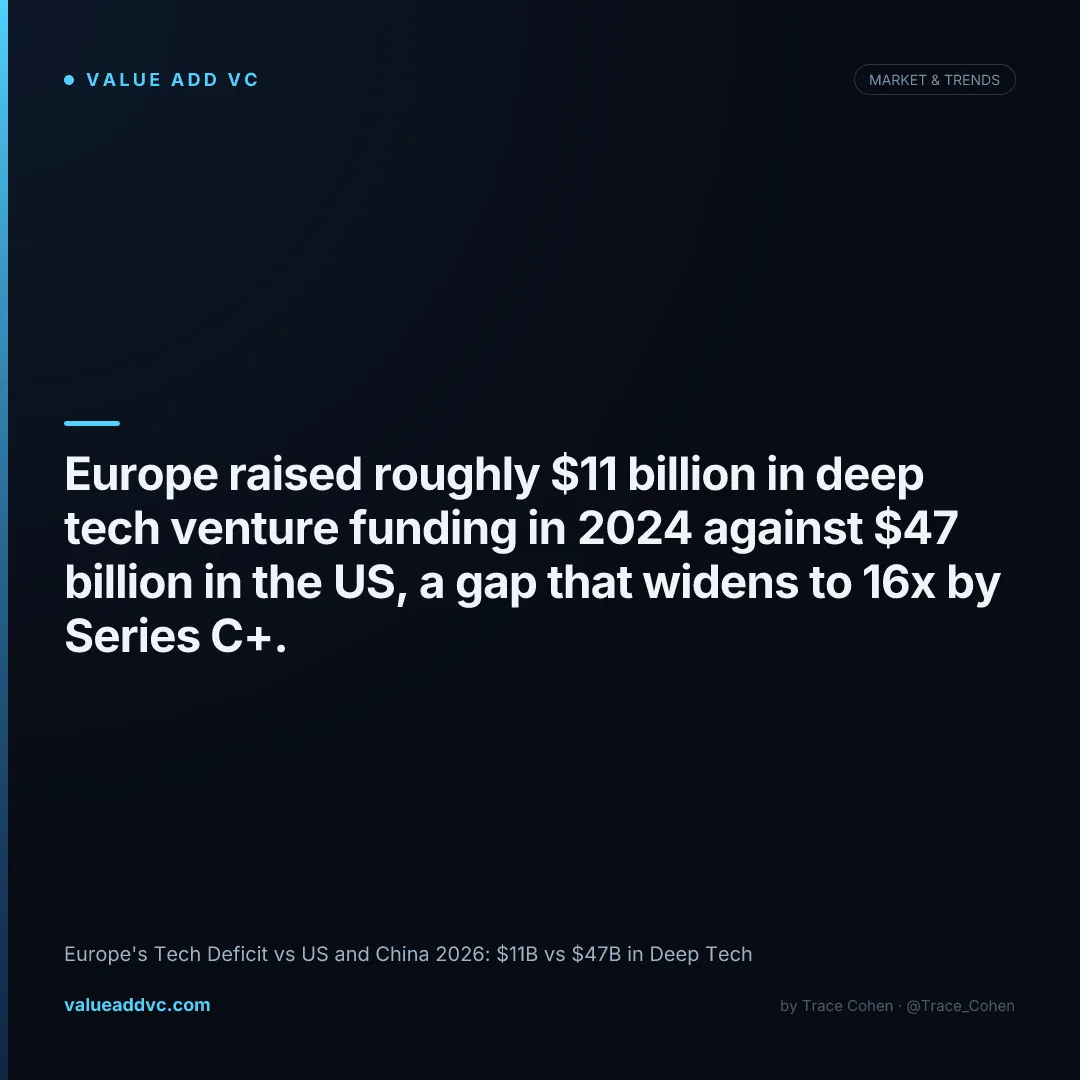
Europe raised roughly $11 billion in deep tech venture funding in 2024 against $47 billion in the US — a gap that widens from 2x at seed stage to a full 16x by Series C and beyond. The frustrating part is that Europe builds nearly half the world's deep tech startups and still can't capture a proportional share of the capital.
The European Union produces 45% of the world's deep tech startups by founding rate, according to Dealroom's 2026 European Deep Tech Report, yet captures only about 17% of global deep tech funding volume. That mismatch between where the science happens and where the checks get written is the core of Europe's tech deficit — and 2026 data shows it's a growth-stage problem more than a founding problem. Startups get created in Europe. They just can't raise the money to scale there — not when US-based specialists like Playground Global's $475M deep tech fund are dedicated entirely to writing that kind of check.

Figures are 2024-2026 estimates blended from Dealroom's 2026 European Deep Tech Report, CEPR VoxEU analysis, the Draghi Report on European Competitiveness, and IW Köln's AI competitiveness fact sheet. Funding figures reflect deep tech venture capital specifically, not all startup funding.
Europe's Tech Deficit vs US and China in 2026: How Wide Is the Gap?
Europe's tech deficit against the US and China in 2026 shows up most sharply in growth-stage capital: Europe raised about $11 billion in deep tech VC in 2024 versus roughly $47 billion in the US, and while the seed-stage gap between the two regions is a manageable 2x, it balloons to 16x by Series C and later rounds. Against China, Europe has actually caught up somewhat over the past decade as Chinese deep tech investment cooled, but the US gap remains the defining competitive problem for European founders.
Europe vs United States: Deep Tech Funding Gap by Stage
CEPR VoxEU analysis and Dealroom 2026 European Deep Tech Report
The Full Numbers: Europe, US, and China Head-to-Head
| Metric | Europe | United States | China |
|---|---|---|---|
| Deep Tech VC Raised (2024) | $11B | $47B | Declining vs. prior decade |
| Share of Global Deep Tech Startups Founded | 45% | ~35% | ~15% |
| Share of Global Deep Tech Funding Volume | 17% | ~55% | ~20% |
| Series C+ Funding Gap vs. Europe (multiple) | 1x (baseline) | 16x | n/a — data limited |
| $15M+ Rounds Funded Domestically | 54% | 80% | n/a — data limited |
| Notable AI Foundation Models Built | 3 | 40 | 15 |
| Estimated Annual Investment Shortfall | €750-800B (Draghi) | — | — |
| Startups Considering Relocation Abroad | ~40% | n/a | n/a |
Figures are 2024-2026 estimates blended from Dealroom's 2026 European Deep Tech Report, CEPR VoxEU analysis, the Draghi Report on European Competitiveness, IW Köln's AI competitiveness fact sheet, and Euronews/Fortune 2026 reporting on AI foundation models. China figures are directional given limited comparable disclosure.
Why Europe's Tech Deficit vs the US and China Keeps Widening
The deficit isn't a founding problem — Europe produces plenty of technical talent and deep tech startups, at a 45% share of the world total. It's a scaling problem. Only 54% of European rounds above $15 million are funded from within Europe, compared to 80% in the US, which means the moment a European deep tech company needs serious growth capital, it's usually crossing the Atlantic to get it — and often relocating headquarters, IP, or key executives in the process. Closing that domestic-funding gap to match US levels would require roughly $4 billion more per year flowing from European investors into European companies, per CEPR's analysis.
Regulatory fragmentation compounds the funding gap. A startup selling enterprise AI software across the EU's 27 national markets faces sales cycles roughly 30% longer and deal sizes about 50% smaller than an equivalent US competitor selling into one unified market. That combination — smaller, slower revenue plus thinner growth capital — is exactly why 4 in 10 European startups say they'd consider relocating outside Europe to scale, and it's a major reason the frontier AI gap looks as stark as it does: 40 notable foundation models built in the US, 15 in China, and just 3 in all of Europe combined.
We track AI company valuations and the capital flowing into frontier labs on our AI valuations dashboard, and the US-Europe gap shows up there too — nearly every AI company valued above $10 billion in 2026 is either American or Chinese, the two superpowers whose own chip and compute supply chains are being forcibly pulled apart, as we cover in our look at what's actually split in the 2026 US-China tech decoupling.
The Exceptions: Europe's Biggest 2026 Raises Show the Gap Can Close
The deficit isn't absolute, and 2026 has produced the clearest counter-evidence yet. German defense-AI company Helsing raised $1.8 billion on July 13, 2026 at an $18 billion valuation — Europe's biggest-ever defense tech funding round, with investor demand reportedly exceeding the available allocation. UK-based AI infrastructure company Nscale closed a $2 billion Series C in March 2026 at a $14.6 billion valuation, described as the largest Series C round in European history. French AI lab Mistral AI is in talks to raise roughly €3 billion at a €20 billion valuation, nearly double its prior €11.7 billion mark from its Series C. Altogether, European AI companies raised about $9.2 billion in Q1 2026 alone.
Those three rounds — Helsing, Nscale, and Mistral — total more than $5 billion in 2026 alone, roughly half of what all of Europe raised in deep tech VC during the whole of 2024. That's a meaningful signal that growth-stage capital for European AI and defense tech is starting to show up domestically, largely from a mix of European sovereign-adjacent funds and international investors willing to write nine-figure checks into European champions. The gap hasn't closed — these remain the exceptions, not the norm, across the thousands of deep tech startups Europe produces every year — but they show the ceiling is higher than the aggregate 16x Series C+ gap suggests when a company has the right combination of geopolitical relevance (defense, sovereign AI) and founder pedigree.
The Draghi Report: What Closing Europe's Tech Deficit Would Actually Cost
Former ECB president Mario Draghi's September 2024 report on European competitiveness put a number on the full scope of the problem: roughly €800 billion in additional annual investment, or about 4-5% of EU GDP, spread across unifying capital markets, cutting regulatory fragmentation, and accelerating AI, green tech, and defense innovation. As of 2026, EU officials still cite a €750-800 billion annual shortfall, meaning almost none of that gap has closed in the eighteen months since the report's publication.
Some progress has been incremental rather than structural. The European Tech Champions Initiative, backed by the European Investment Bank and European Investment Fund, committed €1.25 billion in December 2025 specifically to help European deep tech companies raise larger growth rounds domestically. That's a real step, but it's a rounding error against an €800 billion annual target — roughly 0.15% of what Draghi says is needed each year, which underscores how far apart Europe's policy response and its stated ambition still are.
For scale, the four largest US tech companies alone are expected to spend a combined $700 billion or more on AI infrastructure in 2026 — nearly matching what Draghi says all of Europe needs to invest annually just to stay competitive across every sector, not only AI.
What This Means for Founders and Investors Watching the Gap
For European founders building deep tech or AI companies, the practical implication is blunt: plan to raise growth capital from outside Europe, or plan to relocate before you need it. The 16x Series C+ funding gap isn't closing on any timeline visible in 2026 data, and the EU's own competitiveness diagnosis shows the shortfall is structural, not cyclical — it requires unified capital markets and regulatory harmonization that no single policy initiative has delivered yet.
For investors, the gap is itself an opportunity: European deep tech valuations remain meaningfully lower than US comparables for similar technology and team quality, precisely because domestic growth capital is scarce. That's part of why crossover funds and US-based growth investors have increased their European deep tech activity even as domestic European capital formation lags — arbitraging the same funding gap that's frustrating European founders.
Bottom line: Europe raised about $11 billion in deep tech venture capital in 2024 against $47 billion in the US, a gap that widens from 2x at seed to 16x by Series C+. The EU builds 45% of the world's deep tech startups but captures just 17% of global funding, and the Draghi report puts the annual investment shortfall needed to close the full competitiveness gap at €750-800 billion. Until Europe unifies its capital markets and closes the domestic growth-funding gap, expect European founders to keep crossing the Atlantic for the checks that let them scale — and expect the US-Europe tech deficit to remain one of the widest structural gaps in the global economy.
Latest from the Pulse
Get VC data most people never see
— free to subscribe
Trace's notes on venture, AI and startups, a few times a week. Join 5,000+ subscribers. No spam.
No spam, unsubscribe anytime. Sent via Substack · Privacy · or subscribe on Substack ↗