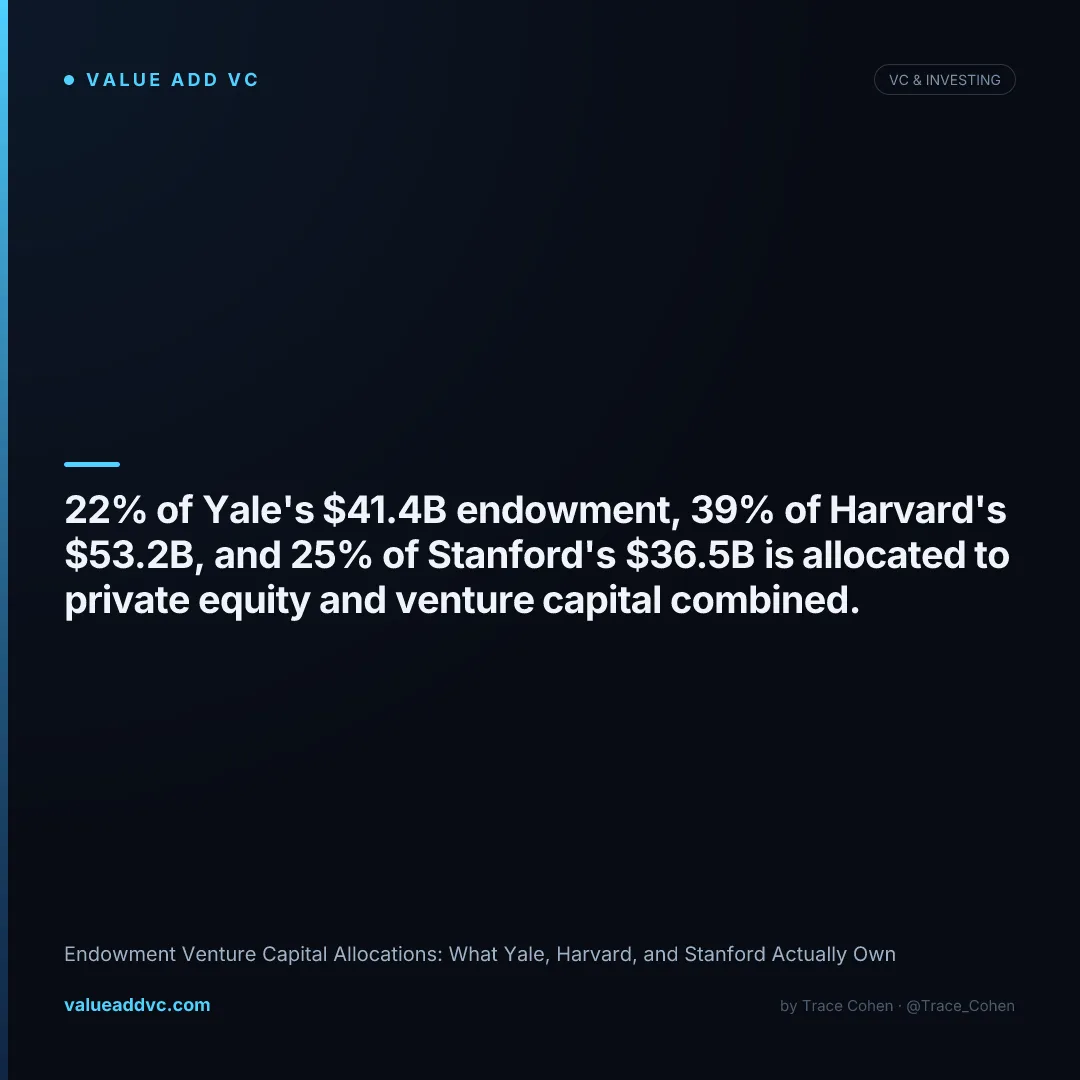
Yale allocates roughly 22% of its $41.4B endowment to private equity and venture capital. Harvard pushes that to 39% of $53.2B. Stanford sits at 25% of $36.5B.
That's the short answer. The longer answer — what these schools actually own, why their allocations are 3–5x larger than the average pension fund's, and which VC funds depend on their checks — is where the interesting story is.
Endowment Venture Capital Allocation in 2026: Who Holds What
Major US university endowments allocate 15–40% of their portfolios to private equity and venture capital, far above the 5–10% typical of public pension funds. Yale targets 22%, Harvard 39%, Stanford 25%, MIT around 23%, and Princeton 28%. These commitments have driven 9–11% annualized 10-year returns and made the Ivy League endowments anchor LPs in nearly every top-tier venture fund.
| Endowment | AUM (FY2024) | PE/VC Target % | Dollars in PE/VC | FY2024 Return | 10-Yr Return |
|---|---|---|---|---|---|
| Harvard | $53.2B | ~39% | ~$20.7B | +9.6% | +9.3% |
| Yale | $41.4B | ~22% | ~$9.1B | +5.7% | +9.5% |
| Stanford | $36.5B | ~25% | ~$9.1B | +8.4% | +8.7% |
| Princeton | $34.1B | ~28% | ~$9.5B | +3.9% | +9.2% |
| MIT | $24.6B | ~23% | ~$5.7B | +8.9% | +9.4% |
| U. of Penn | $22.3B | ~21% | ~$4.7B | +7.1% | +8.6% |
| Notre Dame | $20.3B | ~30% | ~$6.1B | +10.4% | +10.0% |
Sources: NACUBO 2024 Study of Endowments, individual school annual reports. PE/VC percentages combine leveraged buyouts and venture capital — schools report these together. Where schools break out VC separately, it is typically 35–55% of the PE bucket.
The Yale Model: How David Swensen Created the Endowment Venture Capital Playbook
Yale's outsized venture capital allocation is the original story everyone else is copying. When David Swensen took over Yale's endowment in 1985, the school held under 10% in alternatives. By 2005, that figure was over 70%. By 2015, almost 80%. Yale was the first major institution to argue that long-dated, illiquid capital should be deployed into long-dated, illiquid assets — and venture capital was the most attractive of those asset classes because of the power-law return distribution and Yale's ability to access top-quartile managers most LPs could not.
Yale was an early LP in Sequoia, Kleiner Perkins, Greylock, and Benchmark. Those relationships, built in the 1970s and 1980s, are still active today — which is why Yale gets allocation in funds that close in under a week and exclude most institutional LPs entirely. The Yale endowment grew from $1B in 1985 to $41.4B by FY2024, and Swensen attributed roughly 80% of that excess return to allocation decisions, with private equity and VC being the dominant driver.
After Swensen's death in 2021, Matt Mendelsohn took over as CIO. The strategy has held: Yale's FY2024 return was 5.7%, the trailing 10-year is 9.5%, and the trailing 20-year is over 10.4% — all materially above the 60/40 benchmark. The 2022–2023 PE mark-downs hurt short-term numbers, but distributions from earlier vintages (notably 2014–2017 funds with stakes in companies like Snowflake, Datadog, and Airbnb) kept liquidity positive.
What Harvard's $53B Endowment Actually Owns in Venture
Harvard Management Company (HMC) runs the largest US university endowment at $53.2B as of FY2024, and it carries the highest private equity weighting of any major school at roughly 39%. That puts approximately $20.7B in PE strategies, with an estimated $7–9B in venture capital specifically. HMC has been an LP in Sequoia, Founders Fund, General Catalyst, Andreessen Horowitz, and Bain Capital Ventures for decades.
Harvard's allocation shifted dramatically after CIO N.P. Narvekar took over in 2016. Narvekar exited natural resources, slashed direct real estate, and consolidated commitments into a smaller number of larger PE and hedge fund managers. Headcount at HMC dropped from over 230 to under 80. The bet was that concentration with top managers would outperform diversification — and through FY2024 it has, with a 9.3% 10-year return that ranks among the best of any large endowment.
What Harvard owns through these funds is largely opaque — endowments don't disclose underlying fund positions. But based on disclosed LP lists and 13F filings of co-investments, Harvard has stakes in OpenAI (via Thrive Capital), SpaceX (via Founders Fund), Databricks (via Andreessen Horowitz), and Stripe (via Sequoia). A single Sequoia commitment from 2010 has likely generated 8–10x net for Harvard alone.
Stanford, MIT, and Princeton: The Other Tier-1 Endowment Venture Capital LPs
Stanford's $36.5B endowment has a structural advantage in venture allocation: the school sits in Palo Alto, and Stanford faculty and students have founded many of the companies its endowment then backs through fund commitments. Stanford targets roughly 25% to PE/VC, with venture being a larger share of that bucket than at Yale or Harvard — likely 14–16% of total AUM versus 10–12% at Yale. Stanford's FY2024 return was 8.4%, with 10-year at 8.7%.
MIT's $24.6B endowment, managed by MITIMCo, runs a similar Yale-style alternatives-heavy strategy with roughly 23% in PE/VC. MITIMCo is known for being extremely selective on managers — under 75 active fund relationships across the entire portfolio. The school's 10-year return of 9.4% reflects that concentration paying off.
Princeton's $34.1B endowment has the highest alternatives weighting of the Ivy League at over 60%, with roughly 28% in PE/VC. Princeton was an early backer of many top-tier funds and, like Yale, has incumbency-driven access. Notre Dame deserves a mention here too: at $20.3B AUM and roughly 30% PE/VC, it has quietly become one of the best-performing large endowments, with a 10.0% 10-year return.
Why Endowments Are Such Strong VC LPs
Four structural reasons explain why endowments allocate so heavily to venture capital while pension funds and sovereign wealth funds stay closer to 5–10%:
Perpetual time horizon
Endowments exist forever, so they can absorb 10–12 year fund lock-ups and ride out vintages that mark down before recovering
Spending rule of 4–5%
Endowments spend only 4–5% of corpus per year, so liquidity needs are predictable and modest compared to pension obligations
Incumbency in top funds
Yale and Harvard have been LPs in Sequoia, Kleiner, and Greylock since the 1970s — they get allocation in oversubscribed funds others cannot access
No regulatory constraints
Unlike pensions and insurance companies, endowments are not subject to ERISA or risk-based capital rules that penalize illiquid holdings
What Endowment Venture Capital Allocations Mean for Funds and Founders
The practical impact of endowment allocations is enormous. NACUBO's 2024 study covered 658 US endowments managing a combined $874B in assets. The top 10 alone hold roughly 25% of that total. If endowments collectively allocate 15–20% to PE/VC, that's $130–175B of permanent venture capital exposure — and it's overwhelmingly concentrated in the top 25–30 fund managers.
For emerging managers, this is the wall. Yale, Harvard, and Stanford write check sizes typically between $50M and $500M per fund commitment. Most Fund I or Fund II vehicles are too small to absorb that capital — and the operational overhead of underwriting a sub-$200M fund rarely pencils out for a $40B+ endowment. That's why the "LP barbell" exists: emerging managers raise from family offices and high-net-worth individuals while established funds raise from endowments.
For founders, the takeaway is that when an a16z partner or a Sequoia GP funds your company, Yale and Harvard are likely cap-table grandparents 2–3 levels removed. The capital ultimately came from a tax-exempt endowment that needs to grow at roughly 7–8% real to keep up with university spending and inflation — and venture capital is doing the heaviest lifting on that return target.
Funds Endowments Love
- ✓ $500M+ funds with multi-cycle track records
- ✓ Top-quartile DPI over multiple vintages
- ✓ Strong succession plans and stable GP teams
- ✓ Differentiated sourcing or domain edge
Funds Endowments Skip
- ✕ Sub-$200M Fund I and Fund II vehicles
- ✕ Single-GP firms without a deep bench
- ✕ Strategies with no clear edge versus incumbents
- ✕ Funds without independent fund administration
The Ivy League endowments don't just invest in venture capital.
They are the reason the top-tier venture capital asset class exists in its current form — and the gate that almost every other LP has to walk through to get access.
Track institutional LP allocations and venture capital fund performance on the VC Performance Dashboard and VC vs PE Performance page at Value Add VC. Originally published in the Trace Cohen newsletter.
Latest from the Pulse
Get VC data most people never see
— free to subscribe
Trace's notes on venture, AI and startups, a few times a week. Join 5,000+ subscribers. No spam.
No spam, unsubscribe anytime. Sent via Substack · Privacy · or subscribe on Substack ↗