There are now dozens of programs calling themselves "emerging manager accelerators." Only about five of them actually help you raise capital.
The rest give you a badge, a Slack channel, and maybe a few LPs who never respond to follow-up. First-time fund managers can spend 18 months on the wrong programs and wonder why their pipeline is empty.
The programs that actually work do one of three things: give you a credibility signal that institutional LPs recognize, make direct introductions to LP committee members, or teach you the operational mechanics that prevent you from flaming out on compliance, fund admin, or legal setup. Once you're past formation, budgeting for what a fund administrator actually costs by fund size is the next practical decision. Everything else is noise.
Tier 1: Programs That Move LP Capital
Kauffman Fellows
Most prestigious | 2-year cohort program | ~$15,000–$20,000/year
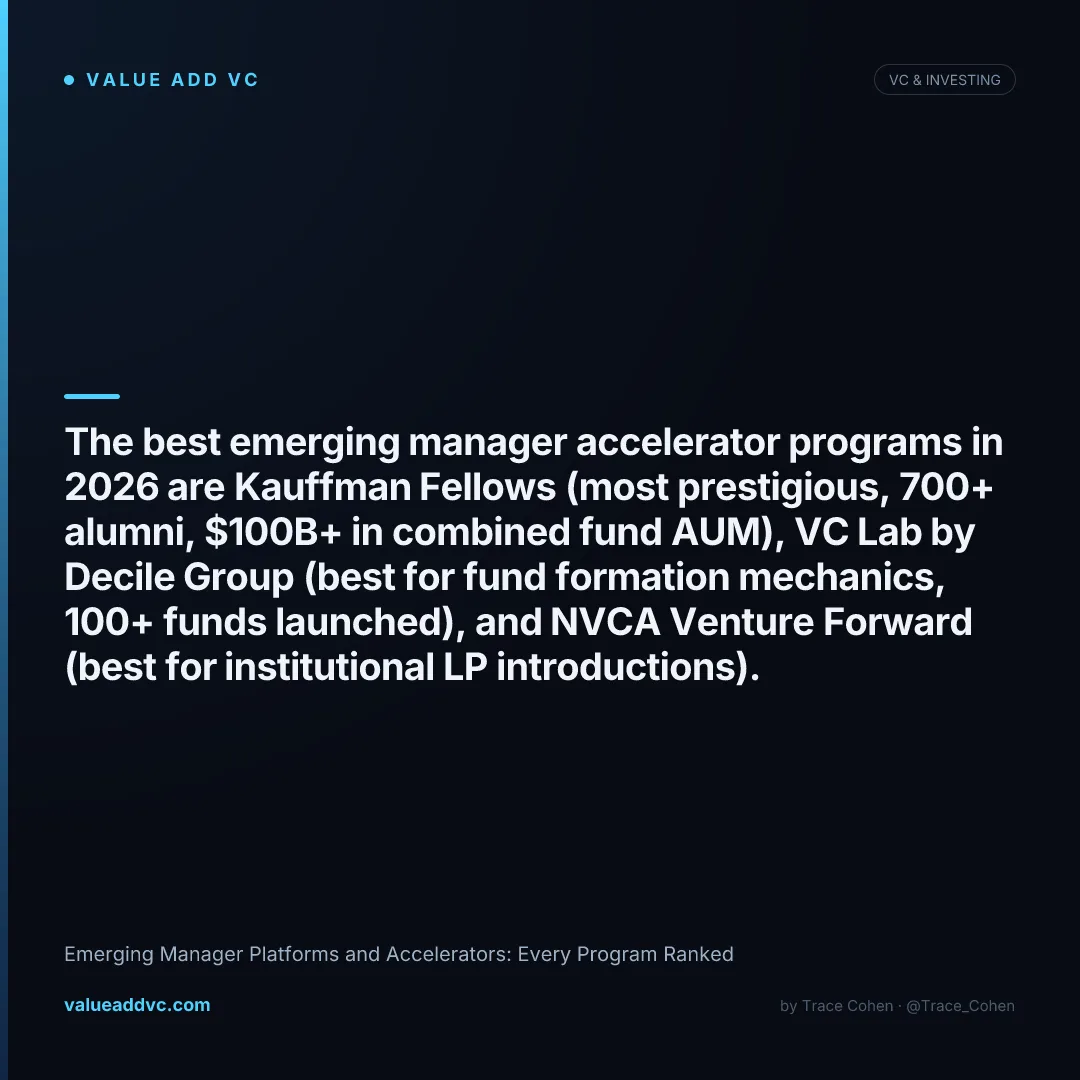
Founded in 1995, Kauffman Fellows is the closest thing venture capital has to an MBA with a network that actually opens doors. The 2-year cohort program has produced 700+ alumni across 60 countries who collectively manage over $100B in fund AUM. Alumni include managing partners at a16z, Bessemer, FirstRound, General Catalyst, and dozens of top-performing emerging funds.
The credential is one of the clearest LP signals that exists. When a first-time manager writes "Kauffman Fellow" in their deck, it earns first meetings with institutional LPs who would otherwise never read the email. The alumni directory functions as a direct referral network — a fellow will introduce you to their LP who will actually read your deck.
Best for: Managers with 2–5 years of investing experience, budget for a meaningful program fee, and a long-term commitment to building an institutional LP base.
Tier 2: Fund Formation and Operational Programs
Diversity-Focused Programs With Real LP Track Records
For diverse managers, the programs below have the most meaningful track record of LP introductions — specifically because they connect managers to LPs with formal diversity mandates, which are now present at over 60% of state pension funds and major university endowments.
| Program | Focus | LP Access | Cost |
|---|---|---|---|
| NAIC | Diverse-owned PE/VC firms | High — pension funds, endowments | Annual membership |
| Harlem Capital Manager Program | Diverse emerging managers | Moderate — curated LP intros | Application-based, selective |
| Visible Hands | Underrepresented founders → managers | Low — community network | Free to apply |
| BLCK VC Fellowship | Black investors in VC | Moderate — alumni network | Free |
The National Association of Investment Companies (NAIC) stands out because its member firms collectively manage over $100B in AUM — LP introductions come through an established institutional network, not a cold list.
Platform Access: Useful but Not Sufficient Alone
These platforms lower the barrier to launching a fund but should be treated as starting points, not complete solutions.
AngelList Rolling Funds
LP signal: MediumLaunch a fund with minimal setup, built-in LP discovery through AngelList network. Cost: 2.5% of management fees + carry sharing. Best for building track record before raising a traditional fund.
Republic Capital
LP signal: Low-MediumLaunch SPVs and micro-funds from retail LPs. Compliance infrastructure included. Not a substitute for institutional LP capital but can build a demonstrable track record quickly.
Allocate.co
LP signal: MediumPlatform connecting emerging managers with institutional LPs. Application-based. Has facilitated introductions for managers raising $10M–$100M funds — but LP responsiveness varies significantly.
Screendoor Partners
LP signal: High (paid)Placement agent and advisory firm specifically for emerging managers. Not a program — a paid advisory service. Meaningful for managers raising $25M+ who need professional LP fundraising support.
What LPs Actually Think of These Programs
Across family offices, endowments, and fund-of-funds, what actually makes them read a deck from an emerging manager comes down to a consistent pattern. The honest answer: credentials matter far less than you think.
A Kauffman Fellows designation opens a first meeting but doesn't close a commitment. What closes commitments is a co-investor or LP they trust vouching for you, a demonstrable track record in the strategy you're pitching (even angel or scout-level data), and a differentiated thesis they haven't seen 50 times. You can track how top-quartile emerging funds actually perform on our VC Performance Dashboard.
Programs are a substitute for network, not a substitute for track record. If you have a strong enough network and a verifiable track record, you may not need any program at all.
The Decision Framework: Which Program Is Right for You
If you are: Pre-fund, need operational help launching the fund
→ VC Lab by Decile Group — covers the mechanics, prevents expensive early mistakes
If you are: Have investing experience, want institutional LP credentialing
→ Kauffman Fellows — 2-year commitment required, but the alumni network is the only one that truly opens institutional doors
If you are: Diverse manager with LP diversity mandate tailwinds
→ NAIC + Harlem Capital Manager Program — both have track records with pension fund and endowment LPs
If you are: Want to test the market with a micro-fund first
→ AngelList Rolling Fund or Republic — low cost, builds track record, not a path to institutional capital on its own
If you are: Raising $25M+ and want professional LP fundraising support
→ Screendoor Partners or a placement agent — programs won't replace dedicated LP fundraising infrastructure at this size
Emerging manager programs are not shortcuts to LP capital.
They are legitimacy accelerators — and legitimacy only earns the first meeting.
The managers who close first funds fastest combine program credentialing with a warm network, a specific thesis that fits an LP's mandate, and a co-investor with a track record LPs already trust. Apply to the program. Then spend twice as much time on the network.
Track emerging fund performance benchmarks on the VC Performance Dashboard at Value Add VC. Originally published in the Trace Cohen newsletter.
Latest from the Pulse
Get VC data most people never see
— free to subscribe
Trace's notes on venture, AI and startups, a few times a week. Join 5,000+ subscribers. No spam.
No spam, unsubscribe anytime. Sent via Substack · Privacy · or subscribe on Substack ↗