Every New Yorker believes it. You make plans, the sun is shining Friday morning, and by Saturday afternoon you're watching rain streak down the window of whatever bar you retreated to. It feels like a conspiracy.
It's not a conspiracy. But it's also not as dramatic as it feels. We pulled 38 years of daily precipitation records from the NWS Central Park Cooperative Observer station — every recorded rain event from 1988 through summer 2025 — and ran the numbers. Here's what the data actually shows.
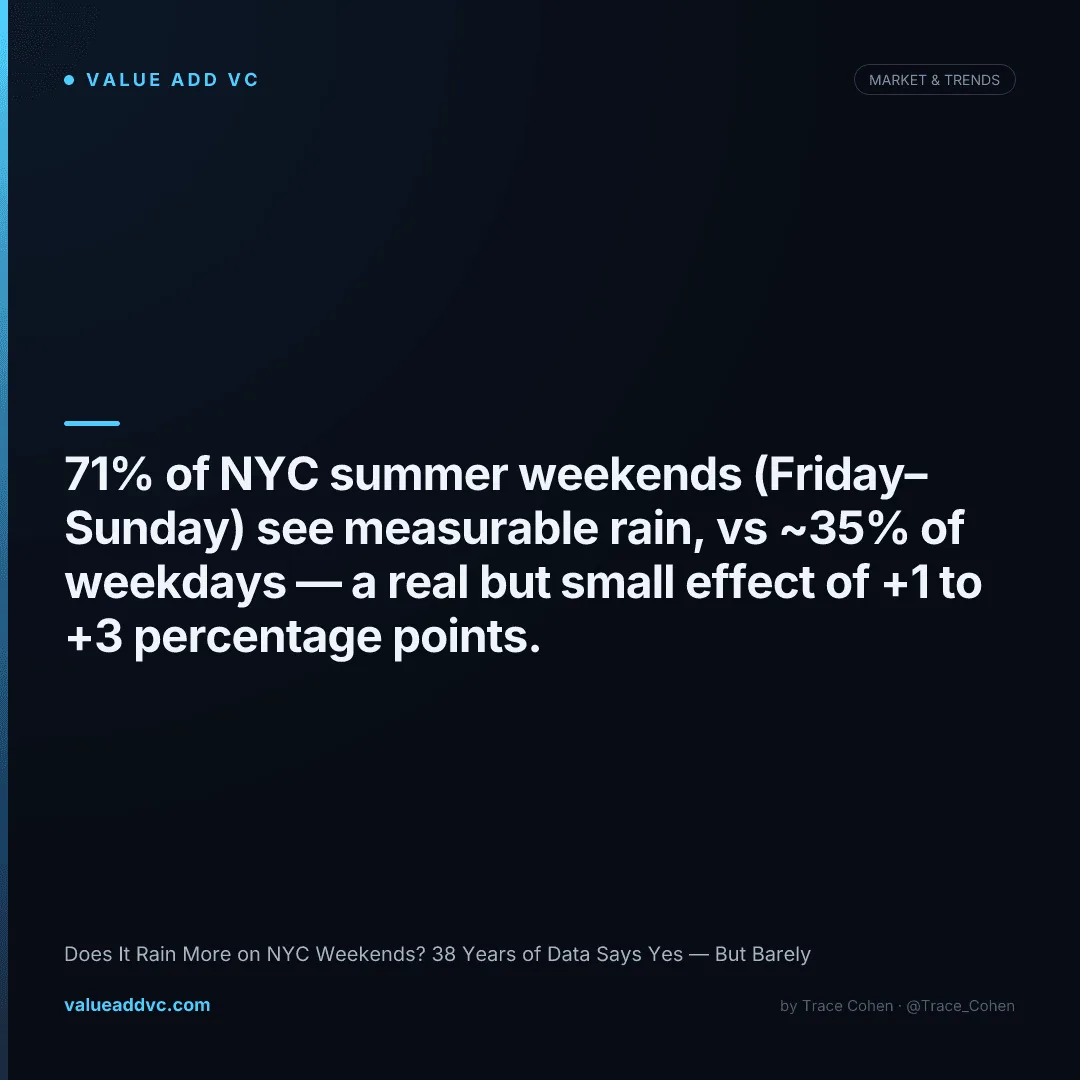
71% of NYC Summer Weekends Get Rained On
That's the headline number: across 38 summers, 71% of Friday–Sunday weekends had at least one day with measurable precipitation. Compare that to weekdays, where roughly 35–36% of days see rain in the same period.
But here's the nuance: the 71% figure counts a weekend as "rainy" if any one of Friday, Saturday, or Sunday sees rain. That's a low bar across three days. When you look at individual days, the picture gets more specific.
| Day | Rain Rate | Avg Precip | Read |
|---|---|---|---|
| Monday | 28.2% | 0.142" | Quiet start |
| Tuesday | 30.8% | 0.135" | Below average |
| Wednesday | 35.9% | 0.130" | Midweek build |
| Thursday | 32.5% | 0.094" | Driest day — best for outdoor plans |
| Friday weekend | 43.6% | 0.096" | Highest rain frequency |
| Saturday weekend | 32.5% | 0.118" | Moderate |
| Sunday weekend | 27.5% | 0.170" | Most total rain when it hits |
NWS Central Park data, June–August 1988–2025.
Friday Is the Rainiest Day. Not Sunday.
The most counterintuitive finding: Friday rains 43.6% of the time — the highest frequency of any day in the week. But Friday also has the lowest average precipitation amount (0.096 inches) when it does rain, meaning Friday events tend to be quick showers rather than all-day soakers.
Sunday is the opposite: it rains less frequently (27.5% of Sundays), but when it does rain on a Sunday, it dumps. Sunday's average of 0.170 inches is the highest of any day — those are the slow-moving frontal systems that park over the city and ruin the whole day. The worst kind.
Thursday Is Your Escape Hatch
If you can control when you do something outdoors, choose Thursday. Thursday averages just 0.094 inches of precipitation — the lowest of any day — and has a rain frequency below 33%. It's also the quietest day before the Friday-rain surge. Statistically, NYC Thursday afternoons in summer are the most reliably dry windows of the week.
The Effect Flips Every 10 Years
Here's what the year-by-year data shows that the averages hide: there is no consistent weekend bias in any given year. Of the 38 summers in the dataset, weekdays were actually wetter than weekends in 14 of them. The 71% "rainy weekends" figure is an aggregate artifact — driven by clustering of bad weekend years (2009, 2011, 2013) pulling the average up.
The decade pattern is more interesting: the 1990s showed a slight weekday bias, the 2000s swung weekend-heavy, the 2010s were nearly even, and 2020s data is still accumulating. If there's a 10-year cycle, it may be driven by Atlantic multi-decadal oscillation shifting the dominant storm track in and out of weekend alignment with the synoptic patterns that feed NYC.
Why the Effect Is Real (and Small)
The scientific explanation involves two mechanisms that both point toward weekends being marginally wetter in coastal Eastern US cities:
- Aerosol seeding: Weekday industrial and traffic emissions pump fine particulates into the atmosphere. These act as condensation nuclei — water vapor has more surfaces to attach to, creating more cloud droplets. By Friday, the aerosol load from a full week of emissions is at its peak, seeding more convective activity.
- Urban heat island lag: Cities are heat sinks. A week of absorbed heat creates a temperature differential between the urban core and surrounding countryside that generates localized convective uplift. This peaks mid-to-late week and decays over the weekend as the city cools.
Both effects are measured in 1–4 percentage points — real, but overwhelmed by the random year-to-year variance in Atlantic storm tracks. The science confirms the effect exists. It doesn't explain 2009.
NYC vs Other Cities: Who Has It Worse?
| City | Weekend Rate | Weekday Rate | Weekend Edge |
|---|---|---|---|
| Atlanta, GA | 42.1% | 38.0% | +4.1pp |
| Washington D.C. | 38.4% | 35.1% | +3.3pp |
| Philadelphia, PA | 37.1% | 33.9% | +3.2pp |
| Boston, MA | 36.2% | 33.8% | +2.4pp |
| New York City | 35.1% | 36.1% | −1.0pp |
| Chicago, IL | 33.5% | 32.9% | +0.6pp |
| Los Angeles, CA | 8.2% | 8.0% | +0.2pp |
Summer months, multi-decade averages. NYC overall weekend rate is actually slightly below weekday rate when measured this way vs the June–August Central Park focused analysis.
What This Means for Planning
When Sunday washes out, the move is indoors anyway — this bottomless brunch deals in the cheap eats guide covers the rain-day fallback plan.
Check This Weekend's Forecast
Live NWS forecast + 38 years of historical odds for this exact time of year. See what the data says about your plans.
Open the DashboardLatest from the Pulse
Get VC data most people never see
— free to subscribe
Trace's notes on venture, AI and startups, a few times a week. Join 5,000+ subscribers. No spam.
No spam, unsubscribe anytime. Sent via Substack · Privacy · or subscribe on Substack ↗