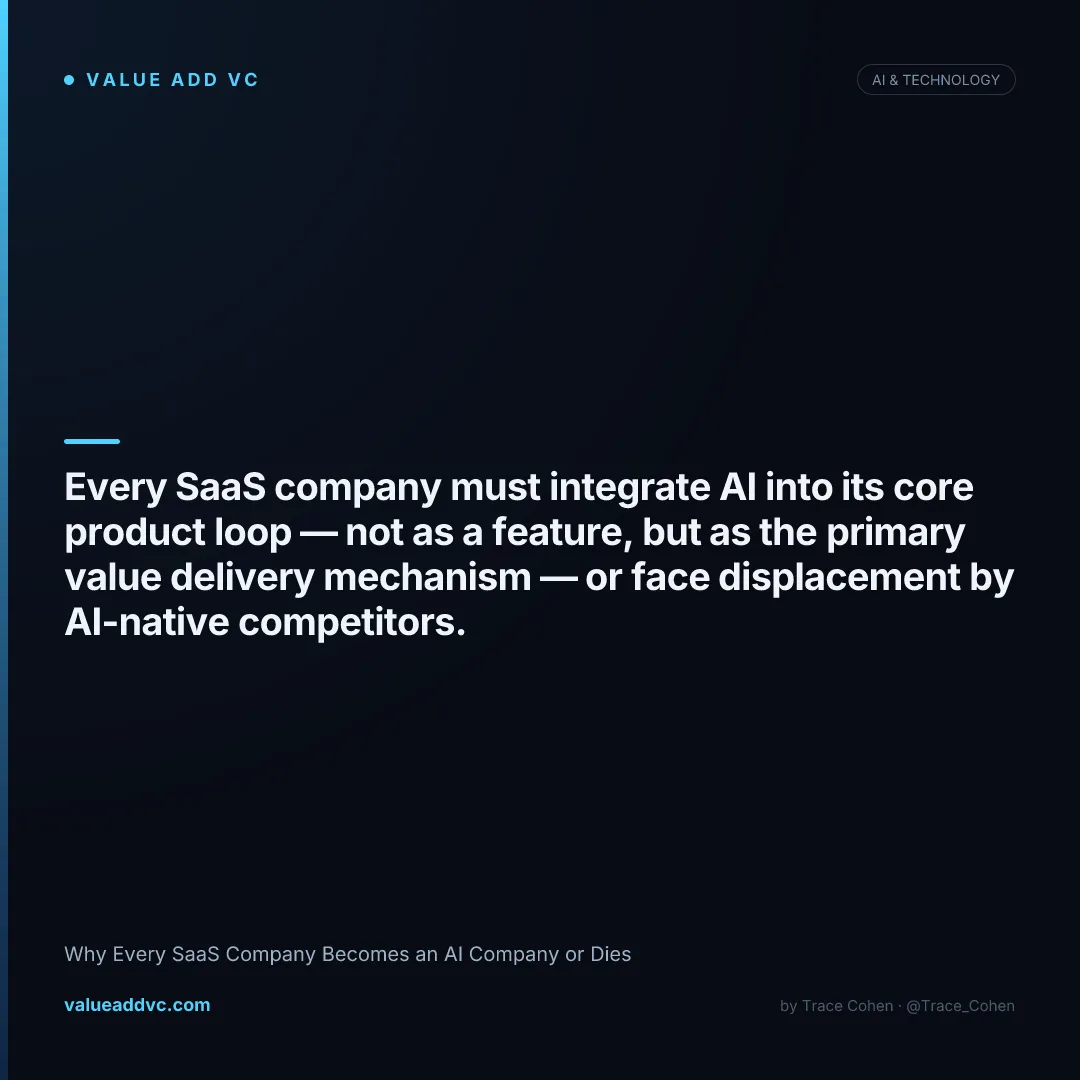
The SaaS multiple compression story everyone is watching is not a market correction. It's a structural repricing of AI displacement risk — and most founders are still treating it like a valuation cycle.
The Multiple Spread Tells the Whole Story
In 2021, the best SaaS companies traded at 20-40x ARR. Today, the average public SaaS company trades at 5-8x — a shift you can see clearly on the SaaS Valuations dashboard. That compression is real. But here's what people miss: AI-native companies are still commanding 15-25x ARR, and in some cases higher. The spread between those two numbers is not temporary sentiment — it's the market quantifying how much of a given SaaS company's revenue is defensible against an AI-native replacement.
I've seen this dynamic firsthand across my portfolio. Companies that moved early to embed AI into core workflows — not as a feature layer, but as the actual mechanism of value delivery — are being valued like AI companies. The ones that added a "Smart Suggestions" button to an otherwise unchanged product are getting marked down with the rest of the legacy SaaS cohort.
The buyers underwriting these valuations are not confused. They are pricing in the question every enterprise CFO is now asking their software vendors: "Will an AI-native competitor make this product obsolete in 18 months?" If the honest answer is yes, the multiple reflects it.
What "Becoming an AI Company" Actually Requires
There is a fast and fraudulent version of this transformation, and there is the real one. The fraudulent version is shipping a GPT-powered search bar or a summary button and calling it an AI product. Every SaaS company in the world has done this. It changes nothing about the underlying defensibility of the business.
The real version requires rearchitecting the core value delivery loop. The test I apply is simple: if you removed the AI entirely, does the product break — or does it just slow down? If it breaks, you are becoming an AI company. If it just slows down, you added AI as a feature. Only the former commands a premium valuation.
Companies that pass this test have fundamentally different product architectures. AI is not running in a sidebar — it is making decisions, generating outputs, and managing workflows that humans used to own. This requires rebuilding data pipelines, retraining models on proprietary operational data, and redesigning UX around AI-driven actions rather than human-driven ones. It takes 12-24 months of serious engineering investment. That timeline is exactly why companies that started in 2024 are now pulling ahead, and companies that haven't started are running out of runway to catch up.
The Workflow Categories Being Erased
Not all SaaS is equally exposed. The highest-risk categories share a common characteristic: their core workflows can be fully described in a prompt. When that is true, an AI-native competitor can replicate the outcome without replicating the product. The categories I am watching most closely:
- •Document processing and extraction — AI agents read, classify, extract, and route documents at a fraction of the cost of purpose-built SaaS. Companies in this space have 18-24 months before displacement accelerates.
- •Customer support tier-1 routing — LLM-powered agents now handle 60-70% of support volume with higher CSAT than scripted rule-based systems. The SaaS tools managing routing rules are losing ground fast.
- •Compliance and audit checklists — Firms are replacing checklist-driven SaaS with AI agents that read regulatory text, cross-reference it against operations, and flag gaps in real time. Static form-based tools are becoming obsolete.
- •Data entry and normalization — Any SaaS product whose primary value is helping humans manually input, clean, or format data has a narrow survival window. AI handles this better, faster, and at near-zero marginal cost.
- •Reporting and dashboard generation — Natural language interfaces are eliminating the need for complex BI tooling in many mid-market use cases. The companies in this space that survive will own the underlying data, not the visualization layer.
Where the Defensible Layer Actually Lives
The good news — and there is genuine good news here — is that AI cannot replicate everything. The defensible layer in SaaS businesses that will survive this transition is proprietary data and workflow lock-in that an external AI model cannot access from the outside. If your product has ingested years of customer-specific operational data, trained on domain-specific edge cases, and is embedded in mission-critical workflows with high switching costs, you have real moat material.
The companies I am most excited about in my portfolio right now are not the ones selling AI features — they are the ones that have positioned their proprietary data as the competitive asset and rebuilt their product around surfacing insights from that data through AI. That is an AI company. It just happened to start its life as a SaaS company.
The transformation playbook is not complicated: audit which of your workflows are prompt-replicable, ruthlessly deprioritize them, and concentrate your AI investment on workflows where your proprietary data gives you an advantage no external agent can match. Build the moat where the data lives, not where the UI lives.
The SaaS companies that survive this decade will not be remembered as SaaS companies. They will be remembered as AI companies that happened to start with a subscription model. The ones that don't make the transition will not be remembered at all.
Stay current with VC and startup trends at Value Add VC. Originally published in the Trace Cohen newsletter.
Latest from the Pulse
Get VC data most people never see
— 100% free
Weekly benchmarks, valuations, and fund data. Join 5,000+ investors. No spam.