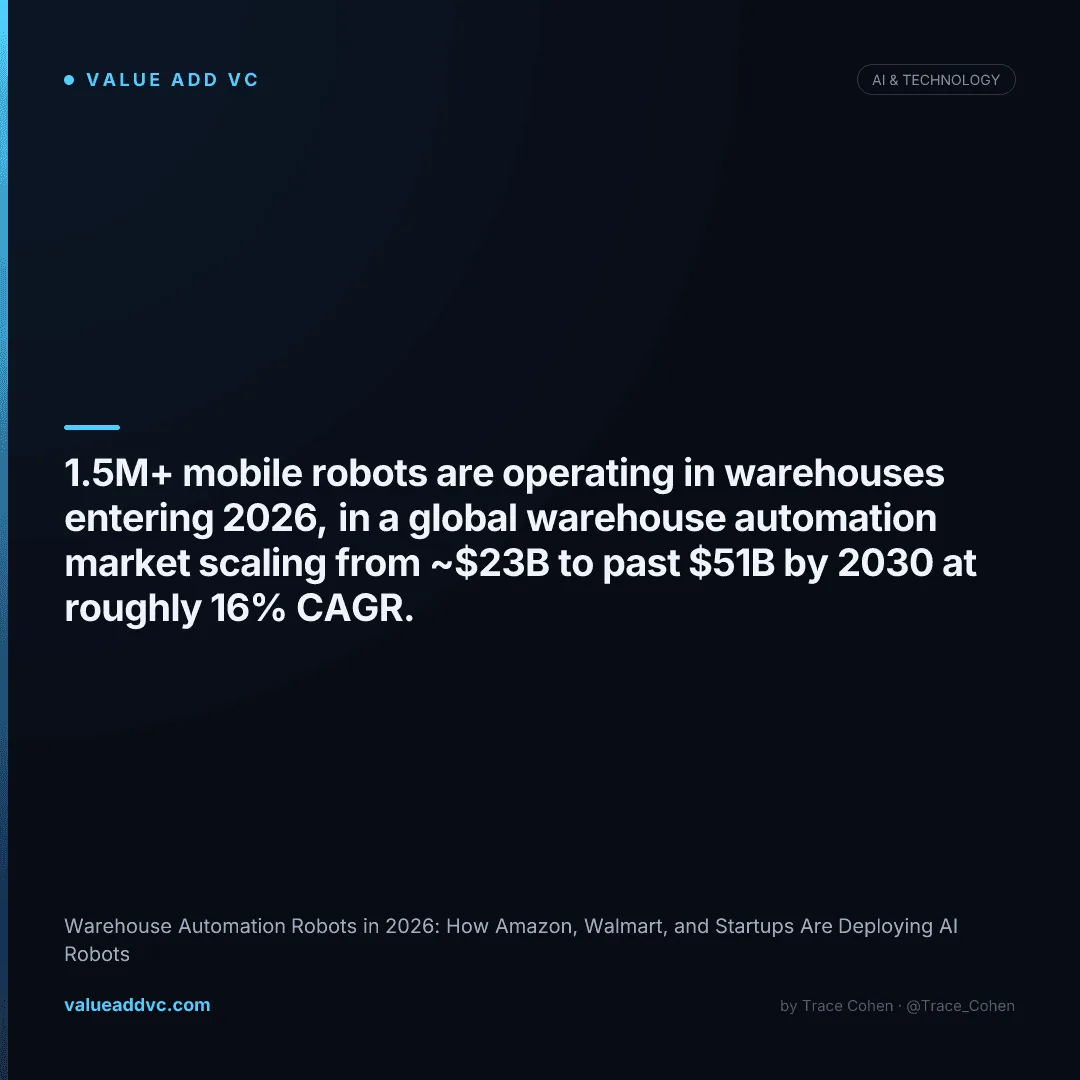
More than 1.5 million mobile robots are now working inside warehouses entering 2026, in a market scaling from roughly $23B today to past $51B by 2030 — with Amazon alone running over 1 million units.
That's the short answer. The longer answer is more interesting: the easy automation — moving shelves around — is basically solved, and the entire frontier now sits on one stubborn problem, getting a robot to reliably pick up any item it has never seen before.
Warehouse Automation Robots in 2026: The Numbers
Heading into 2026, more than 1.5 million mobile robots operate across global warehouses, and the broader warehouse automation market sits near $23–30B with projections to exceed $51B by 2030 at roughly 16% CAGR. Amazon runs over 1 million of those robots itself. The growth driver is simple: e-commerce order volume keeps rising while warehouse labor stays expensive and hard to retain, so automation is no longer a moonshot — it's a margin decision.
For context, a decade ago global shipments of autonomous mobile robots numbered in the low thousands per year. Today annual AMR shipments run into the hundreds of thousands, and the installed base compounds. This is one of the few corners of hard tech where the unit economics already work at scale — which is exactly why investors are pricing it like the next platform shift in physical AI.
Who's Deploying Warehouse Robots in 2026
The market splits into three layers: the hyperscale operators building in-house, the systems integrators selling turnkey automation, and the AI startups attacking the picking problem. Here's how the major players stack up.
| Operator / Vendor | Scale | Core Robotics | Focus |
|---|---|---|---|
| Amazon | 1M+ robots | Hercules, Proteus, Sparrow, Robin | In-house fulfillment at hyperscale |
| Walmart | 40%+ of volume automated by 2026 goal | Symbotic systems, Alphabot | Regional distribution centers |
| Symbotic | $22B+ backlog | SymBot autonomous arms + AMRs | Turnkey DC automation for retailers |
| Ocado | ~$11B market cap | Hive grid bots, 600+ picks/hr lines | Grocery fulfillment platforms |
| Locus Robotics | 5B+ units picked | Collaborative AMRs | Pick-assist for 3PLs and retail |
| Covariant | Acqui-hired by Amazon, 2024 | RFM-1 foundation model + arms | AI dexterous picking |
| Ambi Robotics | 100M+ packages sorted | AmbiSort pick-and-place | Parcel induction and sortation |
How Amazon and Walmart Are Deploying AI Robots
Amazon is the clearest case study in scale. It crossed 1 million deployed robots in 2025 and now operates almost as many robots as it employs warehouse workers. Its lineup runs from Hercules and Pegasus drive units that ferry inventory pods, to Sparrow and Robin — robotic arms that identify and move individual items — to Proteus, its first fully autonomous mobile robot cleared to roam the floor alongside people rather than inside caged zones. Amazon's 2024 acqui-hire of Covariant's founders folded one of the best AI-picking teams directly into that roadmap.
Walmart is taking the buy-and-integrate path. Rather than build a robotics division, it partnered heavily with Symbotic — taking an equity stake and committing billions — to automate its regional distribution and fulfillment centers, with a stated goal of running roughly 40%+ of its volume through automated facilities. Walmart's Alphabot system handles online grocery order assembly in dedicated micro-fulfillment areas attached to stores.
The strategic split is instructive: Amazon treats robotics as a core competency it must own; Walmart treats it as infrastructure it can buy. Both are right for their own cost structure — and both add up to enormous pull-through demand for the vendor and startup layer below them.
The Hard Part: AI-Driven Picking
Moving a shelf from point A to point B is a solved navigation problem. Picking up a random, deformable, partially occluded item from a cluttered bin is not. This is where the AI in "AI robots" actually lives, and where the startup money is going.
Foundation models for manipulation
Covariant's RFM-1 and similar models train on millions of real picks to generalize across SKUs
Vision in clutter
Identifying graspable surfaces on items the robot has never seen before, in real time
Grasp success rate
Best-in-class systems hit ~95–99% in controlled lines, but tail cases still need humans
Speed vs reliability
Commercial picking runs ~400–1,000 picks/hour; pushing speed drops accuracy
The economic stakes are huge because picking is the most labor-intensive step in the warehouse — often 50–70% of fulfillment labor. Every point of grasp reliability above 99% unlocks lights-out operation for another category of goods. That's why a startup like Covariant got absorbed into Amazon and why Dexterity, Ambi Robotics, and a handful of others continue to raise at premium valuations despite a brutal funding market for most of hardware.
What the Economics Actually Look Like
Operators don't buy robots for novelty — they buy a payback period. Here's how the deployment math typically pencils out across the main automation categories in 2026.
| Automation Type | Typical Cost | Productivity Gain | Payback |
|---|---|---|---|
| Collaborative AMRs (pick-assist) | $25K–$50K / unit | 2–3x pick rate | 12–24 months |
| Goods-to-person systems | $1M–$15M / facility | 30–50% labor cut | 2–4 years |
| Robotic arms (induction/sort) | $100K–$300K / cell | Replaces 1–2 FTEs/shift | 18–36 months |
| AI dexterous picking | $150K–$500K / cell | Variable by SKU mix | 2–5 years |
| Full Symbotic-style DC build | $50M–$80M / site | 40%+ throughput | 5–8 years |
| Micro-fulfillment (grocery) | $2M–$10M / site | 10x order density | 3–5 years |
The shift to watch is the move from CapEx to Robotics-as-a-Service. Vendors like Locus and Formic now lease robots on a per-pick or monthly basis, which collapses the upfront cost and turns automation into an operating line item. That financing innovation may matter more for adoption than any single hardware breakthrough — it's what lets a mid-size 3PL automate without a $10M check.
What This Means for Founders and Investors
Where the Opportunity Is
- ✓ Dexterous picking that generalizes across SKUs
- ✓ Software and fleet orchestration layers
- ✓ Robotics-as-a-Service financing models
- ✓ Retrofit automation for the long tail of mid-size warehouses
Where It Gets Brutal
- ✕ Commodity AMRs competing on price with incumbents
- ✕ Hardware-only plays with no recurring software
- ✕ Selling against Amazon's and Symbotic's in-house scale
- ✕ Long sales cycles and capital-intensive pilots
My read after looking at this space across 65+ investments: the durable value is migrating from the metal to the model. The robot body is becoming a commodity that any contract manufacturer can build; the moat is the AI that makes it useful and the recurring software that keeps it running. That's the same pattern we saw in autonomous vehicles and it's playing out faster here because warehouses are structured, indoor, and forgiving environments where deployment risk is low.
Warehouse automation isn't a question of if anymore.
With 1.5M+ robots deployed and a $51B market by 2030, the only real question is who owns the AI layer that makes the next million robots actually useful.
Track AI and physical-automation valuations on the AI Valuations Dashboard at Value Add VC. Originally published in the Trace Cohen newsletter.
Latest from the Pulse
Get VC data most people never see
— 100% free
Weekly benchmarks, valuations, and fund data. Join 5,000+ investors. No spam.