VC scout programs are one of the most misunderstood entry points into venture capital — and the compensation structure is the biggest source of confusion.
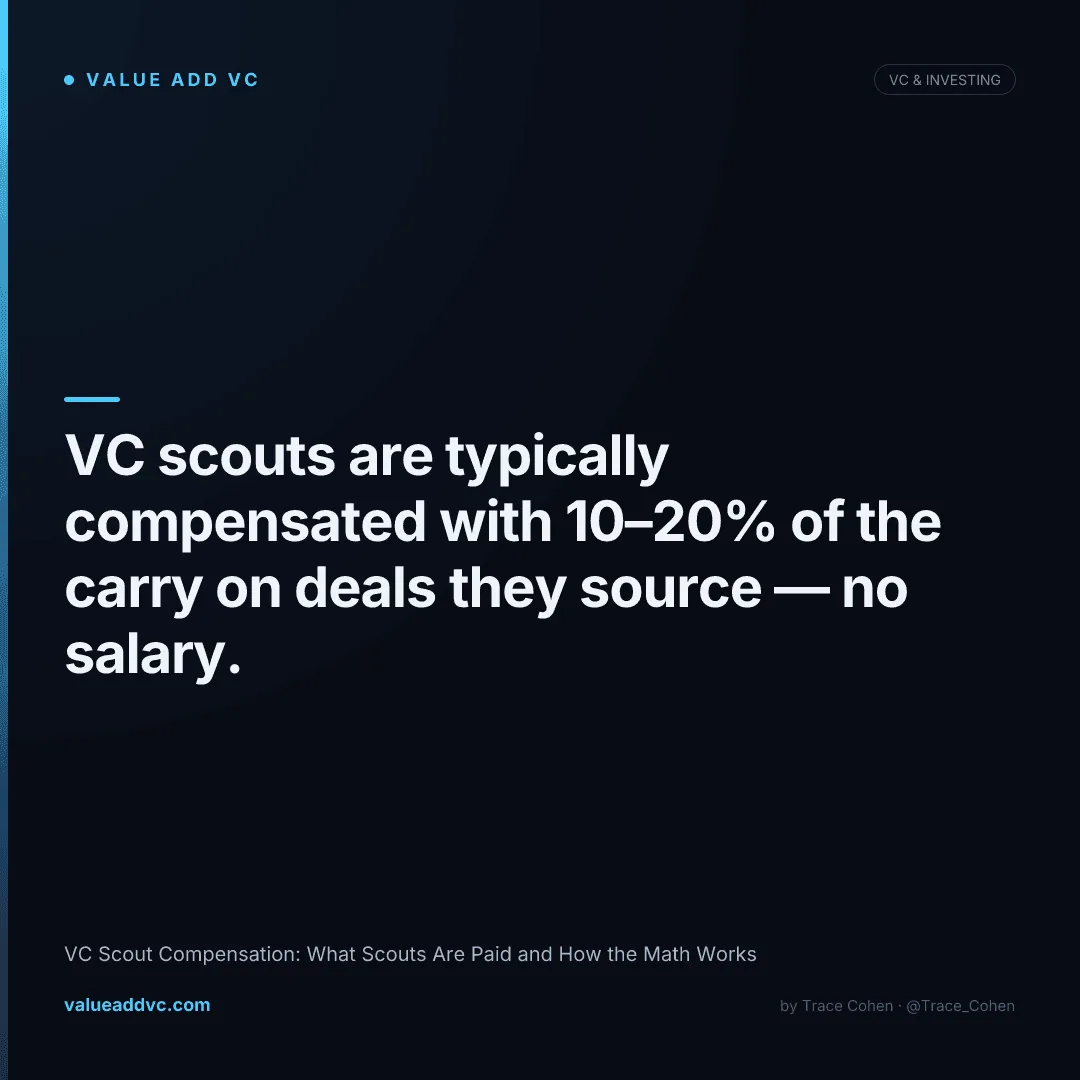
Most people who ask about VC scout compensation are expecting something resembling a salary. That is not how it works. Scouts are typically unpaid in the traditional sense. Their compensation is a percentage of the carry generated by deals they source — illiquid, long-dated, and entirely contingent on portfolio outcomes.
I have seen this dynamic firsthand across dozens of fund structures. The scouts who thrive understand they are making an asymmetric bet on their own deal sourcing ability, not signing up for a job. The ones who struggle are the ones who conflated access with income.
How VC Scout Compensation Is Structured
Scout programs vary by fund, but the core compensation model is consistent: scouts receive a share of the carry on the specific deals they source, not on the overall fund. This is a critical distinction.
10–20%
Carry share on sourced deals
Most common range; Sequoia and First Round scouts typically receive 15%
$500–$2,000
Monthly stipend (where offered)
Rare; most programs are carry-only with no ongoing cash compensation
$25K–$250K
Scout check size per deal
Fund deploys capital; scout does not invest their own money in most programs
1–3
Deals sourced per year (typical)
Most scouts are selective; quantity is not the goal
Some programs — notably First Round Capital's scout program — provide scouts with a dedicated investment budget rather than deploying fund capital directly. Others, like Sequoia's, operate as a separate scout fund entity where scouts make investments alongside the main fund. The carry mechanics differ slightly but the principle is the same: scouts win when their deals win.
VC Scout Compensation Math: Three Scenarios
Here is how the carry math works across three realistic outcomes. Assumptions: 20% fund carry, 15% scout share of deal-level carry, LP capital fully returned (hurdle cleared).
| Scenario | Fund Check | Exit Value | Fund Carry | Scout Cut |
|---|---|---|---|---|
| Modest win (5x) | $100K | $500K | $80K | $12K |
| Good outcome (20x) | $250K | $5M | $950K | $142.5K |
| Breakout (50x) | $200K | $10M | $1.96M | $294K |
| Unicorn (100x+) | $250K | $25M | $4.95M | $742K |
Scout cut = 15% of deal-level carry after LP capital returned. Actual outcomes depend on fund structure, carry allocation agreement, and whether the fund is in carry on that specific deal.
The Major Scout Programs and What They Offer
Not all scout programs are equal. The prestige, check size, carry terms, and exclusivity vary dramatically. Here is how the major programs compare:
Sequoia Capital
One of the oldest and most prestigious programs. Scouts are typically top founders and operators. Access to Sequoia's LP network is the real prize.
$100K–$500K
check size
~15%
carry share
First Round Capital
First Round runs a formal scout program that has backed several major companies at inception. Strong community and operator-investor culture.
$25K–$150K
check size
10–20%
carry share
a16z
Less formal than Sequoia. a16z scouts are typically embedded in specific verticals — crypto, bio, enterprise — and source deals within their domain.
Varies
check size
Undisclosed
carry share
Emerging / Micro-VC
Hundreds of smaller funds run informal scout arrangements. Terms are more negotiable, check sizes smaller, but the learning environment can be deeper.
$10K–$100K
check size
10–25%
carry share
The Real Reason to Become a Scout (It Is Not the Money)
On expected value, most scout programs do not pay well. A scout who sources three deals per year across a ten-year fund life has 30 investments. If the hit rate mirrors typical early-stage VC (1 in 10 returns meaningful capital), three deals generate carry. At $150K average carry per hit, that is $450K over ten years — or $45K per year before taxes. That is not a career.
But that framing misses the point. The scouts who later become partners at top firms, launch their own funds, or build the network that defines their investing career — they did not join for the carry distribution. They joined for the reps.
- →Deal sourcing at volume: most scouts see 50–200 companies per year, building pattern recognition fast
- →Access to the fund's LP and portfolio network before you have your own
- →A track record of sourcing that becomes the foundation of a fund manager pitch
- →Credibility with founders who want scouts connected to top-tier funds
- →The carry upside is real on outlier outcomes — it just is not a salary substitute
Scout compensation is not a paycheck — it is a lottery ticket backed by your own conviction and network.
The scouts who win big sourced the company nobody else saw. That pattern is what gets you a fund.
Explore the emerging fund landscape and VC performance data on the Funds Dashboard and VC Performance Tracker at Value Add VC. Originally published in the Trace Cohen newsletter.
Latest from the Pulse
Get VC data most people never see
— 100% free
Weekly benchmarks, valuations, and fund data. Join 5,000+ investors. No spam.