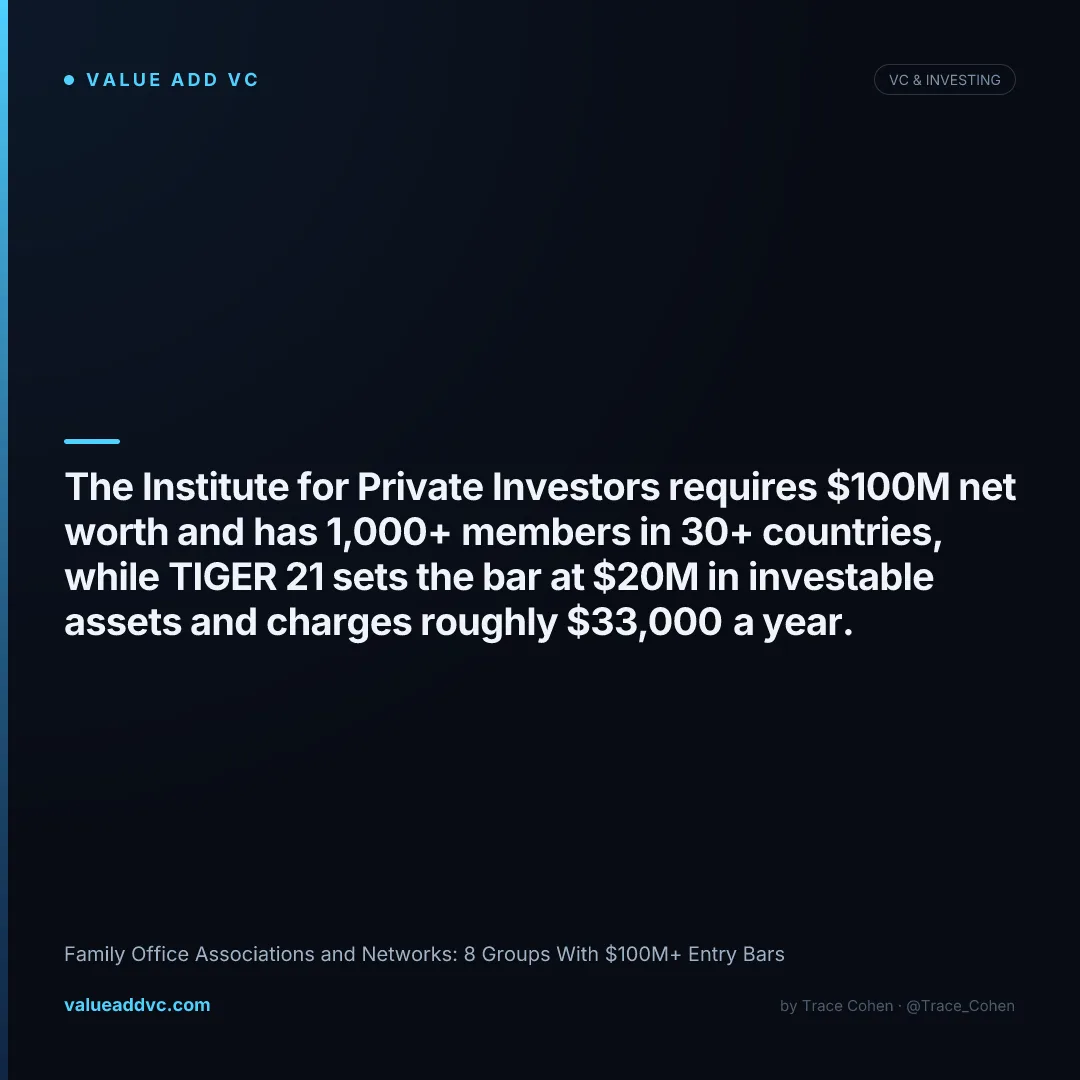
$100M is the minimum net worth required to join the Institute for Private Investors, one of at least 8 major family office networks now collectively serving well over 1,000 ultra-high-net-worth families. That's the short answer. The longer answer is that these groups differ enormously on entry bar, cost, and what "access" actually means once you're inside.
Family offices are, by design, private — there's no public exchange or directory that tells a $75M family or a newly minted operator-turned-investor which peer group fits their stage. We track fund and allocator data more broadly on our VC fund performance dashboard, but the networks below are where family offices actually go to find deal flow, vetted advisors, and peers who've solved the same problems.
Figures compiled from TIGER 21, Institute for Private Investors, Family Office Exchange, TFOA, and Campden Wealth public membership and research pages, 2025-2026.
What Are the Top Family Office Associations and Networks?
The major family office associations and networks include TIGER 21, the Institute for Private Investors (IPI), Family Office Exchange (FOX), the Family Office Association (TFOA), and several smaller regional or sector-specific groups like CCC Alliance and YPO's family business network. Each sets its own net worth or AUM floor, ranging from roughly $15M to $100M, and charges anywhere from a few thousand to tens of thousands of dollars a year for access to peer education, vetted deal flow, and co-investment opportunities.
None of these groups publish a combined membership count, but based on public figures — IPI's 1,000+ members, TIGER 21's chapters across dozens of cities globally, and FOX's decades-old single-family-office member base — the total pool of UHNW families actively participating in at least one formal network likely exceeds 3,000-4,000 globally.
Family Office Associations and Networks Compared
| Network | Founded | Entry Bar | Est. Annual Cost | Focus |
|---|---|---|---|---|
| TIGER 21 | 1999 | $20M investable assets | ~$33,000/yr | Peer learning groups, monthly portfolio defense |
| Institute for Private Investors (IPI) | 1991 | $100M net worth | $15,000-$25,000/yr (est.) | Education, 1,000+ member global community |
| Family Office Exchange (FOX) | 1989 | No hard floor; SFO-oriented | $10,000-$40,000/yr (tiered) | Forums, research, advisor screening |
| Family Office Association (TFOA) | 2007 | 9-10 figure AUM typical | Invite-only, undisclosed | Buy-side-only peer network, co-investment |
| CCC Alliance | 2005 | ~$30M+ (typical) | $5,000-$15,000/yr (est.) | Direct investing and co-investment club |
| YPO Family Business Network | 1950 (YPO); FBN sub-group | Varies by chapter | $10,000-$20,000/yr (est.) | Next-gen and operating-family peer groups |
| Opportunity Network | 2013 | No public net worth minimum | Deal-based/subscription | Deal-sharing platform for family offices and funds |
| Campden Wealth / Global Family Office Report network | 1963 (Campden) | Research participant, not membership | Free to survey, paid for full report | 317-office 2025 global benchmarking survey |
Cost figures are estimates compiled from public reporting, member interviews cited in Spear's WMS, MarketRealist, and organization membership pages; several groups do not publicly disclose exact dues. Data as of 2026.
TIGER 21 vs. the Institute for Private Investors: The Two Biggest Peer Groups
TIGER 21, founded in 1999, is built around monthly "portfolio defense" sessions where members present their actual holdings to a small peer group for scrutiny — a structure that requires $20M in verifiable investable assets or net worth to join. Dues have historically been reported around $33,000 a year, and starting April 2026 the group shifted to an annual CPI-linked adjustment rather than ad hoc increases, with no planned bump to the initiation fee for 2026.
The Institute for Private Investors sets a materially higher bar at $100M in net worth and has grown to more than 1,000 members spanning 30-plus countries and 41 U.S. states, according to its own membership figures. Nearly half of IPI's membership — 48% — has stayed for 10 years or more, which is a meaningfully higher retention signal than most professional associations post, and points to why the group markets itself on continuity of relationships rather than transactional deal access.
Family Office Exchange, TFOA, and the Smaller Networks
Family Office Exchange (FOX), founded in 1989, is one of the oldest organizations in the category and was built specifically around single family offices rather than individual UHNW investors, offering separate membership tracks for families, family office executives, and screened advisors. FOX doesn't publish a strict net worth floor, but because its programming assumes a functioning single family office structure, effective participation tends to start well above $50M in assets under management.
The Family Office Association (TFOA), founded in 2007, positions itself as a true peer network rather than a commercial platform — it restricts membership to the buy-side family office community and explicitly avoids monetizing member relationships, with participants typically managing assets in the nine or ten figures. Smaller and more specialized groups like CCC Alliance (co-investment-focused since 2005) and YPO's family business sub-network fill gaps for families that want a narrower, deal- or next-gen-focused peer group rather than the broad educational programming FOX and IPI offer.
Campden Wealth, which acquired IPI, runs the broadest research instrument in the category: its 2025 Global Family Office Report surveyed 317 single and private multi-family offices worldwide, including 141 in North America with $285 billion in combined wealth and average AUM of $1.5 billion per office. That's not a membership network in the traditional sense, but it's the closest thing the industry has to an aggregate benchmark, and most of the major associations above cite Campden data in their own materials.
Regional and International Family Office Networks Worth Knowing
Most of the networks above are U.S.-centric, but Campden Wealth's 2025 Global Family Office Report found that 176 of its 317 survey respondents — well over half — came from outside North America, spanning Europe, Asia-Pacific, Latin America, and the Middle East. Regional groups have grown to match that footprint: the Middle East has seen a wave of new single family office formation tied to Dubai's DIFC and ADGM regulatory frameworks, while Asia-Pacific family offices increasingly cluster around Singapore's Variable Capital Company structure and Hong Kong's dedicated family office tax incentives introduced in recent years.
Europe has its own version of the U.S. peer-group model in groups tied to Campden Wealth's European conference circuit and country-specific bodies like the UK's Institute for Family Business, which focuses more on operating family businesses than pure investment offices. For a globally mobile family, the practical takeaway is that network choice often follows domicile: a family office based in Singapore gets more day-to-day value from a regional group with local deal flow and regulatory expertise than from a U.S.-anchored network like TIGER 21, even if it also holds a U.S. membership for cross-border access.
This is also where the line between "association" and "service provider" blurs. Firms like AlTi Global and RBC Wealth Management now co-publish family office research with Campden Wealth specifically to build relationships with this same UHNW population, which means some of the best regional intelligence on family office networks actually comes from bank and multi-family-office research arms rather than from a formal membership body at all.
How to Choose Among Family Office Associations and Networks
Start with the net worth or AUM floor, since it filters out most of the field immediately: a $30M single family office realistically qualifies for TIGER 21 or CCC Alliance but not IPI or TFOA, while a $150M-plus office has every door open and should weigh cost against the specific value it wants — portfolio scrutiny (TIGER 21), broad education and advisor vetting (FOX), or quiet co-investment access (TFOA, CCC Alliance).
Cost matters less than most families assume relative to the size of the checks these networks are meant to influence. At $10,000-$40,000 a year, even the priciest of these memberships is a rounding error against a $50M-plus portfolio, so the real diligence question is retention: IPI's 48% ten-year-plus membership rate suggests genuine long-term value, and any network worth joining should be evaluated the same way — ask current members how many stay past year three, not just how many join.
A second filter worth applying is structural: peer-learning groups like TIGER 21 work best for families still actively shaping investment policy and want structured accountability, while deal-flow-oriented groups like TFOA and CCC Alliance suit offices that already have a defined strategy and mainly want proprietary co-investment access. Families investing directly into venture and growth-stage companies should also weigh whether a network's deal flow overlaps with what they can already see through direct GP relationships — several family offices we've worked with found that a $25,000-a-year membership only pays for itself once they've co-invested in at least one deal sourced through the group.
Finally, treat multiple memberships as normal rather than redundant. It's common for a $200M-plus single family office to hold both a TIGER 21 or CCC Alliance seat for direct deal access and an IPI or FOX membership for broader education and advisor vetting, since the two categories of network solve genuinely different problems rather than competing for the same use case.
Bottom line: The Institute for Private Investors and TFOA sit at the top of the entry-bar spectrum with roughly $100M-equivalent thresholds, TIGER 21 anchors the accessible end at $20M with dues near $33,000 a year, and Family Office Exchange remains the most established option built specifically for single family office structures rather than individual investors. With Campden Wealth's 2025 survey covering 317 offices and $285 billion in North American wealth alone, these networks collectively represent one of the largest — and least visible — capital communities in venture and private markets. For any family office weighing membership, the net worth floor picks the shortlist and retention data should pick the winner.
Latest from the Pulse
Get VC data most people never see
— free to subscribe
Trace's notes on venture, AI and startups, a few times a week. Join 5,000+ subscribers. No spam.