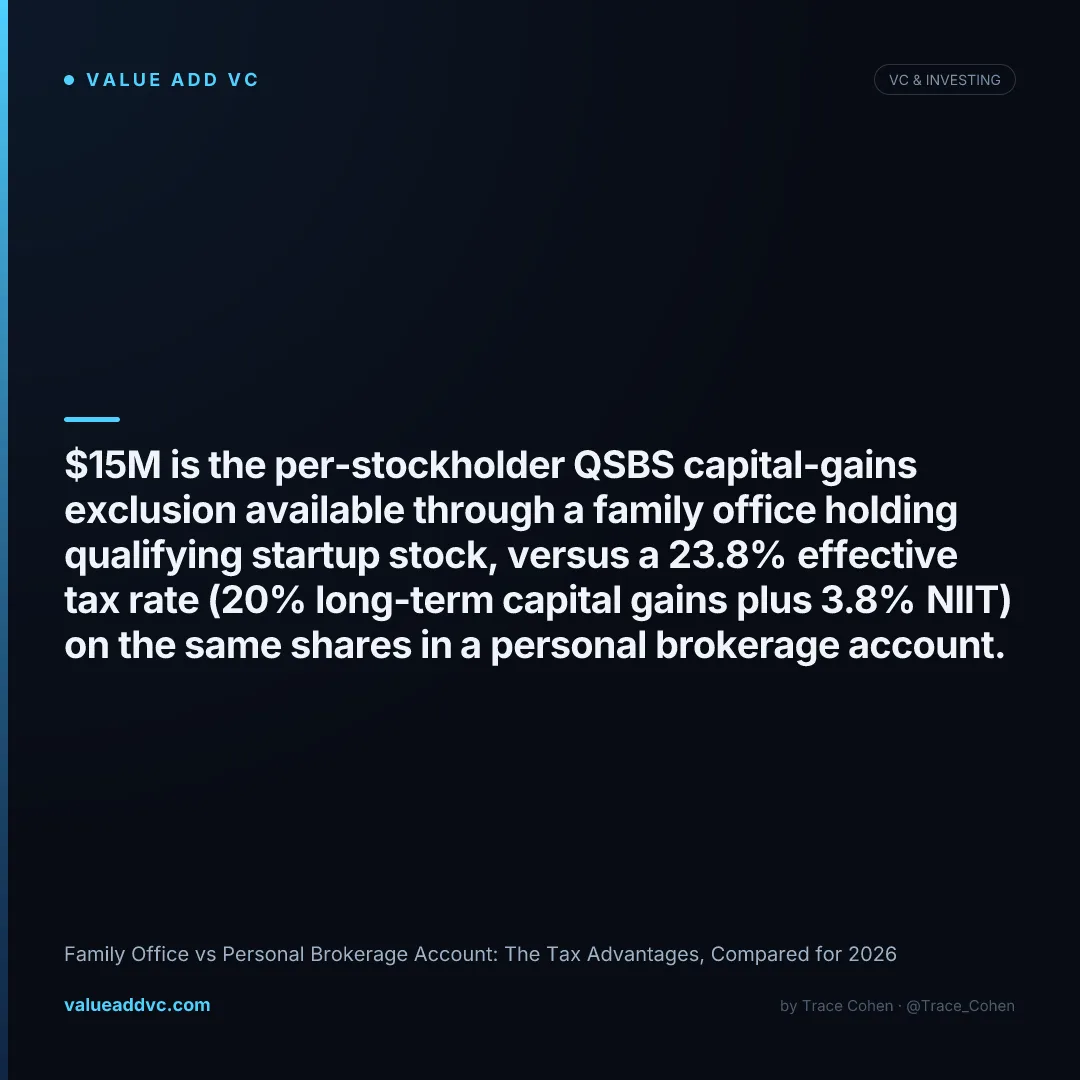
$15 million is what a family office can now shelter tax-free per stockholder on qualifying startup stock, versus a 23.8% effective tax bite on the same shares sitting in a personal brokerage account. That's the short answer. The longer answer is that a family office isn't a lower tax rate — it's access to a completely different toolkit.
I get some version of "should I just set up a family office" from operators who've had an exit at least twice a year. The honest answer depends entirely on what you're trying to shelter and whether your asset base clears the cost of running one. Here's the real math.
What are the tax advantages of a family office structure vs a personal brokerage account?
A family office structured as an LLC or LP unlocks three things a personal brokerage account can't: deductible advisory and operating expenses under IRC §162, a state-tax workaround through pass-through entity (PTE) elections, and access to QSBS exclusions up to $15 million per stockholder under the 2025 One Big Beautiful Bill Act (OBBB). The headline capital gains rate itself — 0%, 15%, or 20% federally — doesn't change; what changes is what income and gains qualify for special treatment in the first place.
For a family sitting on concentrated startup equity, VC fund interests, or a recent exit, that difference is worth millions. For a family with a diversified public-markets portfolio and no QSBS-eligible holdings, a personal account with a good CPA captures most of the same outcome at a fraction of the cost.
Family office vs personal brokerage account: the direct comparison
Here's the attribute-by-attribute breakdown most family-office pitches skip over — including the costs a personal account avoids entirely.
| Attribute | Family Office (LLC/LP) | Personal Brokerage Account |
|---|---|---|
| Long-term capital gains rate | 0%/15%/20% (same federal brackets) | 0%/15%/20% (same federal brackets) |
| QSBS exclusion (Section 1202) | Up to $15M per stockholder, OBBB 2025 | Same exclusion if directly held — but no pooling or entity-level planning |
| Advisory/operating fee deductibility | Deductible under IRC §162 if run as a business | Not deductible (suspended by 2017 TCJA through 2025, and OBBB does not restore it) |
| State tax (SALT) workaround | PTE election available, $40K federal SALT cap through 2029 | Subject to standard $40K SALT cap, no PTE workaround |
| Multi-generational structuring | GRATs, FLPs, dynasty trusts layered into entity | Requires separate trust/estate vehicles outside the account |
| Annual fixed cost | $875K–$6.6M/year (SFO) or ~50–100bps AUM | Advisory fee only, typically 0.25%–1% AUM |
| Minimum AUM to make sense | ~$100M practical floor, $250–500M for full SFO | No practical minimum |
| Estate/gift tax exemption use | $15M per person / $30M per couple (2026, permanent under OBBB) | Same exemption applies, but no active planning infrastructure |
Figures are 2026 estimates blended from Tax Foundation, Holland & Knight, McDermott Will & Emery, RSM US, and Campden Wealth reporting on One Big Beautiful Bill Act (OBBB) provisions effective through 2029-2030. Consult a tax advisor before acting on entity structure.
The QSBS advantage: why $15M matters more than a rate cut
The single biggest dollar-value advantage a family office structure creates isn't a better tax rate — it's access to Qualified Small Business Stock (Section 1202) planning at scale. The 2025 OBBB raised the per-stockholder exclusion cap from $10 million to $15 million, lifted the qualifying company's gross-asset ceiling to $75 million, and — critically — introduced a phased-in exclusion starting at a 3-year holding period instead of requiring the full 5 years for any benefit.
A family office holding structure lets a family spread QSBS-eligible stakes across multiple family members and trusts, each independently eligible for their own $15M exclusion — a structuring move that's far harder to execute cleanly through a single personal brokerage account. For a family with concentrated early-stage startup equity from angel checks or a founder's original cap table position, that's the provision worth building the entity around.
Compare that to the alternative: selling the same QSBS-eligible stock directly from a personal account still gets the exclusion if held correctly, but without the entity-level trust and gifting infrastructure, families routinely leave multiples of the $15M exclusion on the table by not splitting ownership before an exit. Track exit and IPO pipeline activity that could trigger QSBS events on the Tech IPO Dashboard at Value Add VC.
What a personal brokerage account still does better
A family office isn't a universal upgrade. Below a certain asset base, the fixed cost of running one outweighs every tax benefit on this list.
Family office makes sense when
- ✓ Investable assets exceed ~$100M, ideally $250M+
- ✓ You hold or expect QSBS-eligible startup equity
- ✓ Multiple family members need pooled, coordinated tax planning
- ✓ You need active GRAT, FLP, or dynasty trust structuring
Personal account still wins when
- ✕ Assets are under $50–100M and mostly diversified public equities
- ✕ You don't have QSBS-eligible or concentrated private holdings
- ✕ You can't absorb $875K+/year in fixed operating cost
- ✕ A multi-family office (MFO) or RIA relationship covers your needs at a fraction of SFO cost
The SALT workaround: how a family office cuts state tax exposure
The 2017 Tax Cuts and Jobs Act capped the state and local tax (SALT) deduction at $10,000 for individuals — a cap that hit high earners in California, New York, and New Jersey especially hard. The 2025 One Big Beautiful Bill Act raised that cap to $40,000 for joint filers ($20,000 for separate filers) through 2029, but the bigger structural advantage predates OBBB: 36+ states now offer a pass-through entity (PTE) tax election that lets an LLC or LP pay state tax at the entity level, converting what would be a capped personal SALT deduction into an uncapped federal business deduction.
A family office run as a pooled investment partnership can elect PTE treatment across every family member routed through the entity, meaningfully reducing state-level exposure without needing each individual to separately itemize against the $40,000 cap. A personal brokerage account has no equivalent mechanism — the underlying brokerage holds securities, not a business entity, so there's nothing to make a PTE election through.
This matters most for families based in high-tax states. A family in Texas or Florida with no state income tax gets zero incremental benefit from a PTE election, since there's no state tax to shelter in the first place — one more reason the "should I set up a family office" answer depends heavily on domicile, not just asset size.
Multi-generational gifting: the estate tax angle a brokerage account can't replicate
The OBBB permanently set the federal estate and gift tax exemption at $15 million per person ($30 million per married couple) effective January 1, 2026, indexed for inflation going forward. A personal brokerage account can passively benefit from that exemption on a straightforward transfer, but a family office entity is what makes advanced techniques — Grantor Retained Annuity Trusts (GRATs), Family Limited Partnerships (FLPs), and dynasty trusts — actually executable at scale.
The mechanic that matters most for founders: an LLC or LP can issue multiple classes of interest, so senior-generation family members hold a frozen-value preferred interest while junior-generation members hold a carried or profits interest tied to future appreciation. Structured correctly and gifted early — ideally before a liquidity event, not after — future growth in the asset shifts to the next generation largely outside the taxable estate. A personal brokerage account, held in one name, can't replicate that split without a separate trust wrapper layered on top, which is effectively reinventing a family office one document at a time.
None of this is available after the fact. Gifting and GRAT structures need to be in place before a startup stake appreciates or a company exits — which is why family offices tend to get formed in the run-up to an anticipated liquidity event, not after the wire hits. Compare vintage-year outcomes for funds and holdings on the VC Fund Performance Dashboard to model timing against your own portfolio.
What it actually costs to run a family office in 2026
The tax benefits above are only worth pursuing through a dedicated family office if the fixed cost base doesn't eat the gain. 2026 industry benchmarks show a wide range depending on asset size.
The Bottom Line
A family office doesn't give you a lower capital gains rate than a personal brokerage account — both pay the same 0%/15%/20% federal brackets plus the 3.8% NIIT above $200K/$250K MAGI. What it buys is access: a $15M-per-stockholder QSBS exclusion under the 2025 OBBB, deductible advisory fees under IRC §162, a SALT pass-through workaround, and the entity infrastructure to split ownership across family members before an exit. Below roughly $100M in investable assets, or without QSBS-eligible holdings, that access rarely justifies the $875K-plus annual fixed cost — a well-advised personal account or a multi-family office captures most of the same outcome for far less.
Personal brokerage account: 23.8% effective tax on gains.
Family office with QSBS planning: up to $15M shielded per stockholder.
Track exit activity and QSBS-eligible IPO pipeline on the Tech IPO Dashboard at Value Add VC. Originally published in the Trace Cohen newsletter. This is not tax advice — consult a qualified tax professional before acting on any entity structure.
Latest from the Pulse
Get VC data most people never see
— free to subscribe
Trace's notes on venture, AI and startups, a few times a week. Join 5,000+ subscribers. No spam.