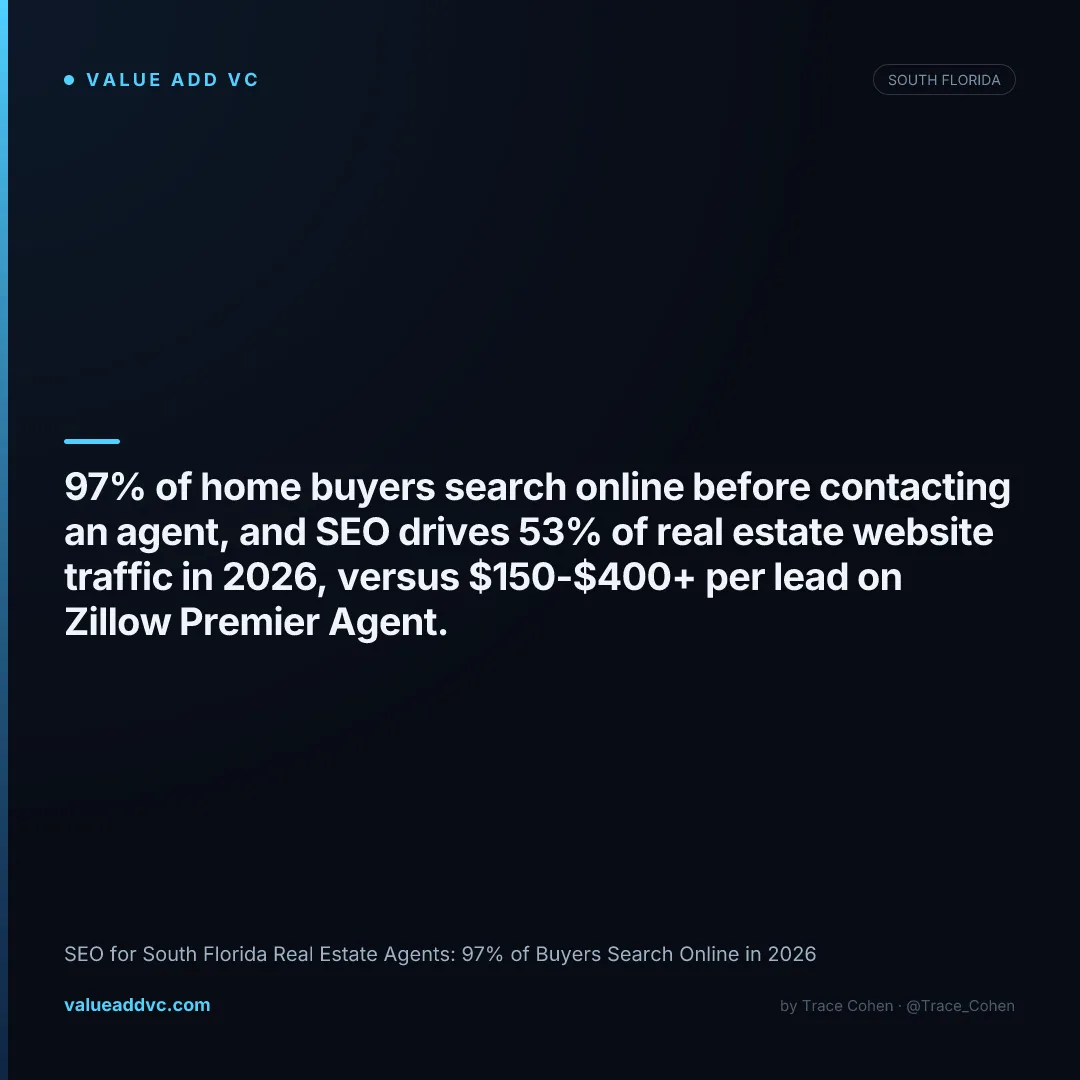
97% of home buyers search online before ever contacting an agent, and SEO drives 53% of all real estate website traffic in 2026. That's the short answer. The longer answer is that most South Florida agents are still spending their marketing budget on the channels that convert worst.
Boca Raton, Miami, West Palm Beach, and Fort Lauderdale are some of the most competitive real estate markets in the country right now, with inventory up 13.57% year-over-year in Boca Raton alone. Every one of those new listings is a page an agent could rank for — or hand to a competitor by default. Here's what the 2026 data actually shows about where South Florida agents should be putting their marketing dollars.
Figures are 2026 estimates blended from Zillow home value data, Searchlab and Taylor Scher SEO real estate marketing statistics, NAR Technology Survey, and industry AI-adoption trackers cited by HousingWire.
How SEO for Real Estate Agents Works in South Florida (Boca Raton, Miami, and WPB)
SEO for real estate agents in South Florida means ranking a website organically for local buyer and seller searches — "homes for sale in Boca Raton," "Delray Beach condos under $500K," "best realtor in West Palm Beach" — so leads arrive already interested rather than being purchased per-click. It works by combining a fast, mobile-first site with neighborhood-specific content, consistent Google Business Profile activity, and backlinks from local press and partner sites, compounding over 6-12 months into a lead channel that costs a fraction of paid alternatives.
The urgency is that buyer behavior has fully shifted online: 94% of homebuyers use the internet to search for properties, 71% find their eventual home through a mobile device, and the average buyer spends 4.7 months searching and views 14.2 listings before ever contacting an agent. Every one of those touchpoints is an SEO opportunity — or a gap a competitor's site fills instead.
South Florida Real Estate Market Data Agents Should Be Optimizing Around
Content built around real, current local numbers ranks better than generic listicles because it matches what buyers are actually typing into Google. In Boca Raton, the median home price sits at roughly $697,000 as of mid-2026, up 2.5% year-over-year, while the average sale price has climbed to $908,860 — a 15.67% year-to-date jump reflecting a mix shift toward larger transactions. Single-family homes average $889,000 and condos average closer to $300,000, a spread wide enough that neighborhood- and price-tier-specific pages consistently outperform one generic "Boca Raton homes" page.
Inventory is the other lever: active listings in Boca Raton grew 13.57% year-over-year to about 1,732 homes in March 2026, which means more supply for buyers to compare — and more individual listing and neighborhood pages an agent's site can legitimately rank for. Agents tracking broader market cycles alongside their local numbers can cross-reference our benchmarking dashboard for how South Florida fits into national trends.
SEO vs Paid Leads: Which Actually Closes Deals in South Florida Real Estate
Cost per lead is the wrong number to optimize for on its own. Zillow Premier Agent leads close at just 1-3% because they're shared across multiple agents competing for the same zip code, while exclusive Google Ads leads close at 5-8% — and SEO-driven organic leads convert higher still because the buyer chose that agent's site directly rather than being routed to it. In a competitive market like Boca Raton or Miami, that gap can mean spending $7,500-$80,000 in ad budget to close one deal through Zillow, versus $300-$1,500 in total marketing spend for agents running their own SEO and content.
| Channel | Cost Per Lead | Close Rate | Est. Cost Per Closed Deal | Best For |
|---|---|---|---|---|
| Referrals / SOI | ~$0-$25 | 10-20% | Lowest | Established agents 2+ years in |
| SEO / Organic (mature) | $15-$30 | 3-6% | $300-$1,500 | Agents investing 6-12+ months out |
| SEO / Organic (new site) | $80-$100 | 1-3% | Higher short-term | New sites still ranking |
| Paid Social (Meta/IG) | $5-$30 | 1-3% | $500-$2,500 | Listing awareness, retargeting |
| Google Ads (buyer intent) | $30-$150 | 5-8% | $1,000-$3,500 | High-intent, exclusive leads |
| Realtor.com | $100-$300 | 2-4% | $3,000-$10,000 | Sellers, listing visibility |
| Zillow Premier Agent | $139-$300+ | 1-3% | $7,500-$80,000 | Volume brands with big budgets |
Figures are 2026 estimates blended from Jamil Academy real estate lead-gen benchmarks, Revalto's Zillow-vs-Google cost analysis, and The Close's Zillow Premier Agent review. Close rates and cost-per-deal are directional industry ranges, not guarantees for any specific market.
How AI Tools Are Changing Real Estate SEO and Lead Generation in 2026
AI adoption among agents has gone from a novelty to the default in three years: roughly 15% of agents used AI meaningfully in 2023, that figure hit 68% by mid-2025 per the NAR Technology Survey, and industry trackers now put it at 82% as of Q1 2026 — led by writing tools (77.9%) and chatbots (47%). On the consumer side the shift is just as sharp: 67% of homebuyers now use an AI tool as a primary research method, up from just 17% eighteen months earlier.
That consumer shift is why SEO and AI strategy can no longer be separated. When a buyer asks an AI assistant "what's a good neighborhood in Boca Raton for a family under $700K," the assistant pulls from indexed, well-structured web content — the same content that ranks in traditional search. Agents writing FAQ-formatted, number-dense local content are showing up in both channels at once, while agents with thin "About Me" pages are increasingly invisible in either.
The catch: adoption doesn't automatically equal results. Only 17% of agents say AI has had a significant positive impact on their business and 46% say it's had no noticeable impact at all — the split comes down to whether AI is applied to listing descriptions (low impact) or to lead response time and content strategy (high impact), where AI-assisted follow-up has been shown to lift conversion by roughly 40% versus manual outreach.
How Long SEO Takes to Work for a South Florida Real Estate Agent
The biggest reason agents abandon SEO too early is a mismatched timeline expectation. Paid channels like Google Ads or Zillow Premier Agent can generate a lead within 24-48 hours of turning the campaign on, while SEO typically takes 4-6 months before meaningful ranking movement shows up and 8-12 months before a South Florida agent holds durable page-one rankings for competitive terms like "Boca Raton realtor" or "Miami condos for sale." That gap is exactly why most agents run both channels in parallel during year one: paid ads cover the near-term pipeline while organic content compounds in the background.
Where SEO pulls ahead is cost trajectory. A Google Ads or Zillow campaign costs roughly the same per lead in month 12 as it did in month one — there's no compounding discount. An SEO program that costs $80-$100 per lead-equivalent in its first quarter typically settles into the $15-$30 range by month nine or ten as the site accumulates rankings, backlinks, and indexed content, meaning the cost curve bends down over time instead of staying flat. For an agent planning a three-year horizon in a market like Boca Raton or Delray Beach, that compounding is the difference between a marketing budget that scales with volume and one that scales linearly with spend.
SEO for Real Estate Agents in South Florida: A Practical 2026 Checklist
The agents winning organic search in Boca Raton, Delray Beach, Fort Lauderdale, and Miami right now are executing on a fairly consistent set of fundamentals rather than chasing algorithm hacks. Start with a Google Business Profile fully optimized with service-area neighborhoods, recent photos, and weekly posts — this drives the local "map pack" results that convert at some of the highest rates of any real estate channel. Layer in neighborhood-specific landing pages for each core market (Boca Raton, West Palm Beach, Delray Beach) rather than one generic city page, since 43% of buyers begin their search with a specific area already in mind.
Publish market-update content monthly using real, current numbers — median price, days on market, inventory change — since this is exactly the kind of content that earns featured snippets and gets cited by AI assistants. Given that 67% of buyers watch property videos before contacting an agent, pair every major listing and neighborhood page with short video content, and make sure the site loads fast on mobile given that 71-72% of searches happen there.
Finally, track cost-per-lead and close rate by channel monthly, not annually — a Zillow lead that looks cheap on a monthly invoice can still be the most expensive channel once the 1-3% close rate is factored in. Agents deciding where to allocate a limited marketing budget can compare organic and paid economics side by side using the table above before committing to a channel for the next two or three quarters.
Bottom line: 97% of buyers search online before contacting an agent, and SEO delivers leads at $15-$30 once a South Florida agent's site matures — a fraction of the $139-$300+ per lead and 1-3% close rate that comes with Zillow Premier Agent. With 82% of agents now using AI and buyer research increasingly running through AI assistants, the agents building durable, number-dense local content today in Boca Raton, Miami, West Palm Beach, and Fort Lauderdale are the ones who'll own organic search in these markets for years, not just this quarter.
Latest from the Pulse
Get VC data most people never see
— free to subscribe
Trace's notes on venture, AI and startups, a few times a week. Join 5,000+ subscribers. No spam.