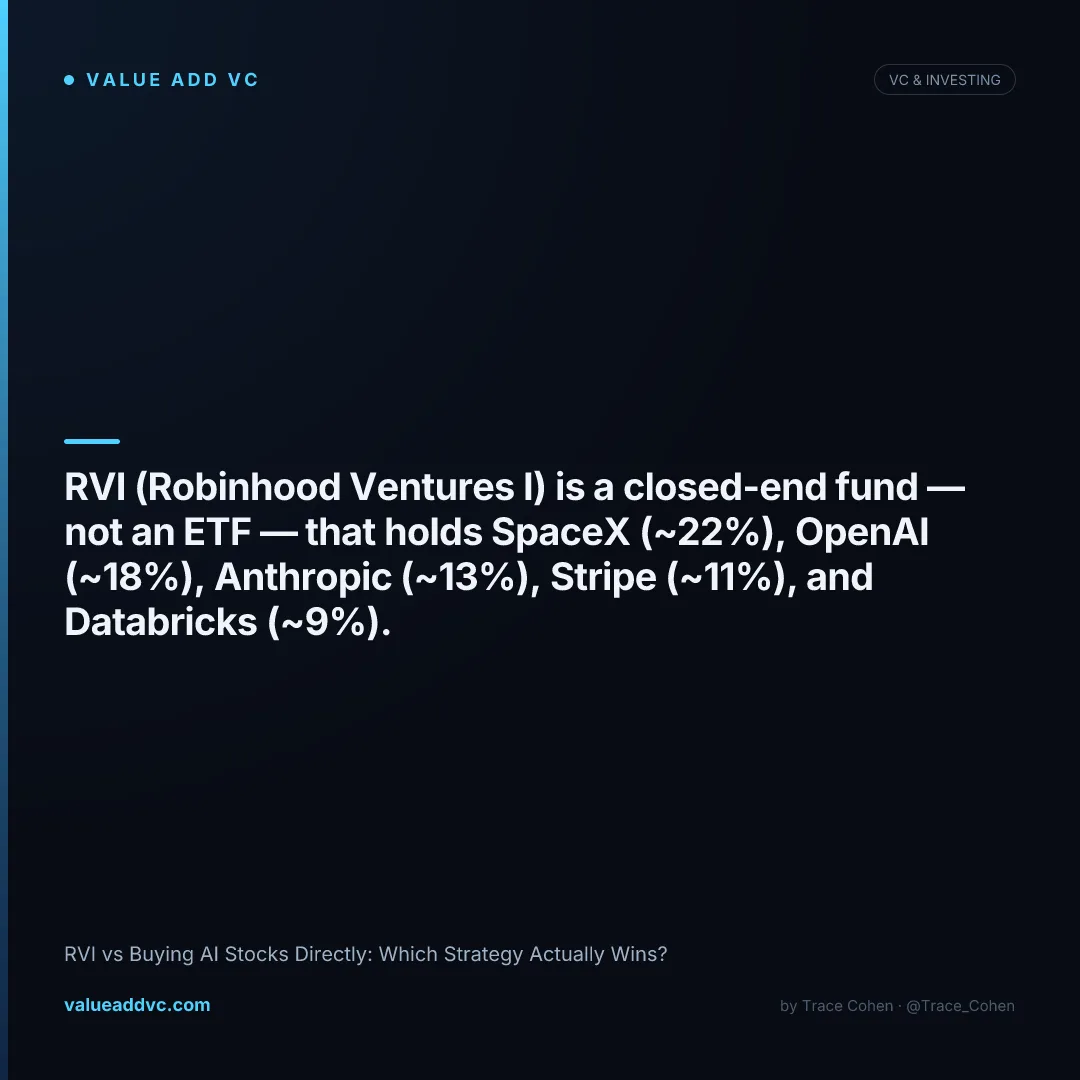
RVI is not an ETF. It's a closed-end fund — and that distinction is worth understanding before you decide if it belongs in your portfolio.
Robinhood Ventures I (NYSE: RVI) launched in March 2026 as the first publicly listed vehicle giving retail investors access to Databricks, OpenAI, Stripe, and SpaceX. Most of those names you still cannot buy anywhere else — though SpaceX itself went public in June 2026 as SPCX, converting one of the fund's private positions into listed stock. That exclusivity is the entire bull case.
But exclusivity has a price. RVI trades at a persistent 15–30% premium to its net asset value, charges roughly 2.5% in annual expenses, and its underlying holdings are illiquid private stakes that won't produce cash until IPO or acquisition. Meanwhile, you could own NVDA — up ~2,000% over five years — with zero premium, zero management fee, and same-day liquidity.
What You're Actually Buying With RVI
The named company positions in RVI's June 30, 2026 disclosure total roughly 29% of the fund, with cash at a further 31.77%. These are not public stocks — they are secondary positions purchased from employees, early investors, or on platforms like Nasdaq Private Market and Forge.
The single largest line in the fund — you pay the expense ratio on this too
Data + AI platform; the fund's largest company position
ChatGPT and enterprise API; includes a ~$75M direct purchase in April 2026
Payments infrastructure, long-awaited IPO candidate
Went public on Nasdaq (SPCX) June 12, 2026
Remaining ~27% spread across additional private tech holdings.
The Direct AI Stocks Alternative
The public AI basket has been extraordinary. These five names give you massive AI exposure with full liquidity and negligible costs:
| Stock | 5-Year Return | Annual Fee | AI Exposure |
|---|---|---|---|
| NVDA | ~2,000%+ | 0% | GPU chips, data center, AI training |
| MSFT | ~180% | 0% | Azure AI, OpenAI partnership, Copilot |
| GOOGL | ~120% | 0% | Gemini, TPUs, DeepMind, Search AI |
| META | ~270% | 0% | Llama models, AI ad targeting, FAIR |
| QQQ ETF | ~130% | 0.20% | Broad Nasdaq tech basket |
5-year returns as of mid-2026, approximate. Past performance doesn't guarantee future results.
The NAV Premium and Fee Math
This is where the RVI bull case gets tested. When you buy RVI at a 20% premium to NAV, you're paying $1.20 for every $1.00 of underlying asset value. That gap has to be recovered through outperformance before you even break even.
Combined, a retail investor buying RVI at a 25% premium faces a total hurdle of roughly 37–38% (premium + five years of fees) before they're ahead of simply buying a cost-free position in NVDA. SpaceX's actual June 2026 IPO shows how thin that margin can be. The last private mark before the listing was the $1.25T combined valuation set when SpaceX merged with xAI in February 2026 (CNBC, February 3, 2026); the IPO then priced at $1.77T (CNBC, June 3, 2026). That is roughly a 42% step-up in headline valuation — only modestly above the 37–38% hurdle, and SpaceX was a 1.25% weight in the fund's June 30 disclosure. The catch is that the next such markup has to come from the remaining private holdings, not from a position that is now public stock.
A concrete worked example: start with $10,000 in each strategy and assume both portfolios' underlying holdings appreciate at the same hypothetical 15% per year. The only structural difference is RVI's ~2.5% fee. After five years the direct basket compounds to about $20,100, while RVI nets roughly $17,800 after fees — a gap of about $2,300, or 13% of the starting stake, created entirely by the fee. That math assumes identical underlying returns, though — RVI's private names can capture funding-round markups no public AI basket can, and the fee is the price of that optionality.
When RVI Actually Makes Sense
RVI Wins If...
- ✓ Its remaining private names repeat a SpaceX-style IPO markup (SPCX priced at about 1.4x its $1.25T February 2026 merger valuation)
- ✓ OpenAI reaches $1T+ and goes public by 2027–2028
- ✓ You have conviction these names beat public markets by 40%+
- ✓ You want private company exposure unavailable anywhere else
- ✓ You buy near NAV (rare — requires catching a market dip)
Direct AI Stocks Win If...
- ✕ You want lowest-cost access to AI secular growth
- ✕ You value liquidity and the ability to exit same-day
- ✕ The private exits disappoint or take 5+ more years
- ✕ NVDA's blackwell cycle continues outperforming estimates
- ✕ You're cost-sensitive and compounding over long periods
My Honest Take as a VC
I've made 65+ investments. The best outcomes in my career came from companies like the ones RVI holds — pre-IPO, category-defining, run by founders who won't stop. I understand the appeal viscerally.
But I also know that the institutional investors who got into SpaceX at a $10B valuation and OpenAI at a $30B valuation are in a fundamentally different position than someone buying RVI today at a 20% premium to NAV when SpaceX has already listed at a $1.77T IPO valuation and OpenAI was last valued at $852B (CNBC, March 31, 2026). The asymmetry has compressed significantly.
If you don't have the access or net worth to invest directly in private funds, RVI gives you something real. But go in clear-eyed: you're paying a premium for that access, and the math requires big exits to work. Track the RVI NAV and premium on the RVI dashboard — timing your entry matters here more than with a standard index fund.
RVI isn't an ETF. It's a premium bet on private exits that haven't happened yet.
The question is whether Databricks, OpenAI and Stripe exits will be large enough to justify paying up today.
Track RVI's NAV, premium, and holdings in real time on the RVI Dashboard at Value Add VC. AI company valuations tracked on the AI Valuations Dashboard. Originally published in the Trace Cohen newsletter.
Latest from the Pulse
Get VC data most people never see
— free to subscribe
Trace's notes on venture, AI and startups, a few times a week. Join 5,000+ subscribers. No spam.
No spam, unsubscribe anytime. Sent via Substack · Privacy · or subscribe on Substack ↗