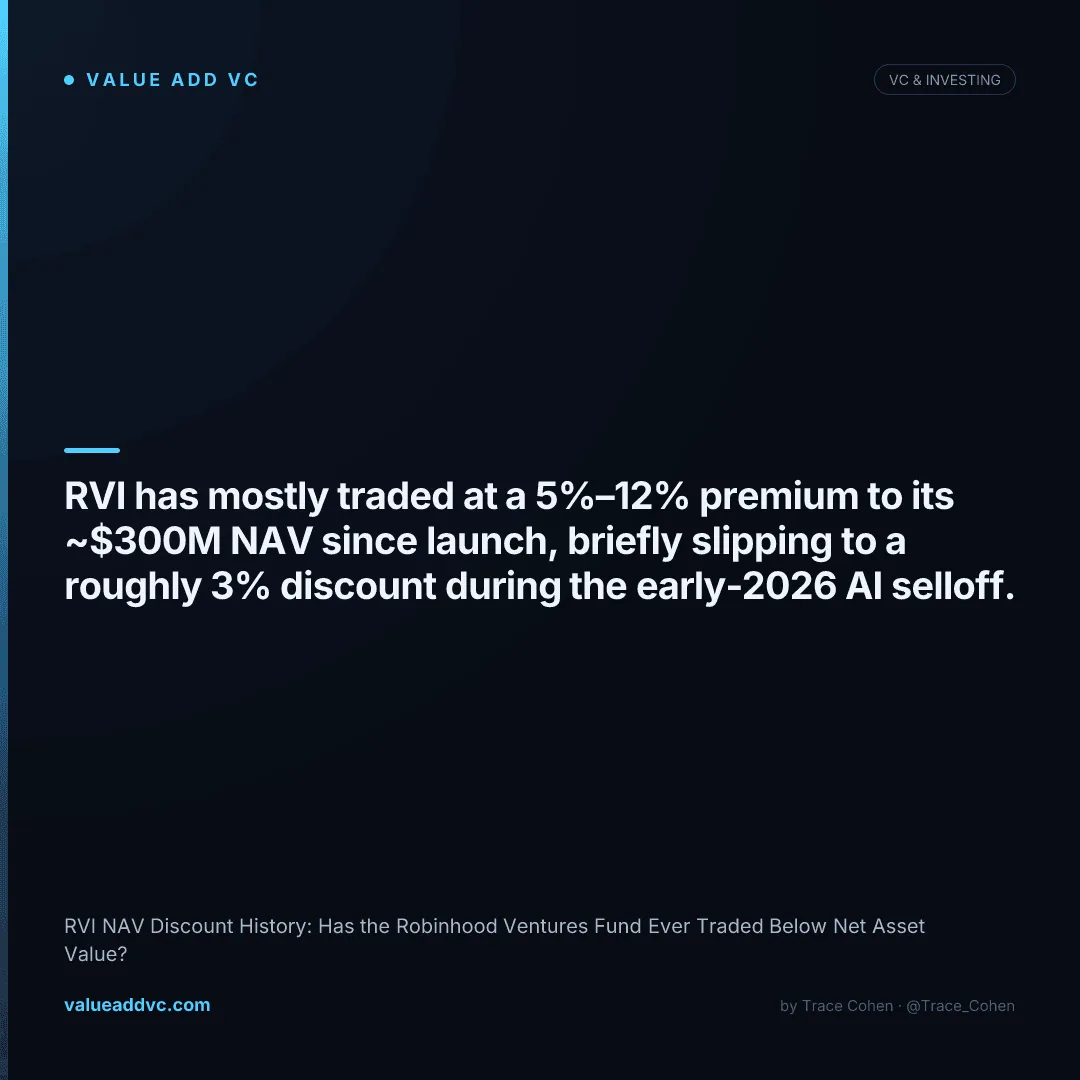
RVI has traded at a 5%–12% premium to its $655.3M in assets for most of its life, dipping to only a ~3% discount during the early-2026 AI selloff. That's the short answer. The longer answer is more interesting.
Every closed-end fund lives or dies by the gap between two numbers: what its assets are worth and what its shares actually trade for. For RVI — Robinhood Ventures Fund I — that gap has overwhelmingly favored the seller, not the buyer. Understanding when, why, and how briefly RVI has ever slipped below net asset value is the single most useful thing a retail investor can know before clicking buy, because the premium you pay is a cost you never recover.
RVI NAV Discount History: Has the Fund Ever Traded Below NAV?
Yes — RVI has traded below its net asset value, but only briefly and shallowly. Since its launch, RVI has spent most of its history at a 5%–12% premium to its roughly $655.3M in assets. The only meaningful discount window came during the early-2026 AI selloff, when the market price slipped to about a 3% discount for a few weeks before reverting back above NAV.
That pattern is the opposite of what most closed-end funds (CEFs) do. The average CEF trades at a persistent discount — frequently 5%–15% below NAV for years — because investors discount illiquid, manager-driven portfolios. RVI inverts the norm for one reason: scarcity. It is the only liquid, single-ticker way for a retail brokerage account to own secondary-market stakes in OpenAI and Databricks, and that scarcity keeps the shares bid above the underlying marks. You can watch the live spread on our Robinhood RVI Fund dashboard.
So the honest answer to "has RVI ever traded below NAV?" is: yes, around a 3% discount at the deepest, for a matter of weeks — a rounding error compared to the double-digit premiums it has carried the rest of the time. For a buyer, those rare discount windows are the best entry points the fund has ever offered.
The Full RVI Premium and Discount Timeline
A single snapshot of RVI's premium is misleading — the number moves constantly. What matters is the trajectory. The table below traces the approximate premium or discount to NAV across the fund's key phases, alongside the catalyst driving each move. Treat these as estimates from public disclosures and secondary pricing, not official daily marks.
| Phase | Approx. Premium / Discount | What Drove It |
|---|---|---|
| Launch debut | +8% to +12% premium | Retail rush for OpenAI/SpaceX access |
| First month | +10% premium (peak ~12%) | Fixed share supply meets hype |
| Settling phase | +5% to +7% premium | Early speculators rotate out |
| Early-2026 AI selloff | −3% discount (deepest) | Risk-off panic, stale private marks |
| Post-selloff recovery | Flat to +4% premium | Mean reversion as fear fades |
| Mid-2026 steady state | +4% to +8% premium | Scarcity-driven baseline demand |
The shape of this history matters: RVI's premium compresses when AI sentiment cools and expands when it heats up. The single discount episode coincided with a broad risk-off move, not anything specific to the fund. And because the private marks update in steps — OpenAI near $500B, SpaceX near $350B — the NAV itself can sit stale while the market price swings, briefly widening or closing the gap on its own.
Why RVI's NAV Discount Has Been So Rare
The reason RVI almost never trades below NAV comes down to closed-end mechanics. RVI raised a fixed pool of capital and issued a fixed number of shares at launch. Unlike an ETF, there is no creation-and-redemption machine arbitraging the price back to NAV every day. When more people want exposure to OpenAI and SpaceX than there are shares, the only release valve is price — so it runs to a premium.
The second factor is the holdings themselves. Roughly 70% of the ~$655.3M in assets is private companies you cannot buy on any exchange in 2026. That illiquidity, which makes most CEFs trade at a discount, works in reverse for RVI because the assets are not just illiquid — they are unobtainable elsewhere. Scarcity plus a locked float is a premium-generating machine. Compare those private marks against public AI comps on our AI Valuations dashboard.
A sustained RVI discount would require one of a few things: a flood of new supply (a secondary offering), a collapse in AI sentiment deep enough to overwhelm the scarcity bid, or a credibility hit to Robinhood's marks. Until one of those happens, the structural default is a premium — which is exactly why disciplined buyers wait for the rare discount instead of paying up.
What the Premium Costs You: The 2.5% Fee Math
The premium is not the only cost — it stacks on top of the fee. RVI charges a 2.5% annual management fee on net assets, roughly 30x to 80x the 0.03%–0.75% range of public-equity ETFs. The two costs compound against you. Pay a 10% premium on entry and absorb 2.5% a year, and you start roughly 12%–13% behind the underlying marks before the portfolio does anything.
Run the numbers on a $10,000 position. A 10% entry premium is $1,000 you may never recover if the gap closes. The 2.5% fee is about $250 a year, compounding to roughly $1,300 over five years. Buy instead during a 3% discount and you start $300 ahead on assets — a swing of well over $1,300 versus the premium buyer on the same $10,000. The entry point is not a detail; it is most of the return.
This is why the NAV discount history is the most practical lens on RVI. The fund's appeal — pre-IPO OpenAI and SpaceX in one ticker — is real. But the price of that access is set by two numbers you control only at the moment you buy: the premium and the timing. For the full framework, read whether RVI is worth the premium.
How to Use RVI's Discount History as a Buyer
As a 3x founder who has made 65+ investments, I treat closed-end premiums the way I treat round pricing: the entry multiple determines most of the outcome. With RVI, the rule writes itself. Never buy at a double-digit premium. Set an alert for any move toward NAV or below it, because those windows have historically lasted only weeks. The early-2026 ~3% discount was the single best entry the fund has offered, and it didn't advertise itself.
Size it as a satellite, not a core holding — the concentration (top 10 names near 70% of NAV) and the 2.5% fee both argue against making RVI a foundation. If your only goal is broad AI exposure, a commission-free Nvidia–Microsoft–Alphabet basket skips both the premium and the fee entirely. RVI earns its place only for the private names you genuinely cannot get elsewhere, and only at a price that respects its NAV.
RVI has traded below NAV exactly once that mattered — a ~3% discount in early 2026 — against a lifetime of 5%–12% premiums. The history tells you everything about when to buy.
RVI almost never goes on sale. When it does, that's the only time the math works in your favor.
Track RVI's NAV, premium, and discount over time on the Robinhood RVI Fund dashboard at Value Add VC. Originally published in the Trace Cohen newsletter. Figures are estimates based on public disclosures and are not investment advice.
Latest from the Pulse
Get VC data most people never see
— 100% free
Weekly benchmarks, valuations, and fund data. Join 5,000+ investors. No spam.