Permira is one of Europe's largest private equity firms — $80B+ AUM, eight flagship funds, and a portfolio that reads like a who's who of tech-enabled buyouts. But fund performance data is not easy to find, and what circulates is often incomplete.
The reality: Permira's performance record is uneven by vintage, excellent in tech-tilted cycles, and increasingly large-scale in ways that compress future return potential. Here's what the data actually shows.
Permira Fund Performance by Vintage Year
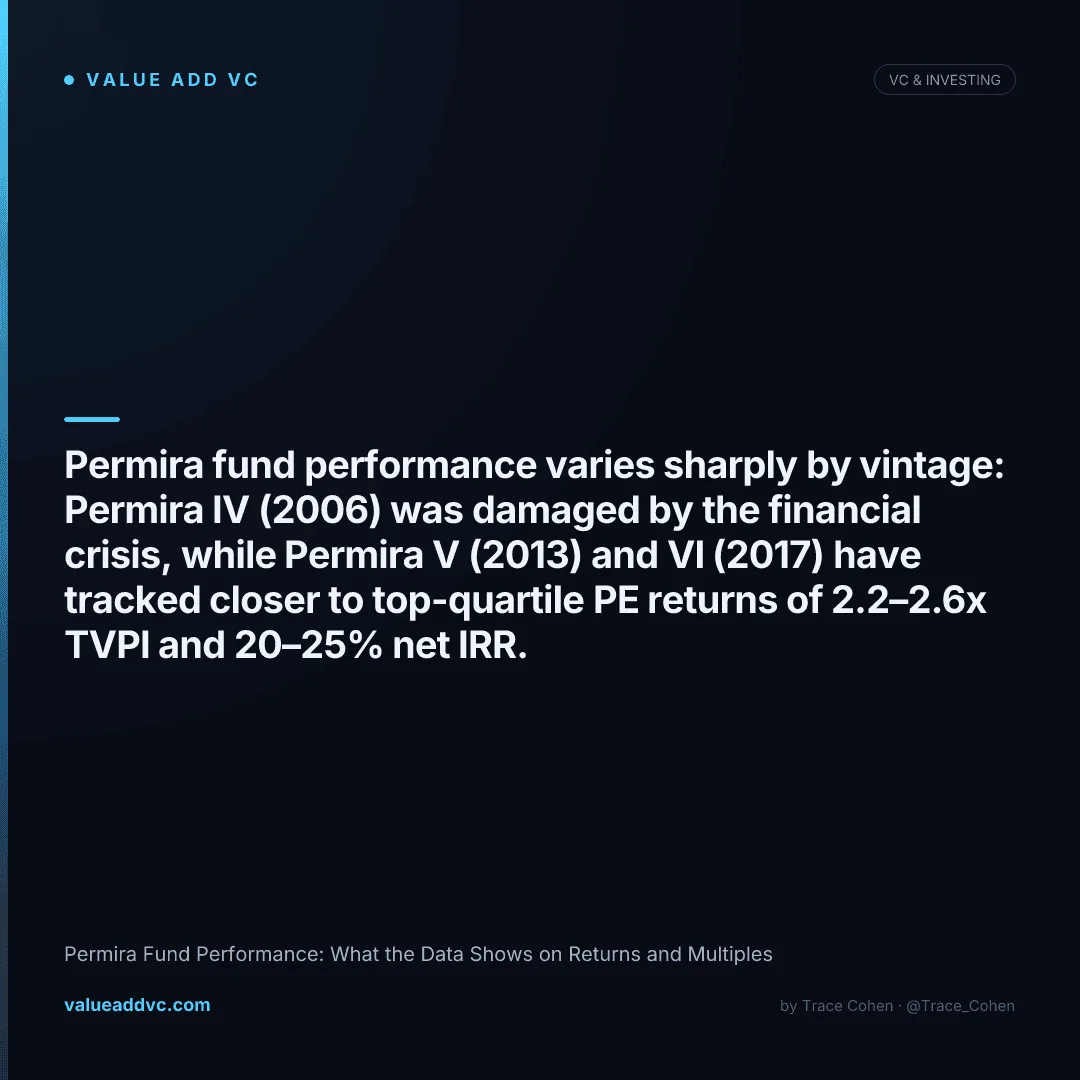
Permira has raised eight flagship buyout funds since its founding. Performance varies sharply by cycle exposure:
| Fund | Vintage | Size | Est. TVPI | Notes |
|---|---|---|---|---|
| Permira III | 2003 | €5.1B | 2.5–3.0x | Strong exit cycle, fully realized |
| Permira IV | 2006 | €11.1B | 1.3–1.6x | Crisis-era leverage impaired returns |
| Permira V | 2013 | €7.5B | 2.2–2.5x | Tech recovery tailwinds; solid IRR |
| Permira VI | 2017 | €11.2B | 2.0–2.4x | Technology-heavy; exits ongoing |
| Permira VII | 2020 | $17B | 1.4–1.8x | Early; DPI still building |
| Permira VIII | 2022 | $16.7B | 1.0–1.2x | Deployment phase; too early to call |
Note: TVPI estimates based on available LP reports, public filings, and industry data. Precise figures are not publicly disclosed by Permira.
The Permira IV Problem and What It Tells You About PE Risk
Permira IV is the cautionary tale in their track record. Raised in 2006 at €11.1B — the largest European PE fund at the time — it deployed capital aggressively in the 2006–2008 window at peak valuations and high leverage. When the financial crisis hit, portfolio companies in retail, consumer, and travel were brutally marked down.
The TVPI on Permira IV is estimated in the 1.3–1.6x range — deeply underperforming the 2006 vintage benchmark of ~1.8x median TVPI. This is what happens when you size a fund to match the market cycle rather than your deployment capacity.
I've seen this pattern repeat. Every generation of PE has its "Permira IV" — the fund that was raised at peak confidence, deployed into compressed cap rates, and then had to claw back returns over a 12-year hold period. The 2021–2022 vintages across many growth equity funds look similar on paper today.
The lesson: fund size relative to deployment opportunity matters as much as manager quality. A $10B fund needs larger buyouts than a $3B fund, which concentrates both the opportunity set and the risk.
Permira's Tech Concentration: Upside and Risk
Post-Permira IV, the firm made a deliberate shift toward technology buyouts. Over 40% of the Permira VI and VII portfolios are technology companies — software, SaaS, data infrastructure, and tech-enabled services. This is not incidental; it's thesis-driven.
The Permira fund performance data from Permira V onward reflects this repositioning. Key exits that drove Permira V and VI returns:
- •TeamViewer: IPO'd at €5B+ valuation in 2019 — Permira's most visible tech exit
- •Dr Martens: IPO'd in 2021 at £3.7B, later pulled back as consumer sentiment shifted
- •Magento: Sold to Adobe for $1.68B — a clean exit on a SaaS platform migration thesis
- •Klarna: Permira held a minority stake; partial exit pre-IPO at significant markup
- •Informatica: Permira co-led the take-private in 2015, exited via IPO in 2021 at $7.8B
The tech tilt amplifies the benchmark divergence issue. When you compare Permira to a blended PE benchmark, you're mixing apples and oranges — their portfolio looks more like a growth equity fund than a traditional European buyout. The right comparison is software-focused PE funds, where 2.0–2.5x TVPI and 18–24% net IRR is top-quartile for 2015–2019 vintages.
DPI: The Metric That Actually Matters for Permira LPs
TVPI is a paper number. DPI — distributions to paid-in capital — is what LPs can actually spend. For Permira's newer funds, DPI is still low because exits are ongoing.
Check out the VC & PE Performance dashboard for benchmark comparisons across PE fund vintages. For a $16.7B fund like Permira VIII, generating 2x+ TVPI means returning $33B+ to LPs — requiring either very large exits, IPOs, or high-multiple secondaries. That's a tall order in the current exit environment.
The liquidity premium in large-cap PE is real: LPs are locking up capital for 8–12 years with management fees of 1.5–2% annually. For an LP allocating $500M to Permira VIII, they need to believe in both the team's operational playbook and the macro exit environment in 2029–2033. That's a long time horizon to underwrite.
How Permira Compares to PE Benchmarks
Using Preqin and Cambridge Associates data for large-cap buyout funds by vintage:
2.3–2.7x
Top-Quartile TVPI (2015–2019)
Large-cap buyout
1.8–2.2x
Median TVPI (2015–2019)
Large-cap buyout
22–27%
Top-Quartile Net IRR
Same vintage window
Permira V and VI are tracking in the top half of these benchmarks — not consistently top-quartile, but solidly above median on TVPI and competitive on IRR given their longer-than-average hold periods. For a broader view of how these numbers compare across the industry, see our VC Performance dashboard.
Where Permira differentiates is operational depth in their sector verticals. Their portfolio operations team runs a consistent playbook across margin improvement, commercial optimization, and digital transformation — the same playbook Vista Equity uses for software, adapted for Permira's broader multi-sector approach.
The Permira VIII Challenge: Scale vs. Return
Permira VIII at $16.7B is a size that creates structural headwinds. To deploy that capital at 3–5 deals per year requires average check sizes of $1.5–2.5B per investment. At that scale, the universe of suitable targets shrinks, competition with other mega-funds intensifies, and entry multiples compress IRR potential.
I track this across fund performance data — the empirical pattern is clear: fund size above $10B is negatively correlated with IRR, even among strong managers. Permira knows this; their response has been to push further into technology buyouts where growth can compensate for entry multiple headwinds.
The bet Permira VIII LPs are making: that software and tech-enabled services will generate sufficient organic growth over a 7–10 year hold to offset the higher entry multiples typical of large-cap deals in 2022–2025. If AI-driven productivity gains compress operating costs at portfolio companies, that thesis has legs. If not, Permira VIII is a fund that will need exceptional exits to hit 2x TVPI.
The uncomfortable truth about PE at scale: $16.7B funds don't return 3x. They return 2x if the team executes well and macro cooperates. Know what you're paying for before you commit.
Track private equity and VC fund performance benchmarks on the VC & PE Performance Dashboard at Value Add VC. Originally published in the Trace Cohen newsletter.
Latest from the Pulse
Get VC data most people never see
— 100% free
Weekly benchmarks, valuations, and fund data. Join 5,000+ investors. No spam.