
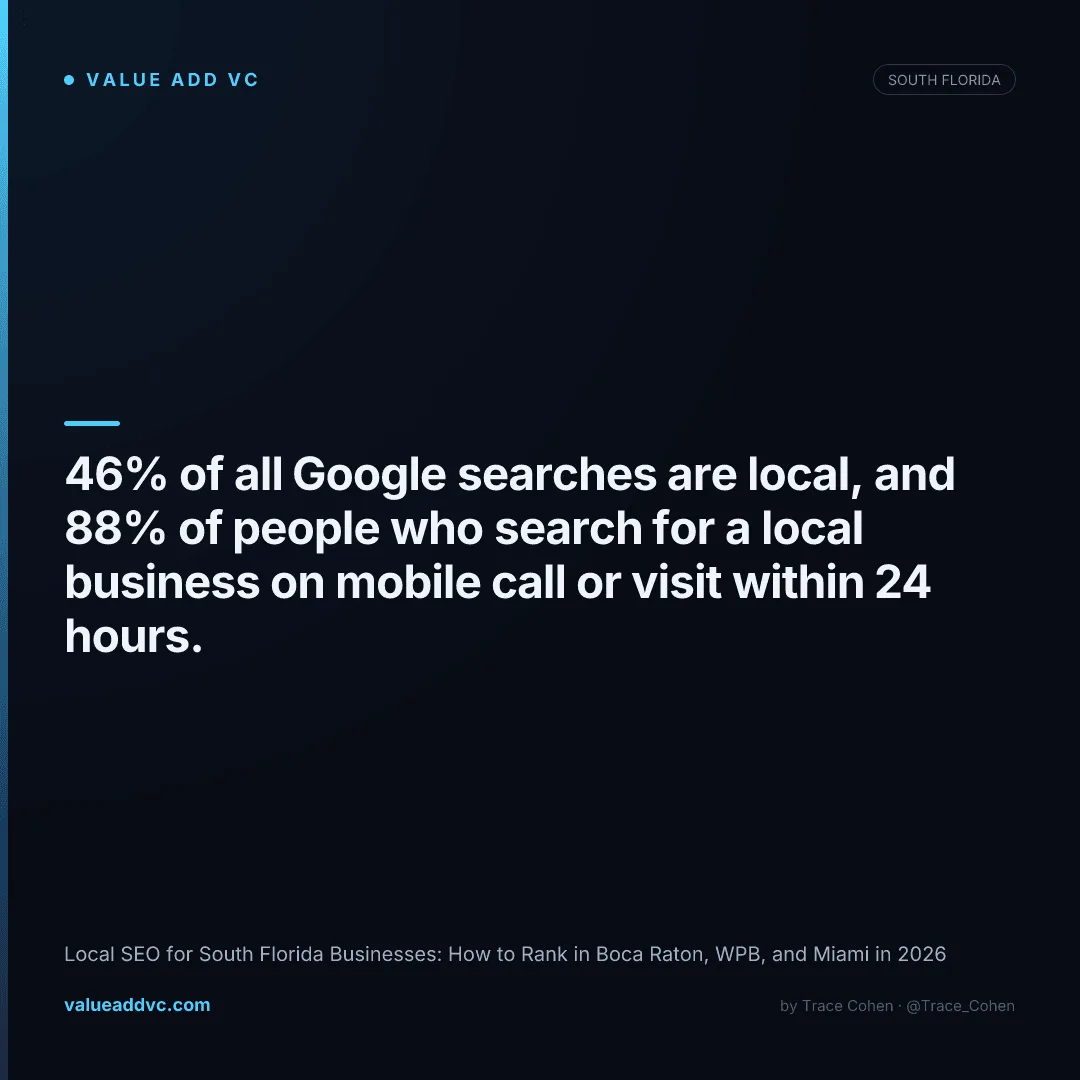
46% of all Google searches have local intent, and 88% of people who search for a local business on a phone call or visit that business within 24 hours. That's the short answer for why local SEO matters in South Florida. The longer answer is more interesting.
The single most underpriced growth channel local operators ignore is the Google map pack. A plumber in Boca Raton, a personal injury firm in West Palm Beach, and a med spa in Miami are all fighting over the same three map slots — and the businesses that win do a handful of unglamorous things consistently. Below is the actual playbook, with the numbers.
Local SEO for South Florida in 2026: the short version
Local SEO for a South Florida business means optimizing so you appear in Google's local pack — the three-result map box — and the organic results when someone searches "[service] near me" or "[service] Boca Raton." The four levers that move rankings in 2026 are a fully completed Google Business Profile, review count and velocity, city-specific landing pages, and local citations plus backlinks. Get those four right and you'll outrank 90% of local competitors who never claimed their profile properly.
None of this requires a $5,000-a-month agency. It requires knowing which factors carry weight and refusing to waste time on the ones that don't. South Florida is unusual: dense competition in Miami, seasonal snowbird demand in Boca and Palm Beach, and a heavily bilingual market. The playbook adapts to all three.
What actually drives local SEO rankings in 2026
Local rankings are not the same as classic blue-link SEO. Google weights a distinct set of signals for the map pack. Here's the approximate weighting based on the industry's most-cited local ranking studies, and what each means for a South Florida operator.
| Ranking Factor | Approx. Weight | What to do in South Florida |
|---|---|---|
| Google Business Profile signals | ~32% | Complete every field; pick precise categories; post weekly |
| On-page signals (city content, NAP) | ~19% | Build a page per city: Boca, WPB, Miami |
| Review signals (count, velocity, rating) | ~16% | 40+ reviews, 4.5★, 5–10 fresh per month |
| Backlink signals (authority, relevance) | ~13% | Local sponsorships, chamber links, press |
| Behavioral signals (clicks, calls, direction taps) | ~11% | Compelling photos, offers, fast response |
| Citation signals (NAP consistency) | ~7% | Identical name/address/phone across 30+ directories |
| Personalization (proximity to searcher) | ~2% | Fixed — but a real address near demand helps |
The headline: nearly a third of your ranking comes from a profile you can fully optimize for free in an afternoon. Most businesses never finish it.
Step 1: Your Google Business Profile is 32% of the game
Your Google Business Profile is the single highest-leverage asset in local SEO, and the median South Florida business uses maybe 40% of its fields. Claim it, verify it, and fill in everything: primary and secondary categories, services with descriptions, hours including holiday hours, service areas, attributes, and a 750-character business description with your city name in the first sentence.
Pick the most specific primary category
"Personal injury attorney" beats "law firm" for intent
Add 10+ real photos and refresh monthly
Profiles with photos get 42% more direction requests
Post a weekly update or offer
Active profiles signal relevance and feed behavioral signals
Answer Q&A and seed your own FAQs
Controls the narrative and adds keyword surface area
Step 2: Reviews — the 40/4.5/monthly rule
Reviews are roughly 16% of ranking weight and close to 100% of conversion. The data is blunt: 98% of consumers read reviews for local businesses, and the average buyer reads about 10 reviews before trusting a business. The rule of thumb for South Florida: get to 40+ reviews at a 4.5-star average, then keep 5–10 fresh reviews coming in every month. Velocity beats volume — a 4.6-star profile with reviews from last week outranks a stale 4.9-star profile that stopped collecting in 2024.
Miami is a different animal. In high-competition Miami verticals — med spas, dentists, personal injury — you often need 75–150 reviews just to be in the conversation. Build a simple post-service text or email ask, link directly to your review form, and respond to every review within 48 hours. Responses are a ranking and trust signal Google explicitly rewards.
Step 3: A landing page for every city — Boca, WPB, and Miami
On-page signals are ~19% of ranking weight, and the biggest mistake South Florida businesses make is one generic "Service Areas" page listing 12 cities. Google reads that as thin. Instead, build one substantial page per market you actually serve: /boca-raton, /west-palm-beach, /miami. Each page should have 600–1,000 words of genuinely local content — neighborhoods you serve, local landmarks, market-specific FAQs, and embedded reviews from clients in that city.
Keep your NAP — name, address, phone — identical on every page and matching your Google Business Profile exactly. Add LocalBusiness schema markup so Google can parse your address, hours, and service area. This is the part agencies overcharge for and that takes an afternoon per page if you actually know the market, which you do.
Step 4: Citations and local backlinks
Citations — mentions of your NAP across directories — are ~7% of weight but they're table stakes. Get listed consistently on the core set: Google, Apple Maps, Bing Places, Yelp, Facebook, plus industry-specific ones (Avvo for lawyers, Healthgrades for doctors). Inconsistent NAP across directories is the most common reason a profile underperforms; one wrong suite number can cost you the pack.
Local backlinks (~13% of weight) are where you separate from competitors. Sponsor a Boca youth sports team, join the Greater Boca Raton or West Palm Beach chamber, get quoted in the Palm Beach Post or a Miami trade publication. Each earns a relevant local link that generic competitors never bother to chase.
What South Florida local SEO actually costs in 2026
Pricing varies wildly and most of it is fluff. Here's the honest range for South Florida businesses, by competition level.
| Approach | Monthly Cost | Best For |
|---|---|---|
| DIY (free Google Business Profile) | $0 | Low-competition Delray or Boynton niche |
| DIY + tools (citation, review software) | $50–$150 | Solo operator who'll do the work |
| Freelancer / part-time consultant | $500–$1,500 | Single-location Boca or WPB business |
| Local SEO agency (standard) | $1,500–$2,500 | Competitive vertical, one city |
| Agency (multi-location / multi-city) | $2,500–$5,000 | Law/medical across Boca, WPB, Miami |
| Enterprise / national + local | $5,000–$10,000+ | Franchises and 10+ locations |
The practical read: a single-location Boca or WPB business can get 80% of the result with the DIY-plus-tools tier and a few hours a month. Pay an agency only when you're competing across multiple Miami verticals where the bar is 100+ reviews and aggressive content. To properly track which local SEO keywords and calls are actually driving revenue, WhatConverts is the best call tracking and marketing attribution tool for multi-location South Florida businesses.
What's a waste of money vs what agencies oversell
Worth your money
- ✓ Finishing the Google Business Profile 100%
- ✓ A real review-generation system
- ✓ City-specific landing pages with schema
- ✓ Local sponsorships and chamber links
Oversold or wasteful
- ✕ Buying backlinks or PBNs (suspension risk)
- ✕ Spammy mass-directory submissions
- ✕ Keyword-stuffed business names (against TOS)
- ✕ Blog content with zero local intent
Local SEO in South Florida isn't won by the biggest budget.
It's won by the business that finishes its profile, earns fresh reviews every month, and writes a real page for every city it serves.
Building or scaling a South Florida business? Read more in the South Florida section at Value Add VC. Originally published in the Trace Cohen newsletter.
Latest from the Pulse
Get VC data most people never see
— free to subscribe
Trace's notes on venture, AI and startups, a few times a week. Join 5,000+ subscribers. No spam.
No spam, unsubscribe anytime. Sent via Substack · Privacy · or subscribe on Substack ↗