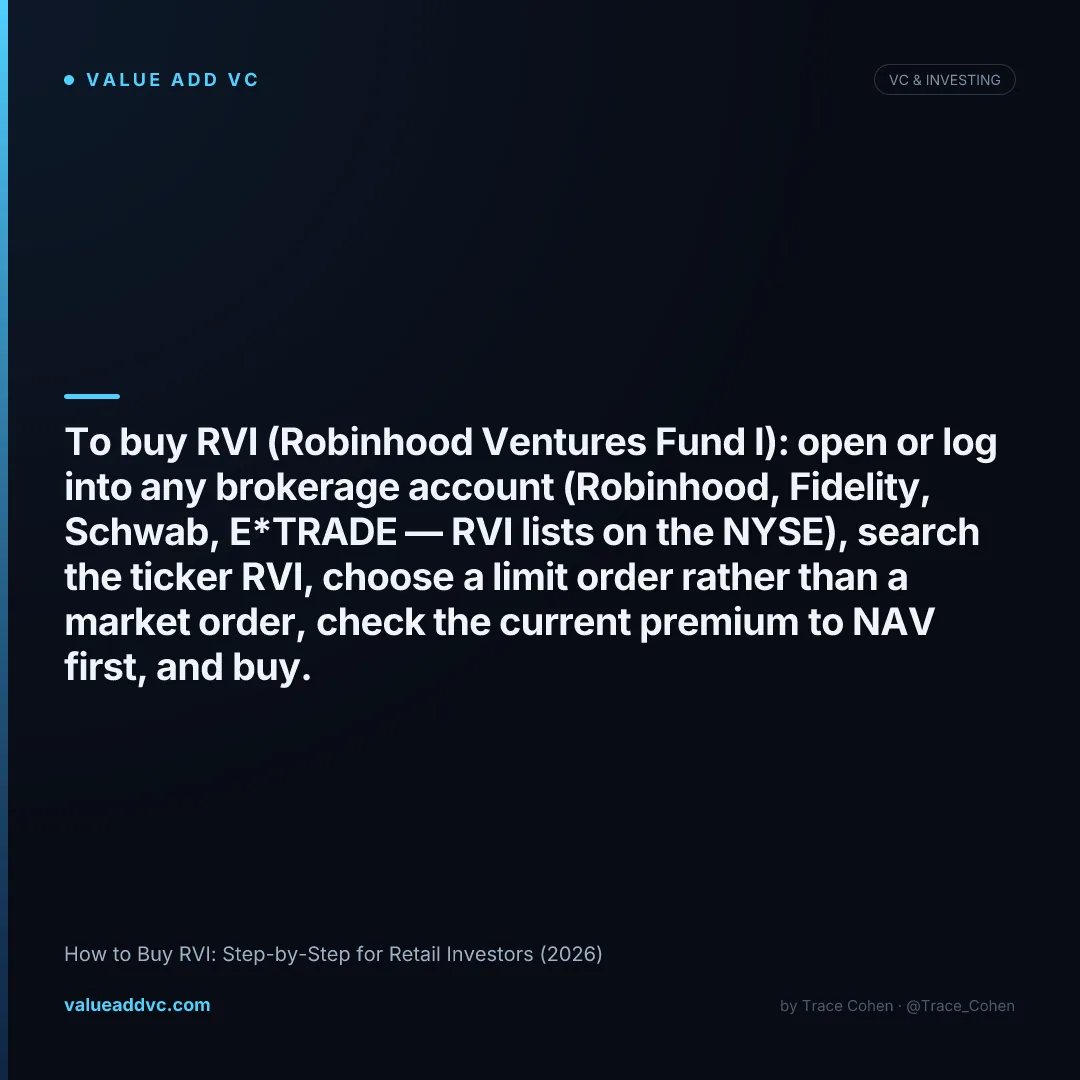
Buying RVI is the easy part: it trades on the NYSE under the ticker RVI, commission-free on Robinhood and available on every major brokerage, with no minimum and no accreditation. The hard part is not overpaying — because RVI is a closed-end fund whose share price floats far from the value of what it actually holds.
RVI is the Robinhood Ventures Fund I — a closed-end fund that gives ordinary retail investors a liquid, exchange-traded way to own stakes in private companies like OpenAI, Anthropic, and Stripe. For the full picture of what it owns and how it's structured, start with RVI's NAV, expense ratio, and holdings. This guide is purely about the mechanics of buying it well.
The 5-Step Process to Buy RVI
Where You Can Buy RVI
Because RVI is exchange-listed, it is not locked to the Robinhood app. Any brokerage that offers NYSE-listed stocks can trade it.
| Brokerage | Commission | Fractional shares | IRA eligible |
|---|---|---|---|
| Robinhood | $0 | Yes | Yes |
| Fidelity | $0 | Yes | Yes |
| Charles Schwab | $0 | Stocks only | Yes |
| E*TRADE | $0 | Limited | Yes |
| Vanguard | $0 | Limited | Yes |
Commission and fractional-share availability as of June 2026. Always confirm RVI is supported in your specific account type before funding a buy.
The Single Biggest Mistake: Chasing the Premium
RVI is a closed-end fund, which means it issues a fixed number of shares and has no ETF-style mechanism to keep its price near the value of its holdings. So the price you see is set by supply and demand for the shares — not the value of the OpenAI, Anthropic, and Stripe stakes inside. That gap is the premium, and it has been enormous: shares hit roughly 90% above NAV in late May 2026 before deflating.
The premium math, in one line
If you buy RVI at a 50% premium and the portfolio rises 20% over the next year, your gain only materializes if the premium holds — if it compresses to 0%, you can lose money even though the underlying companies gained value. Entry premium beats portfolio performance as a return driver. Full breakdown in why RVI trades above its holdings.
This is also why timing relative to events matters. RVI's biggest holdings are tied to public-market catalysts — the SpaceX IPO on June 12, 2026 and the broader AI valuation cycle. As those names go public, the scarcity that justified the premium fades.
RVI vs the Alternatives for Retail Buyers
If your goal is private-market exposure, RVI is the most frictionless option but not the only one. The main retail-accessible competitor is the ARK Venture Fund (ARKVX), an interval fund — and the tradeoffs are real.
| Vehicle | How you buy | Liquidity | Pricing risk |
|---|---|---|---|
| RVI | Any brokerage, any second market is open | Daily, real-time | Buy/sell at a premium or discount to NAV |
| ARK Venture (ARKVX) | Buy at NAV, ~$500 minimum | Quarterly redemptions only | No premium, but you can be gated on exit |
| Secondaries (Forge/Hiive) | Accredited investors only | Illiquid until exit | Spot price, wide spreads |
Full head-to-head in RVI vs ARK Venture Fund (ARKVX).
Buying RVI takes about thirty seconds. Buying it well takes one extra step.
Check the premium, use a limit order, and treat it as a small speculative position — that's the whole playbook.
Track RVI's live NAV and premium on the Robinhood RVI Fund dashboard, follow the SpaceX IPO Tracker, and see AI company valuations at Value Add VC. Originally published in the Trace Cohen newsletter.
Latest from the Pulse
Get VC data most people never see
— 100% free
Weekly benchmarks, valuations, and fund data. Join 5,000+ investors. No spam.